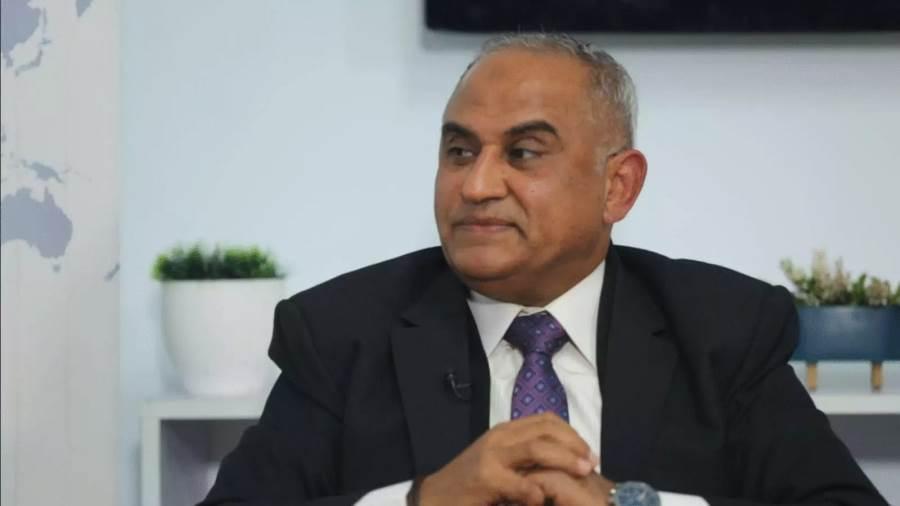
Africa-Press. Regional security expert Mohamed Abdel Wahid believes that the Grand Ethiopian Renaissance Dam crisis transcends technical disputes to become a geopolitical conflict backed by the U.S. and Israel, aimed at reshaping the balance of power in the region.
The crisis between Egypt and Ethiopia over the dam goes beyond technical disagreements regarding filling and operation years, revealing a deep geopolitical struggle that redraws the balance of power in East Africa and the Red Sea. It transforms the river from a source of life into a tool of pressure and influence in the hands of regional and international powers whose interests intertwine at the expense of downstream countries, as emphasized by regional security and international relations expert Mohamed Abdel Wahid.
Abdel Wahid explained that the Nile has been used as a pressure weapon since the Crusades when the Pope advised Ethiopian emperors to use water as a means to weaken Egypt. This continued through colonial attempts to alter the Nile’s course in the 15th century, culminating in the U.S. leveraging water issues during the Cold War after Egypt’s tilt towards the Soviet Union.
The security expert stated during the “Mawazin” program that the real water crisis predates the official announcement of the dam’s establishment in 2011, with roots tracing back to the Nile Basin Initiative in 1998, when Ethiopia first raised the issue of redistributing water shares and rejected the historical agreement signed in 1959.
He added that Ethiopia seized the opportunity to incite Nile Basin countries against Egypt before announcing the laying of the dam’s foundation in April 2011, a timing deliberately chosen to exploit the political turmoil in Egypt following the January 2011 revolution.
Abdel Wahid pointed out that the dangers of the dam extend beyond political dimensions to serious engineering concerns, as satellites have detected the leakage of over 44 billion cubic meters of water into the ground due to fissures in the volcanic soil on which the dam is built.
Satellite images, as the security expert illustrates, show that the actual reservoir does not exceed 48 billion cubic meters instead of the 74 billion that Ethiopia claims it can store. Ethiopia has yet to provide satisfactory answers to the technical inquiries raised by Egypt since 2018.
Concerns are exacerbated, according to Abdel Wahid, due to the presence of the “rockfill saddle dam,” which is 5 kilometers long and also at risk of water leakage, in addition to the recurring earthquakes in the area.
International Dimensions
Regarding international dimensions, Mohamed Abdel Wahid held both the United States and Israel directly responsible for supporting the Ethiopian dam project, noting that Israel provides intelligence, agricultural, and technical services to Ethiopia. He stated that Israel adopts a “vital space” strategy aimed at keeping neighboring Arab countries in a state of perpetual weakness.
He linked Israeli control over river sources in Syria, Lebanon, and Palestine with Ethiopian support for controlling the Nile’s sources, considering these two paths as two sides of a single strategy aimed at turning water resources into tools of regional dominance.
However, Abdel Wahid noted that Egypt has not remained idle; it has worked to build a network of defense and development relations with Nile Basin and East African countries, from Uganda and Rwanda to Burundi, Somalia, and Eritrea.
Internally, Egypt has developed a system of water alternatives, including lining canals, desalination, and wastewater treatment, emphasizing that Egypt is wisely addressing the weighty issues surrounding it from Libya to Sinai to Sudan.
Yet, the security expert confirmed that the option of military confrontation remains on the table if Ethiopia were to take direct hostile action, such as deliberately opening the dam’s gates. He warned that chaos in this “fragile region” would be a multifaceted disaster affecting international navigation, oil markets, and the global economy, which would not serve anyone’s interests.