
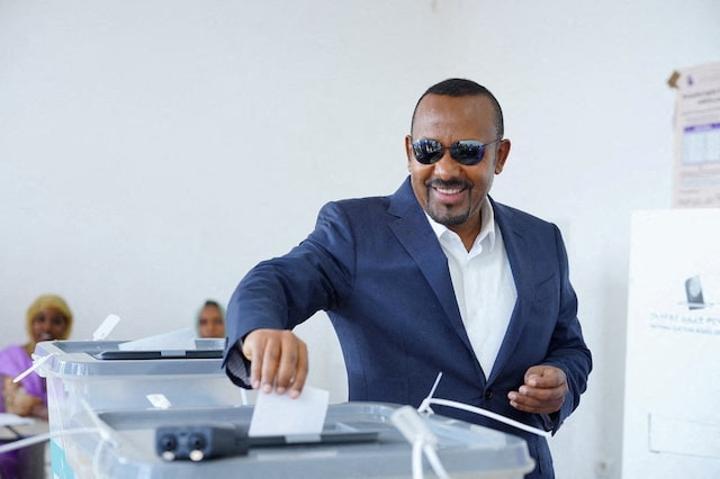
Africa-Press. The results published by the national election commission show that the Prosperity Party, led by Ethiopian Prime Minister Abiy Ahmed, has won another significant parliamentary majority in this month’s elections.
Abiy, who was widely expected to dominate the elections amid a divided opposition, was appointed in 2018 following mass protests against the long-ruling Ethiopian People’s Revolutionary Democratic Front coalition and established the Prosperity Party the following year.
Abiy’s party won 438 seats, nearly 90% of the announced results in a ceremony broadcast on Facebook. They needed 274 seats to achieve a majority.
The Prosperity Party will form the new government, and Abiy is set to take the oath of office for a new term in early October. Not all of the 547 seats in the House of Representatives were up for voting, as elections were not held in the Tigray region and parts of Amhara.
In the last elections held in 2021, the Prosperity Party won a similar percentage of the available seats. The Prosperity Party replaced a often incoherent multi-party coalition that had ruled Ethiopia for over a quarter of a century, helping Abiy Ahmed, 49, consolidate his grip on national politics, despite facing violent opposition in some of the country’s largest regions.
This time, candidates from the Prosperity Party promised to improve food security and achieve strong economic growth in Africa’s second-most populous country, which officials expect to exceed 10% by 2026, one of the fastest growth rates on the continent.
Over 50 million people registered to vote, but elections were not held in the northern Tigray region, where organizers cited “unfavorable conditions” following a two-year civil war and ongoing political unrest.
The government also faces insurgent movements in the country’s two largest regions, linked to grievances among various ethnic groups regarding alleged marginalization within the Ethiopian federal system.
In Oromia, Abiy Ahmed’s birthplace to the south, clashes between government forces and the separatist Oromo Liberation Army have resulted in hundreds of deaths over the past few years.
In the neighboring Amhara region, a militia known as “Fano” has controlled large areas of the countryside since 2023. As a result, elections were not held in at least eight electoral districts out of a total of 138 in Amhara.
Although a peace agreement in 2022 ended the civil war in Tigray, which researchers say caused the deaths of hundreds of thousands, a move taken by the main political party there last month to reassert control over the region’s political administration has led Ethiopian officials and analysts to warn of the risk of new unrest.
Opposition parties accuse the federal government of undermining them by arresting their leaders and imposing legal restrictions on their political activities, allegations that the government denies.