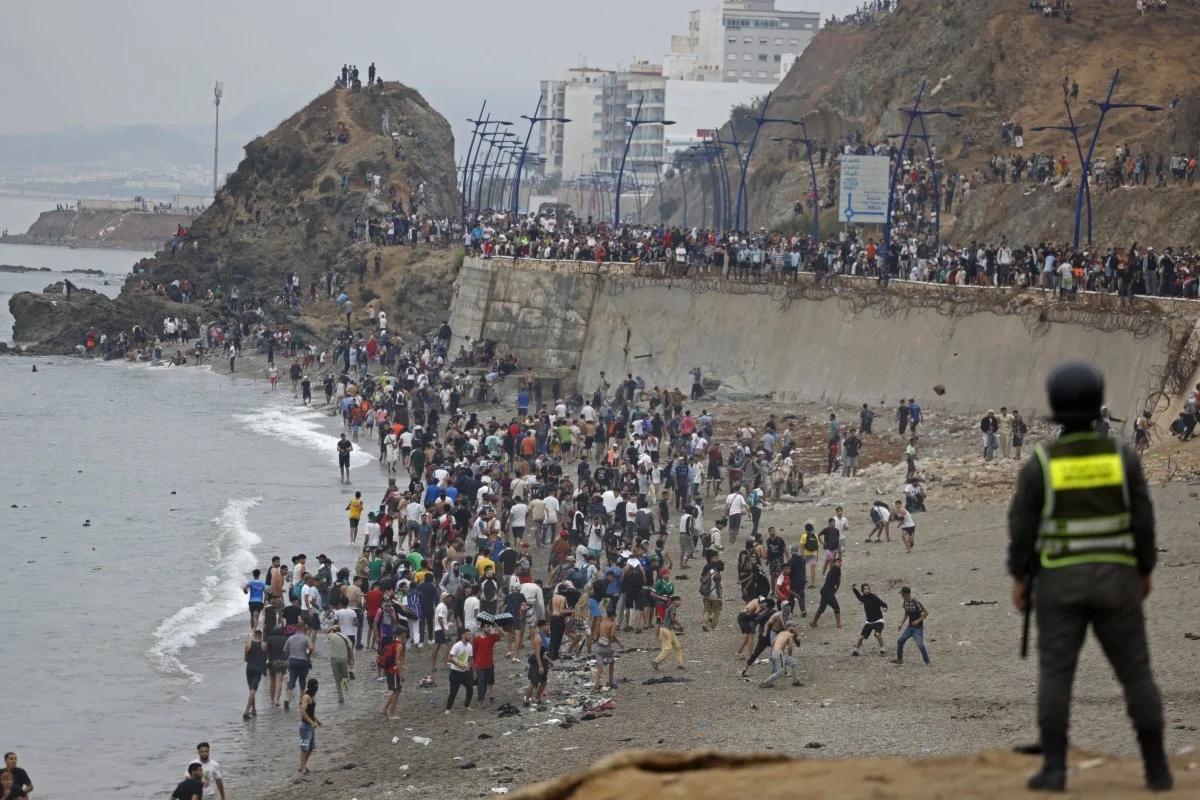
Africa-Press. The Spanish city of Ceuta has become a focal point of an unprecedented migration crisis after between 50,000 and 60,000 migrants crossed from Moroccan territory within two days, marking the largest wave at the only land border between Africa and the European Union. The crossings resulted in at least 57 fatalities, while Madrid and Rabat rushed to contain the crisis and return most of the migrants, as its repercussions extended to the European Union amid escalating disputes over migration policies and the future of the Schengen Area.
Unprecedented Wave of Crossings and Heavy Toll
The Spanish Ministry of the Interior announced that around 50,000 migrants entered Ceuta in less than 48 hours, while the city government estimated the number at about 60,000, in an unprecedented influx that occurred via sea and by climbing the border fence. The attempts resulted in the recovery of 57 bodies on the Spanish side, with indications of other victims on the Moroccan side, as some migrants drowned while others died due to stampedes during attempts to breach the border barriers.
Madrid and Rabat Act to Contain the Crisis
Spanish authorities confirmed that more than 48,000 migrants had returned to Morocco by Friday evening, either voluntarily or through repatriation operations, while Rabat intensified its security presence and used tear gas and water cannons to prevent further crossing attempts. In response, Spain deployed additional forces at the border, and the Prime Minister visited Ceuta, asserting that the events represented a violation of Spanish sovereignty, emphasizing the continuation of migrant repatriations in coordination with Morocco.
European Dispute and Escalation Over Schengen
The crisis has caused divisions within Europe, as Italy announced a temporary suspension of mobility arrangements with Spain and tightened controls on arrivals from there, while France also enhanced its border measures. Madrid rejected the Italian move, considering it a violation of European treaties, while the Prime Minister called for maintaining the unity of the European Union, asserting that data from the agency shows Spain is not the country receiving the most irregular migrants compared to other European nations.
Why Did the Crisis Erupt?
Spanish officials believe that the wave of crossings is linked to interpretations of a ruling by the Spanish Supreme Court regarding the handling of migrants arriving by sea to Ceuta and Melilla, which human trafficking networks exploited to promote the possibility of remaining in Spanish territory. Madrid confirmed that the ruling does not prevent the deportation of migrants, while praising the security cooperation with Morocco, which is a key partner for the European Union in managing migration and border control.
Ceuta… A New Test for European Migration Policies
The current crisis highlights the strategic sensitivity of Ceuta and Melilla as the only land borders between Africa and the European Union, while also intensifying the European debate over tightening migration policies and protecting external borders, amid the rise of right-wing parties and increasing pressure on European governments to reconsider mechanisms for managing irregular migration.