Africa-Press. The Egyptian Prime Minister, Mostafa Madbouly, announced that the government has secured alternative sources to meet the country’s energy needs following damage to two gas ships from a drone attack at the Damietta port. He confirmed that the measures taken by the government will ensure the continuity of energy supplies and that the local market and electricity generation stations will not be affected by the incident.
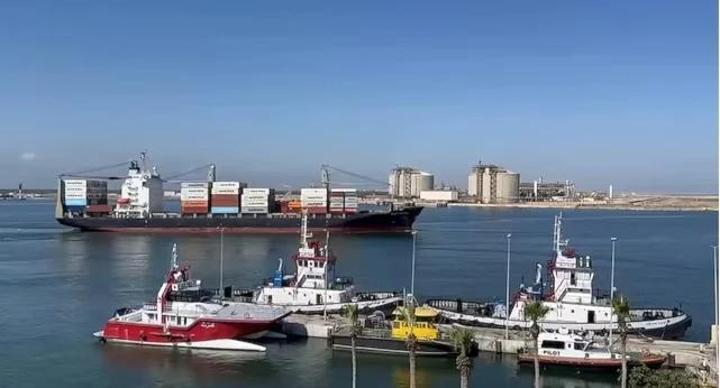
A drone of unknown origin targeted the American gas storage ship “Energos Winter” inside the port, resulting in a fire that spread to a nearby vessel. No group has claimed responsibility for the attack, while Egyptian authorities continue to investigate to determine the source of the drone and the party behind the operation.
For his part, the Egyptian Minister of Petroleum and Mineral Resources, Karim Badawy, stated that the country has four floating units for liquefied natural gas storage and regasification, in addition to a fifth stationary unit at the Jordanian port of Aqaba, which both countries share.
These units allow Egypt to receive imported liquefied natural gas shipments and inject them into the local network, helping to compensate for any emergency supply shortages and providing fuel for electricity and industrial plants.
Meanwhile, the Minister of Electricity and Renewable Energy, Mahmoud Asmat, announced that electricity demand in Egypt ranged between 37 and 39 gigawatts over the past fifteen days, reflecting high consumption levels coinciding with the summer season. He confirmed the availability of sufficient stocks of alternative fuel types, including more than 425,000 metric tons of fuel oil within electricity generation stations, in addition to other quantities in strategic reserves.
The targeting of the two ships at Damietta port raised concerns about the extension of security threats to Egyptian ports overlooking the Mediterranean Sea, and their proximity to the Suez Canal, which connects the Red and Mediterranean Seas.
The port is located near one of the most important routes for global trade and energy, at a time when the importance of the Suez Canal and the “Sumed” pipeline for oil transport has increased, due to a decline in shipping traffic through the Strait of Hormuz because of the war on Iran. The attack has also prompted insurance and maritime transport markets to reassess the risks facing ships and energy carriers heading to Egyptian ports or transiting through adjacent maritime corridors.
Securing multiple alternatives for gas and fuel is part of the government’s plan to deal with emergencies and ensure the stability of the electricity grid following the attack on the two ships at Damietta port.