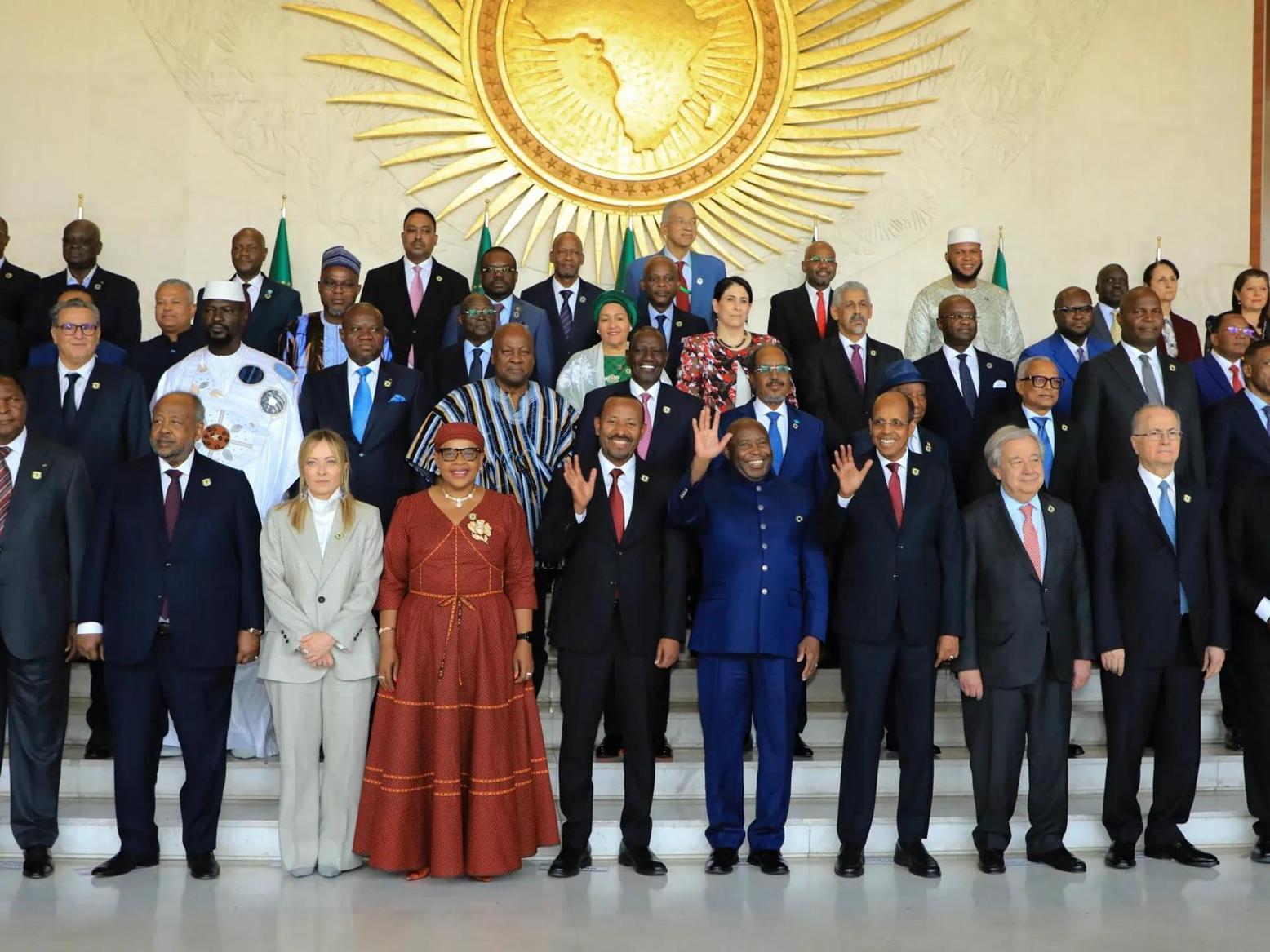
Africa-Press. The 39th African Union summit at the level of heads of state and government, held on February 14–15, comes under this year’s theme: “Ensuring the provision and sustainability of safe water and sanitation services!”, amid unprecedented challenges facing the African continent—especially its continental umbrella institution, the African Union. These challenges range from the spread of crises and conflicts to the funding of peace missions, alongside routine operational constraints, as the international financing dilemma deepens and peaks in a crisis of reform and leadership. As these challenges escalate, the distance from achieving “the Africa we want” has become clearer than ever to observers.
The African leadership crisis and the new leadership
Since his election as Chairperson of the African Union Commission in February last year, Djiboutian Mahmoud Ali Youssouf has faced daunting challenges leading the Commission—the organization’s top post and the executive body responsible for day-to-day management, as well as for designing and implementing policies with the support of specialized organs. He inherited the Commission and the organization at a moment of decline and an intensifying funding crisis. He did not inherit only the financial deficit, structural inflation, and inefficiency from the previous Commission’s era; he also inherited what paralyzes the organization: corruption, dependency, and susceptibility to external penetration instead of resisting it—especially as charismatic leadership and innovative, transformative visionaries have waned within the institution, and as it has become increasingly subject to the interests of external actors.
In this context, Abdoul Mohammed (Senior Fellow at Amani Africa in Addis Ababa and former Senior Advisor to the AU High-Level Implementation Panel for Sudan and South Sudan—AUHIP) argues that the core of the problem lies in the current leadership crisis within the African Union, which he describes as an “erosion of authority.” This problem worsens markedly with the decline of “African agency” amid a growing crisis of multilateralism in the international system, leaving “Africa’s most prominent multilateral institution” weak and unable to exert influence—making the continent a victim of this situation rather than an active player in it.
The legitimacy accumulated by the organization—from the founding of the Organization of African Unity to the African Union—now appears to be declining in an alarming way. The principles of African unity, sovereignty, solidarity, and collective action are increasingly being violated by member states themselves even before external actors.
Reform failure and widespread disappointment
The failure of the reform project led by a team chaired by Rwandan President Paul Kagame in 2017 has frustrated partners as well as African peoples and elites alike. This failure represented a genuine missed opportunity, and today’s disappointing performance reflects that broader disillusionment.
As a result, the gap has widened in recent years between the African Union and the aspirations of African societies—and even between the AU and some member states. The AU has increasingly become either subject to the dictates of certain member states rather than African values and principles, or a burden on other member states because of its weak and hesitant positions.
Moreover, despite the “division of labor” between the African Union, the Regional Economic Communities (RECs), and sub-regional mechanisms (REMs), effectiveness—and the ability to take initiative and lead—continues to decline. This perpetuates overlap, competition, and a lack of will across the continent’s ongoing conflict files, as seen in Sudan and the Democratic Republic of the Congo, among other examples.
In this context, two prominent experts on African Union affairs and on peace, security, mediation, and conflict resolution—Saïd Djinnit and El Qassem Wane—recently discussed (in a report by the Amani Africa foundation, February 2024) the African Union’s handling of Sudan’s crisis, seen as one of Africa’s most significant and most dangerous crises. They argue that the AU’s performance during the war in Sudan since April 2023 has been disappointing and has followed the familiar path of failure and incapacity, despite the fact that the organization’s engagement in the Darfur file after 2003 served as a real test of its ability to translate the continent’s peace-and-security slogans and principles into practice, and achieved important successes from the perspective of African leadership.
Building on this, a research report issued by the Pan-African Agenda Institute (PAAI) on February 10 raises a pivotal question: is the African Union fit for its intended purpose? In its findings and conclusions, the report reflects the disappointment of elites—especially groups who have known the AU closely: either because they worked within its institutions, or alongside advisory and research circles that examined the AU’s performance and programs as well as those of comparable regional institutions worldwide, or because they still believe in the unifying African values on which the AU was founded.
According to these groups, the spirit and principles of Pan-Africanism—as embodied by the founding fathers of the Organization of African Unity and by Pan-African unity currents that championed the continent’s independence, renaissance, sovereignty, and prosperity—are now eroding in an alarming way, increasingly replaced by their negation from within the continent itself.
Overall, it is clear that the African Union, under the current leadership, is either unable—or unwilling—to define the nature of the sensitive conflicts unfolding across the continent, in a way that effectively relieves it of responsibility. Conflicts and crises such as those in Sudan and Somalia have shown clearly that some member states not only act directly against other member states, sometimes in cooperation with external actors, but also work to weaken the African Union itself and undermine its institutions.
“Orphans of Pan-Africanism”
A sense of disappointment, anger, and frustration toward the African organization and its leadership has grown since the two terms of Moussa Faki Mahamat as Chairperson of the AU Commission, which ran from March 2017 to February 2025. Those two terms saw a major retreat from much of the legacy the organization had built since near its founding—something that has become a broad point of agreement among African elite circles concerned with the continent’s major issues.
The latest of the groups that sought to improve the performance of the AU’s organs and institutions was the “Mbeki Group,” which included former presidents and officials as well as international and African experts. The group coalesced around Thabo Mbeki, the former South African president and one of the last standard-bearers of Pan-Africanism and its aspirations—figures who increasingly feel alienated and “orphaned.” The group has now become more pessimistic about the African Union’s present reality and future.
Compared with the African Union’s current decline, the African Union High-Level Implementation Panel for Sudan and South Sudan (AUHIP), established in July 2008, is regarded as one of the most successful and pride-worthy African experiences within AU institutions in dealing with crises, conflicts, and their resolution on the continent. It embodied the meaning of “African agency,” combining African leadership and commitment to African principles on the one hand, with initiative-taking, international partners’ respect, and support from international institutions on the other.
In this context, Thabo Mbeki, through chairing AUHIP, sought to transform African policy and play active roles within its bodies. He took on files of major importance to the continent—from conflicts such as the 2003 Darfur crisis and the Sudan–South Sudan conflict before and after the 2011 secession, to illicit financial flows in Africa, and even the Red Sea arena, where he also chaired the AU High-Level Committee on the regional arrangements for the Red Sea. That committee led governance efforts on the Red Sea until March 2022, aiming to make the AU a central actor. Although the Red Sea initiative was ultimately stifled, current developments around the issue have shown how capable the committee’s team was of raising vital questions with forward-looking insight from an innovative African perspective.
However, unfortunately, the AUHIP team encountered obstacles from within and outside the organization, which led to its gradual marginalization, followed by the suspension and dissolution of the high-level panel within the AU’s corridors. It was replaced by weaker mechanisms and figures—either more pliable and willing to compromise on continental principles and values, or more subject to states’ will than to the organization’s higher objectives and founding principles. This approach is clearly reflected in the composition of several high-level panels on various issues.
Similarly, the same sense of disappointment and fading hope about the AU’s performance is shared by both El Qassem Wane, a former senior African official who served within the AU Commission, and Saïd Djinnit, who served as the first Commissioner for Peace and Security from 2003 to 2008 and is considered the spiritual father of the Peace and Security Council and Africa’s peace and security architecture. He is currently a member of the African Panel of the Wise and is also regarded as one of the continent’s leading figures in high-level African mediation initiatives.
Militarization and coups: a continental challenge for the AU
In recent years, the phenomenon of rising militarization has dominated, marked by an increasing pace of coups and military takeovers across the continent—especially in the Greater Sahel and West Africa.
In response, the African Union’s approach to coups has not only been traditional; it has also been disproportionate to the nature of the phenomenon. Defining militarization solely as “the military institution’s seizure of power,” in the classic sense of military rule, is an incomplete definition. What is unfolding is, in reality, a reflection of failing and ossified political systems, accumulated anger and frustration, and the failure of ruling regimes to adhere to the principles of democratic, accountable governance—internally accountable even to the AU. It also reflects the AU’s stark failure to apply its relevant instruments and to confront the trend of leaders changing constitutions to remain in power beyond constitutionally defined terms, for example.
The lack of renewal of political legitimacy, the absence of democracy, and the failure to establish national governance systems capable of delivering economic prosperity have created an environment in which the military institution may resort to taking and controlling power—especially since it is often not held accountable by legitimate, successful, stable civilian governments.
Against this backdrop, a clear contradiction has emerged between popular will—since all coups that occurred on the continent received, to varying degrees, visible popular support—and the African Union’s positions and policies.
In this context, the rise of the “Alliance of Sahel States” has appeared as another manifestation of the decline in the African Union’s performance at the continental level. Failure to grasp the dimensions of the new militarization has not only expanded unrest and political instability in several countries with conditions similar to Sahel states—widening the “coup belt”—but has also negatively affected the cohesion of the regional order and its sub-regional mechanisms.
As a result, the establishment of the “AES” union—also known as the Confederation of Sahel States—as a separate regional entity following its members’ withdrawal from ECOWAS (one of the continent’s most successful regional economic communities and an effective model for division of labor between regional groupings and mechanisms in peace and security, political crisis management, and effective intervention) underscored this shift.
To acknowledge the shortcomings of existing mechanisms in dealing with the pressures of the new wave of coups—especially as the number of states facing sanctions through membership suspension grows—creating informal consultation channels to organize communication between the AU’s organs and coup-led states has become unavoidable, given the policy gaps on this issue.
AU failures in peace and security draw sovereignty critiques
The African Union’s performance is seen as failing in multiple ways, according to broad segments that can be described as part of a “new African sovereignty current.” This current—made up of experts, thinkers, politicians, and activists—calls for halting the continent’s decline and growing vulnerability, and demands a radical overhaul of Africa’s institutions to achieve higher goals of unity and solidarity grounded in Pan-African values, foremost among them the African Union, whose creation was meant to embody those aspirations.
Recently, as noted in a research report by the Pan-African Agenda Institute (PAAI) issued on February 10, the African Union has failed in the most essential area of its mandate on the continent: preventing, managing, and resolving conflicts.
Most dangerously, these deadly conflicts include elements of genocide and ethnic cleansing, yet the African Union is unable to take timely and appropriate action before catastrophe strikes. In conflicts such as those in Sudan, the Democratic Republic of the Congo, and South Sudan, the AU has continued to overlook serious warning signs despite the high human and humanitarian costs of these conflicts’ continuation and escalation. These conflicts also involve new dimensions related to sovereignty and the territorial integrity of states, as well as growing external interventions that play a decisive role in fueling and sustaining them—yet these dimensions are often ignored.
Drawing on his experience in African politics, regional work, shifts in the international order, and the crises of multilateralism—as well as the nature of intra-African challenges and today’s African leadership—Dr. Abdoul Mohammed argues that the African Union is now facing its “greatest test” in redefining its role amid international-system dynamics, structural and institutional challenges, and the internal crises and conflicts confronting the organization.
AU failures: Sudan, Somalia, and the DR Congo
Conflicts have accumulated and intensified across the continent, and the cases of Sudan, Somalia, and the Democratic Republic of the Congo (DRC) now stand out as prominent examples.
The African Union deployed its first AU-led peace mission in Somalia in 2007. Since then, three successive missions have operated there (AMISOM, ATMIS, and AUSSOM), making Somalia a serious test of the AU’s ability to rise to comparable challenges. Somalia—emerging from civil war after the fall of Siad Barre’s regime and the state’s collapse in 1991, followed by the rise of the Islamic Courts and their ouster in 2006 after external intervention, and then international focus on state rebuilding—was an ideal case for how Africa could take ownership of major issues like those Somalia has faced and continues to face.
Israel’s recent recognition of Somaliland has likewise highlighted another dimension of the AU’s failure to meet the required level in resolving complex crises and conflicts, especially politically charged issues tied to state-building on the continent.
In this context, the AU sought—through its intervention in Somalia—to establish an African model for managing peace operations in situations of national-state crisis. Yet it ended in a major failure, largely because the AU could not achieve the financial independence needed to lead such files without relying entirely on international partners—and therefore becoming subject to their agendas.
Similarly, in the DRC—long mired in conflict in its east since independence—the AU’s shortcomings are evident. The Union has been unable to make a real, serious breakthrough toward ending a conflict that has threatened Great Lakes stability for decades, amid complex communal dynamics and a toxic colonial legacy that continues to run through the region’s societies, fueling violence and instability and producing severe humanitarian crises.
The AU has shown strong capacity to form committees, mechanisms, and frameworks around the eastern DRC crisis, but without grasping and addressing its driving causes as they appear today: the Rwanda–DRC dispute and the crises surrounding Banyamulenge communities (or Kinyarwanda-speaking Tutsis), often seen as among the core roots of this entrenched crisis.
Continental institutions and leaders of organizations such as the AU avoid offering their own vision of the conflict, either out of fear of threatening foreign powers’ interests if the conflict were resolved, or fear of angering certain regional states—alongside a failure to persuade the Congolese leadership and challenge its narratives about the conflict’s nature.
As a result, the AU has found itself mired in failure on this file—either due to external dependence and subservience, or due to submission to the interests of certain regional states that work to obstruct AU mechanisms, even by turning outward and seeking external backing.
Sudan, meanwhile, represents the worst and most dangerous form of failure for the organization. As El Qassem Wane and Saïd Djinnit described it, “Sudan’s crisis is Africa’s crisis,” and resolving it according to African principles should be a “moral and strategic commitment.”
Since Omar al-Bashir was ousted on April 11, 2019, the country has slid toward chaos and political turmoil, while the AU at times watched, and at other times stepped aside, leaving space for actors from outside the continent. This contributed to the collapse of the transition process and the country’s descent into a devastating war that nearly destroyed the state and its people—linked to the AU’s failure to activate early-warning mechanisms and preventive diplomacy in response to developments in the country.
Because it failed to properly analyze and read the trajectory of events in Sudan, the AU not only watched the flow of mercenaries and lethal weapons, mass displacement, starvation, and sieges imposed on large segments of the population; it also failed to acknowledge the conflict’s nature as an external aggression using local forces—an approach that could dismantle the state and bring about its collapse if left to run its course.
On this point, Wane and Djinnit argue: “The choices taken now (regarding the conflict in Sudan) will not only determine the fate of the Sudanese people, but also the credibility and capacity of the African Union itself.” They add that “the continent must rise to this moment—fully, clearly, and firmly.”
Joining the G20: a conditional glimmer of hope
Amid the current decline of the African Union, talk of fair African representation in the UN Security Council reform process or other multilateral international platforms remains meaningless unless the African Union itself is first reformed, so it can return to the standards of the “golden era” it had at least a few years ago, when there was a minimum level of institutional effectiveness grounded in African principles.
The announcement that the African Union would join the Group of Twenty (G20) as a full member as of September 9, 2023 was widely welcomed and generated a sense of euphoria across the continent—especially among elites and intellectual circles who aspire to see Africa and its institutions assume their rightful place among nations.
Although the AU’s entry into the group was an important political gain, in practice it remained more of a “guest” than a “full member.” Still, joining the G20 is a test of the AU’s ability to translate, in real practice, the concept of “African agency”—namely, the capacity of Africa’s institutions to formulate their own independent agenda, free of dependency or external influence, and to assert their will in the face of global powers or external interests.
But unfortunately, while the African Union is still searching for pathways and models for exercising its role within the G20, a dispute erupted between the Trump administration and South Africa—which had been the only African member in the group. As usual, the AU limited itself to issuing a statement expressing solidarity with this sole African G20 member in the face of President Trump’s aggressive policies, prompting Pretoria to freeze its participation after the United States recently assumed the group’s presidency.
Despite the ambition of the slogan “Africa speaking with one voice,” the continent’s institutions are going through one of their most fragmented and divided periods in terms of positions and stances, including on Africa’s own issues in which external actors are involved. As a result, strengthening Africa’s presence in the international system still appears to be a distant dream.
Conclusion
Current debate trends suggest that the African Union reform project led by a team chaired by Rwandan President Paul Kagame, whose report was issued in 2017, ended in a resounding failure—and that the organization’s present shortcomings stem from that project.
As a consequence, the AU’s annual summit risks becoming little more than faded ceremonial formalities. What matters is not repetitive routine statements or the annual repetition of familiar slogans, but restoring the AU’s role, effectiveness, and standing—starting with the independence of will and decision-making from external influence, and maintaining the principle of being a partner rather than a subordinate to others.
In closing, Africa enters 2026 burdened by crises. As Abdoul Mohammed and Selmon Derso argue, the continent has effectively entered a new phase of instability, insecurity, and geopolitical competition, amid weakening collective action, fragile continental institutions, and a leadership dilemma. Accordingly, the trajectories and indicators of the conflict in Sudan—given what they reveal about shifts in the nature of conflicts across Africa over past decades, especially external interventions—will largely shape the future of the African Union.