
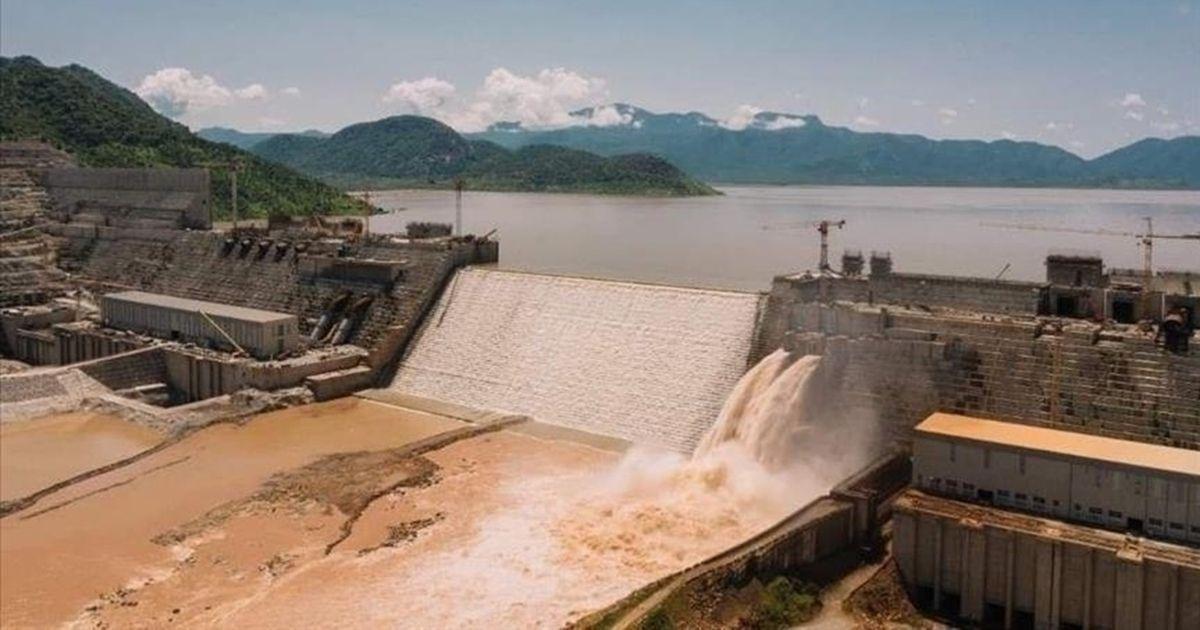
Africa-Press. It seems that the issue of the conflict over the waters of the Nile River between the downstream countries, Egypt and Sudan, on one side, and the seasonal upstream country (Ethiopia) on the other, has begun to take a more serious turn for the people of the Nile Valley, where more than 170 million people live. This is due to the ongoing actions of Addis Ababa, the latest of which was the elevation of defense cooperation with the American administration.
On August 19 and 20, 2026, a high-level Ethiopian delegation visited the American capital, where it was announced at the headquarters of the American Department of Defense that Washington and Addis Ababa had agreed to elevate their relations in the fields of defense and security to a new level, developing defense relations into a more advanced strategic partnership that keeps pace with the future.
The agreement is based on expanding cooperation between the defense institutions of the two countries, enhancing strategic coordination, protecting national interests, achieving mutual benefits, and establishing long-term cooperation through building mutual trust and intensifying efforts to support peace, security, and sustainable stability in the Horn of Africa.
Atmosphere of the Agreement
This agreement was preceded and followed by a significant change in the Ethiopian rhetoric towards Egypt, announcing the imposition of a new reality regarding the water issue and the Ethiopian dam. This reveals, according to observers and speakers to “Arab21,” a “greater sense of confidence and ability to act on the water issue” and an “Ethiopian awareness of Addis Ababa’s presence in a new international position with American military support, which Egypt must pay attention to regarding its dangers and consequences and study how to deal with it.”
On August 16, the Ethiopian Minister of Water and Energy, Habtamu Itefa, made shocking statements to the Egyptians regarding the Nile water issue, asserting Ethiopia’s unilateral control over the water flow to the downstream countries from the “Grand Ethiopian Renaissance Dam,” announcing the construction of three new dams on the Blue Nile.
Last Saturday, it was announced that the agreement of the “Permanent Commission for the Nile Basin” had come into effect, indicating that six countries from the Nile Basin had ratified the establishment of the commission, despite Egypt and Sudan’s opposition.
While Ethiopia is moving unilaterally on the Nile water issue and seeks to pressure Cairo by discussing the activation of the Nile Basin Commission, it is also claiming that as a landlocked country, it seeks to gain a foothold on the Red Sea in agreement with the separatist Somali Land region. Additionally, it is supporting the “Rapid Support Forces” against the Sudanese army, which raises concerns for Egypt regarding its national security.
Egypt emphasizes Ethiopia’s and the Nile Basin countries’ right to development as long as it does not harm its interests and according to a prior agreement. In contrast, Cairo is constructing dam projects on the Nile Basin, including the recent inauguration of a dam with a capacity of 2.1 gigawatts on the Rufiji River in Tanzania, coinciding with the signing of agreements by seven Egyptian investors to establish manufacturing facilities there.
Has Trump’s Position Changed?
Observers fear that the American-Ethiopian agreement may lead to a change in the American administration’s position on the Nile water issue and the Ethiopian dam, especially since American President Donald Trump had strongly supported Egypt’s position during his first term and sought a final agreement between the downstream countries and Ethiopia, which refused to sign in February 2020.
During Trump’s second term, in mid-January, he reaffirmed his rejection of any country’s unilateral control over Nile resources at the expense of its neighbors or harming their water security, indicating that he understands the importance of the Nile to Egypt and its people, announcing his readiness to resume mediation to reach a final and fair solution for the sharing of Nile waters and the Grand Ethiopian Renaissance Dam.
An American Policeman in the Horn of Africa
The Egyptian politician and diplomat, Masoum Marzouk, in his reading of the implications of the timing of the elevation of American-Ethiopian defense and military cooperation, stated that it “does not represent, in my view, a modification of America’s strategy in the Horn of Africa; it has invested for more than a quarter of a century in building partnerships and cooperation in counter-terrorism, but there have been criticisms of human rights violations, especially in the Tigray region (northern Ethiopia).”
In his conversation with “Arab21,” the former Egyptian ambassador in one of the Nile Basin countries, Uganda, confirmed that “what America wants from Ethiopia is to be a ‘policeman’ in the Horn of Africa and the Great Lakes region (East and Central Africa), ensuring a foothold for the expansion of American Central Command operations.”
Regarding the contradiction of that role with Egyptian files, the former Assistant Foreign Minister explained that “the development of American-Ethiopian relations from the Egyptian file is highly intertwined. It is known that the current American administration has made some goodwill efforts to bring the views closer regarding the Nile issue, but it seems that this effort stops at this point, as the American strategy in Africa assigns Ethiopia a distinguished role.”
In response to the question: “Did Ethiopia resort to Washington to pressure Cairo to pass the Ethiopian port file in the Somali Land region?” Marzouk said: “I do not think that Ethiopia resorts to Washington’s mediation or pressure on Egypt to facilitate its access to a maritime outlet in what is called ‘Somali Land.'”
He pointed out that “Ethiopia strongly believes that this is its right as a landlocked country, and that its management of its international relations, such as recognizing ‘Somali Land’ – a region that is seceded from Somalia and is not internationally recognized except by Israel – is a matter of sovereignty that it independently manages without contestation from anyone.”
In his reading of the consequences of Ethiopia obtaining American support and what it grants it in terms of power to impose a new reality on Egypt and Sudan regarding the water issue, he believes that “Ethiopia has indeed imposed a new reality regarding the Grand Ethiopian Renaissance Dam, and it is now moving to the stage of political investment to establish its position as an upstream state, without regard to the rules of international law concerning transboundary watercourses, or even its bilateral agreements with Egypt.”
Pressures Since the 1960s
At the beginning of his talk with “Arab21,” regarding the military and defense developments between America and Ethiopia, former Egyptian Minister of Water Resources and Irrigation, Mohamed Nasr El-Din Allam, first stated that what is being raised about “Ethiopia activating the ‘Nile Basin Commission’ is merely media noise and talk to exert pressure on Egypt, and it is not a reality to date.”
He pointed out that the beginning of the crisis was also to exert political pressure on Cairo in the 1960s, explaining that “the plan for dams on the Blue Nile was prepared by the American Bureau of Reclamation and published around 1964, in response to Egypt’s initiation of the High Dam project and securing the country’s water supply by storing the Nile River’s flow that was wasted into the Mediterranean Sea and dividing it between Egypt and Sudan (the downstream countries), according to the 1959 agreement.”
He noted that this project was not completed at that time, explaining that “official relations between Egypt and Ethiopia improved afterwards, and this plan was not initiated until the January 25, 2011 Egyptian revolution, with the establishment of their dam on the Blue Nile with a huge capacity (about 74 billion cubic meters of water), instead of the 14.5 billion cubic meters that had been previously planned.”
Allam, who served as Minister of Irrigation from 2009 to 2011, pointed out the Egyptian moves regarding Ethiopia’s proposal to build dams on the Blue Nile during the ‘Nile Basin Initiative’ signed by the ten basin countries in 1999.
He noted that “Cairo evaluated the impacts of these dams on the water share and on the country’s water security, and indicated that the impact of these dams would be catastrophic. It prepared a memorandum summarizing the negative impacts of these dams and sent an official rejection to Ethiopia, as well as copies to most international funding agencies to prevent funding for these projects, which was done at the end of 2010.”
He explained that the pressures on Cairo regarding this existential file are still ongoing and increasing, indicating that “there have recently been numerous Ethiopian movements and official statements leaning towards violence and threats, in addition to explicit Ethiopian intervention in Sudan’s events against its army, which affects Sudan’s unity and stability and Egyptian national security,” hinting at Addis Ababa’s support for the “Rapid Support Forces” against Khartoum.
America’s Submission to Occupation Pressures
Allam indicated that there is another aspect of the current pressures on Egypt, confirming that “there is clear Israeli intervention and military support, along with (Israeli/Ethiopian) interventions in the Horn of Africa, threatening its countries and the security of navigation in the Bab el-Mandeb Strait and the Red Sea,” pointing to the potential impact on international trade movement from the Suez Canal and the effect on Egypt’s annual revenues from it.
The former professor and head of the Department of Irrigation and Hydraulics at Cairo University stated that “the unfortunate new aspect is America’s submission to Israeli pressures and its attempt to support its dubious movements in the Horn of Africa.”
He believes that “the main goal of all these pressures, in my personal opinion, is Egypt, which stands as a barrier to the implementation of Israeli expansion plans and the establishment of Greater Israel, and Egypt’s refusal to displace Palestinians to Sinai, as well as obstructing any plans to displace them to Libya or other African countries, in addition to Egypt’s declared position on the battles that Israel wants to ignite between Iran and the Gulf region.”
He believes that “after the success of the Zionist plan to control the Arab Mashreq, the plan began to develop and transition to its application in the Gulf and involve Egypt in the conflict, attempting to tighten the noose around the remaining regular Arab army in the face of Zionist expansion. Therefore, they are trying to fabricate wars and conflicts in Sudan, Libya, the Red Sea, and the Horn of Africa by all means and methods.”
He pointed out that “there are, of course, other international powers with their strategic goals in the region, such as Russia and China, in addition to regional powers like Turkey and Iran, and thus the scale of escalation is surrounded by many risks, and there is a great need for patience and insight in this large arena.”
What Are Egypt’s Options?
Minister Allam clarified that “the water file is an existential file, not subject to flexibility in positions or concessions; rather, the opposite is entirely true,” stressing that “Egypt must officially request the Nile Basin countries to increase its water share by attracting a small portion of the losses from lakes and swamps to increase its share by at least (5-10 billion cubic meters) annually.”
He indicated that “the current share of the Egyptian citizen from water is less than 500 cubic meters per year, while the minimum water poverty line as defined by the World Bank is no less than 1000 cubic meters per year.”
Therefore, he sees the necessity for “Egypt to expand its seawater desalination projects in its coastal cities, to import large quantities of food to feed its citizens, and to rely on recycling water multiple times to cultivate its limited lands. There is also an urgent need to increase the water share and expand the agricultural area by at least (1-2 million feddans).”
He concluded his remarks by confirming that he personally believes that “the escalation with Ethiopia is intended to prevent Egyptian-Ethiopian rapprochement and cooperation, which I see as inevitable for the benefit of both countries and their ancient peoples and the region as a whole. I believe that the escalation between them serves only our enemies,” asking: “Is there any response?”
In his comment, researcher in military and strategic affairs Mahmoud Jamal stated that “Ethiopia, which succeeded in imposing the Grand Ethiopian Renaissance Dam as a fait accompli, seems to be working on building a broader political and security umbrella before moving to a new phase in managing the water file, including expanding the construction of other dams on the Nile and its tributaries.”
He confirmed via “X” that the agreement “grants Addis Ababa greater confidence and political and strategic cover in facing any potential regional pressures from Egypt and Sudan,” while he believes that “Cairo should not view this development as a separate military agreement, but rather as a development in the strategic environment surrounding the Nile file.”