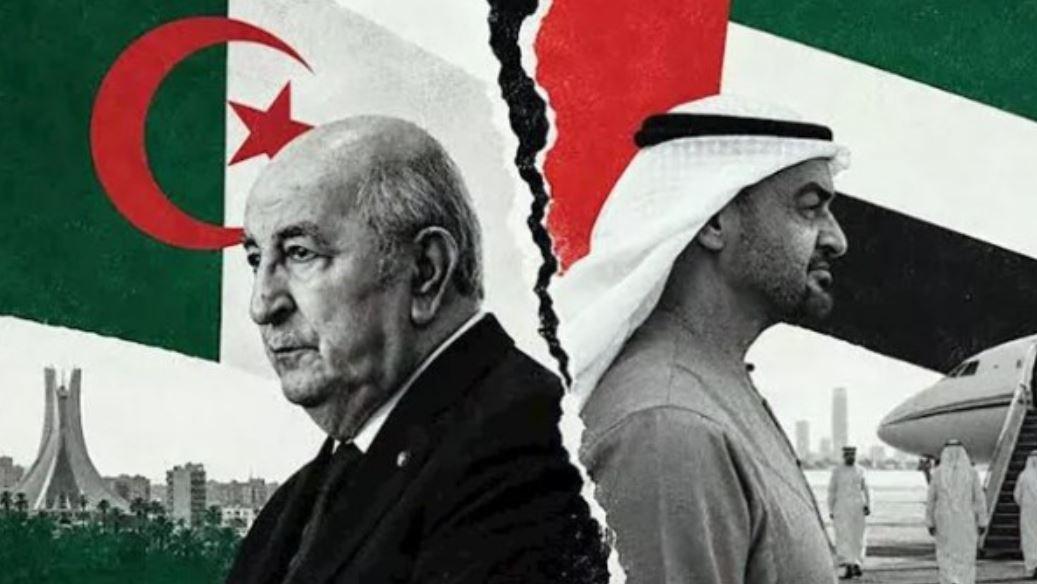
Africa-Press. Algeria announced on Thursday, September 10, the severance of relations with the UAE, marking a significant development in the relationship between the two countries after years of escalating tensions and disputes over regional, security, and political issues. The Algerian foreign ministry has given the UAE ambassador 48 hours to leave the country.
The Algerian foreign ministry announced the decision after stating that it had exhausted “all means to preserve bilateral relations,” accusing Abu Dhabi of continuing “provocative or hostile actions” despite repeated warnings. The ministry did not specify a single incident as the direct cause of the decision, indicating that the move resulted from a long accumulation of disputes rather than a singular crisis.
The paths of disagreement reveal four main issues that led Algeria to consider the continuation of relations with Abu Dhabi as more costly to its security and political interests than severing ties.
Western Sahara and the UAE-Morocco Alliance
Western Sahara and Morocco have been longstanding points of friction between Algeria and the UAE. Algeria supports the Polisario Front and insists on the principle of self-determination for the people of Western Sahara, while Abu Dhabi has strengthened its ties with Rabat in recent years and supported Morocco’s position regarding the region.
In October 2020, the UAE opened a consulate in Laayoune, Western Sahara, a move that Algeria viewed as support for Morocco’s stance in a dispute that Algeria considers a strategic issue linked to its national security.
This occurred after the UAE established official relations with Israel under the Abraham Accords, while Algeria rejects normalization with Israel and considers the Palestinian issue a fixed part of its foreign policy.
Algeria views the trilateral rapprochement between Morocco, the UAE, and Israel as a shift in the balance of power within the Maghreb, especially with the ongoing rupture in Algerian-Moroccan relations since 2021.
The Sahel, Mali, and Conflicting Security Calculations
The disagreement extended to the Sahel region, which Algeria considers a direct extension of its national security, particularly concerning Mali, Niger, and Libya. Algeria shares a long border with Mali, and the region has witnessed a series of military coups and a decline in traditional Algerian influence in recent years.
Algeria’s vision, which is based on preventing military interventions and maintaining its role as a primary regional power in the Sahel, clashes with the rising roles of various external actors in the region.
A report by an international crisis group indicated that tensions with the UAE were already high, citing Algerian accusations against Abu Dhabi of inciting unrest in Libya, Mali, and Sudan, alongside growing Algerian concerns over the expansion of UAE economic and political influence in its regional surroundings.
Algeria has also attempted to maintain its influence in the Sahel through political and economic initiatives, including establishing free trade zones with regional countries, at a time when its ability to influence has diminished following military coups in Mali and Niger and changes in regional power dynamics.
Accusations of Interference in Internal Affairs
Relations entered a more sensitive phase when Algeria began accusing the UAE of interfering in its internal affairs and seeking to destabilize the country. These accusations were no longer mere media leaks but were voiced by President Abdelmadjid Tebboune on multiple occasions, without always naming the UAE directly.
Tebboune stated that Algeria’s relations with Gulf countries were “brotherly” except for one country, widely understood to refer to the UAE, accusing it of interference in internal affairs and attempts to destabilize the country.
In March 2024, Tebboune indirectly accused the UAE of inciting problems in Libya, Mali, and Sudan, according to documentation from the international crisis group.
The tone of Algerian rhetoric escalated during 2025 and 2026, with references to a “small state” seeking to destabilize regional countries becoming part of Tebboune’s political discourse.
In July, Tebboune stated that the UAE’s influence was “very negative” in the region and urged it to stay away from Algeria to prevent what he described as bloodshed from spilling into his country.
This coincided with media accusations in Algeria against Abu Dhabi for supporting parties and movements that Algeria considers a threat to the unity of the state.
Mohammed bin Zayed Model and Conflicting Interests
Ultimately, the disagreement transcended individual issues to a broader divergence regarding the nature of the regional role played by the UAE. While Abu Dhabi seeks to build influence that exceeds its geographical and demographic size through investment and political and security alliances, Algeria views the Maghreb and the Sahel as strategic areas that should not become spheres of influence for external powers.
This clash intensified after Algeria’s failed attempt to join the BRICS group in 2023, when the group announced the acceptance of Egypt, the UAE, Iran, and Ethiopia into its expansion, while Algeria remained outside the core membership.
Algeria later sought to compensate for this by obtaining membership in the New Development Bank associated with BRICS, which was achieved in 2024, but this did not alleviate Algeria’s feeling that some regional powers were working to limit its influence.
The decision to sever relations followed preliminary steps that revealed the crisis had reached an unprecedented level, including Algeria’s initiation in February 2026 of procedures to cancel the air transport agreement signed with the UAE in 2013, amid increasing criticism in the Algerian media towards Abu Dhabi.
The UAE responded to the severance decision by expressing hope that it would be temporary, reaffirming its commitment to its relations with peoples and countries and serving mutual interests, without entering into an open confrontation with Algeria.
Thus, Algeria’s decision to sever ties with the UAE represents the culmination of accumulated clashes over Morocco and Western Sahara, influence in the Sahel, accusations of internal interference, and the nature of the UAE’s role in the region. Ultimately, Algeria chose to prioritize considerations of sovereignty and national security over the continuation of a bilateral relationship that had become unmanageable through traditional diplomatic means.