
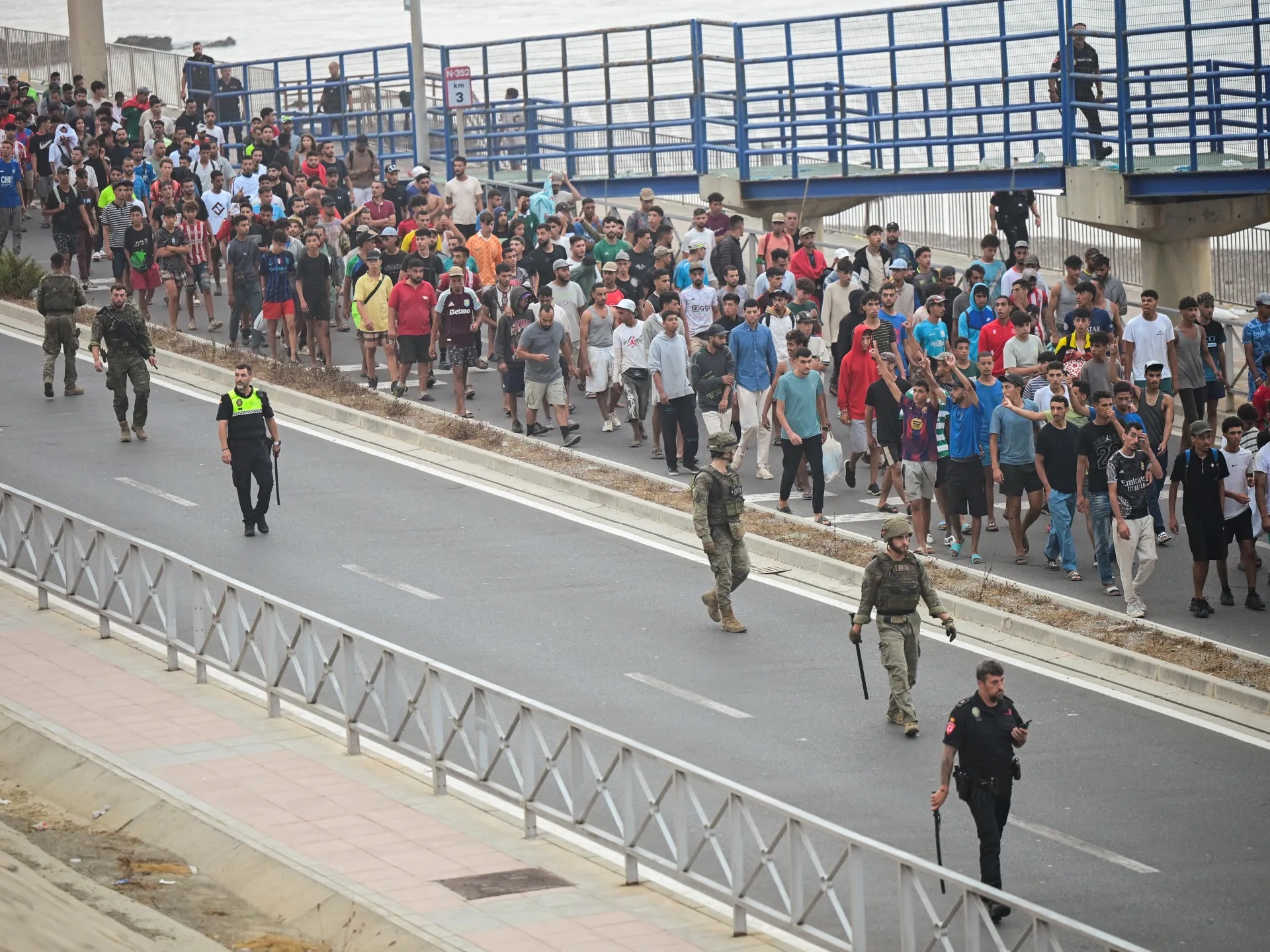
By Walid Qattati, Political Researcher
The image of the human wave of tens of thousands from the Kingdom of Morocco to the occupied Moroccan city of Ceuta was not merely a repeated attempt or a rehashed scene of migration to Spain and the West. It was a story of renewed Arab pain written by the wretched with ink from a sea of blood and tears, and a tale of an open Arab wound narrated by the unfortunate with words from a well of deprivation and loss. This human wave resembles a sad funeral, where the deceased is the dream of an entire Arab generation, or it is akin to a mournful wake for a victim crushed between the hammer of deprivation and the anvil of alienation. It is a story of pain, with its surface presenting a grim Moroccan image, while its underlying narrative reveals a deep Arab predicament.
This grim image reflects a profound crisis; on the surface, it shows Moroccan and Arab migration to the West across the Atlantic, fleeing hardship, misery, and poverty, while hoping for ease, comfort, and wealth. Beneath this image lies a complex social phenomenon that encapsulates a deep structural Arab crisis, confirmed by official international and national statistics indicating that the average number of Arab migrants outside the Arab world is around 35 million people. This is further supported by opinion polls regarding those wishing to migrate outside the Arab world, with percentages ranging from 25% to 50% among youth. For instance, a survey by the Arab Barometer in 2018 revealed that half of Arab youth wished to migrate, while the Arab Index survey in 2025 indicated that a quarter of Arab youth desired to leave.
The numerical statistics of actual Arab migration in the past, along with the data on those wishing to migrate in the future, illustrate the reality of the deep Arab predicament. This reality has rendered most Arab countries unlivable environments that repel their youth and reject their talents. The responsibility for this situation lies with the ruling political systems, which have plunged their peoples into deep-rooted crises. The most notable cognitive manifestations of these crises include the confusion of terms and the ambiguity of concepts. Despotism is labeled as a system for subjugating oppression, corruption is termed as cleverness to normalize crime, stagnation is referred to as stability to bury creativity, imitation is seen as commitment to hinder innovation, extremism is presented as moderation to beautify fanaticism, normalization is called peace to legitimize the entity, dependency is termed diplomacy to beautify colonialism, alienation is labeled as modernity to justify dispossession, cowardice is called wisdom to coexist with humiliation, and impotence is seen as patience to get used to disgrace.
The Arab predicament is not only rooted in the confusion of terms and the ambiguity of concepts, which represent the cognitive aspect of the crisis and reflect its other dimensions. The most significant and closest to the cognitive aspect is the religious predicament. The ruling Arab regimes have produced religious institutions and scholars who have excluded major issues concerning the people and the nation from their religious discourse, such as renaissance, unity, justice, independence, and Palestine. Instead, their religious discourse has focused on issues that serve the regimes and distract the people, such as endorsing obedience to authority, emptying revolutionary consultation of its binding content, transforming worship into cold, detailed rituals, asserting that women are a source of temptation, and declaring that the arts are sinful acts.
Institutions and scholars have failed to resolve the issues arising from the intersections of various dualities, including Islamic brotherhood and equal citizenship, faith and science or tradition and reason, authenticity and modernization or heritage and renewal, the fixed and the variable in religion, creativity and innovation…
In addition to the predicaments of the regimes in the cognitive and religious aspects, there exists a political predicament, the most prominent manifestations of which include the practice of despotism in various forms, such as monopolizing power and wealth, the absence of peaceful power transfer, suppressing public freedoms, violating civil rights, excluding opposition and dissenting opinions, and engaging in corruption in various forms, including the lack of transparency, oversight, and accountability, the prevalence of nepotism and favoritism, the decline of the rule of law, and the manipulation or rigging of elections through the power of authority and money. The practice of exclusionary unilateralism has failed to manage internal diversity and differences, has not applied the principle of equal citizenship in rights and duties, has linked rights to loyalty, has differentiated between races, religions, and sects, and has practiced brutal authoritarian and security overreach, leading to a lack of personal and investment security, silencing dissent, persecuting innovators, and stifling renewal. This has deepened feelings of collective impotence and psychological oppression, resulting in forced displacement and political asylum.
Perhaps the most significant aspect of the Arab predicament has been, and continues to be, the economic dimension as a fundamental cause of migration. Under the rule of Arab regimes that have squandered their people’s wealth to maintain their existence and the control of the privileged elite over power and wealth, passing it on to their children and grandchildren instead of investing it in economic development, infrastructure, and essential services. They have entrenched a parasitic consumer economy dependent on the Western economy, rather than building an independent productive economy in commercial agriculture and manufacturing. They have mismanaged human resources by failing to ensure equality among citizens in accessing public jobs and investment opportunities, instead of relying on criteria of competence, merit, diligence, and measures of knowledge, work, and creativity. They have caused an increase in unemployment rates by failing to provide opportunities for youth and graduates and have not planned to bridge the gap between educational outputs and labor market requirements. The quality of essential services, such as education, health, water, electricity, and roads, has declined. Budgets for scientific research and technical development have been severely restricted.
The reality of individual and collective migration, both legal and illegal, of citizens from the Kingdom of Morocco and most Arab countries in the Maghreb, the Mashreq, and the Nile Valley is a reflection of another reality: that most Arab countries are repelling their inhabitants and are unwelcoming homelands for their people. This indicates that they are unfit for a dignified and free life in the present and for achieving simple, bright dreams in the future. Thus, migration becomes a search for that life and those dreams elsewhere. This is the truth that paints a grim picture of a deep predicament, but it is not a predetermined fate or an inevitable path. This fate and path can be changed to become a bright destiny and a luminous course, provided that the ruling regimes possess the effective political will for change towards the better, and that Arab youth have a positive practical will to create change, transforming the current grim image into a beautiful one, and turning the deep predicament into a new hope.