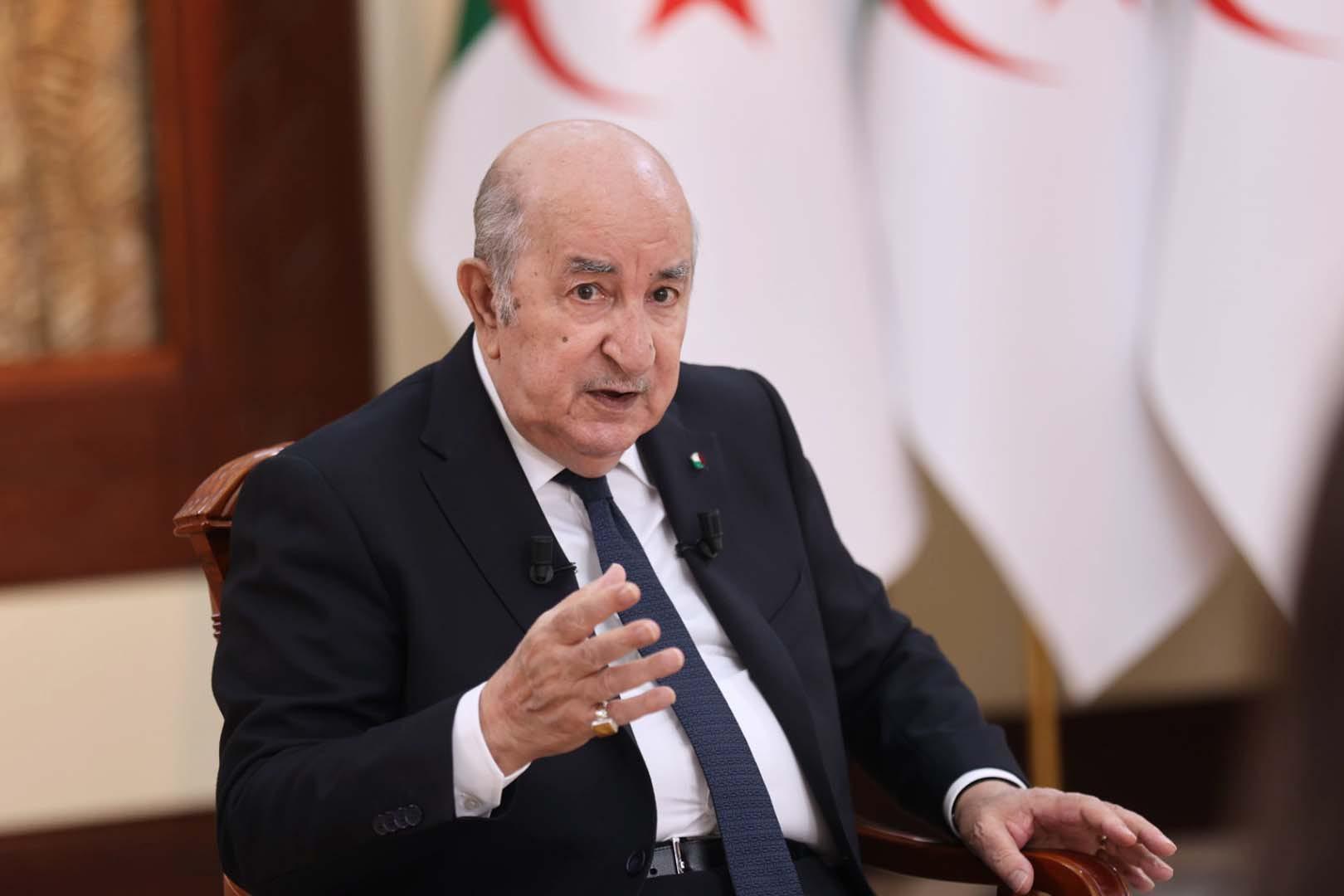
Africa-Press. The recent judicial reshuffle carried out by Algerian President Abdelmadjid Tebboune in early September 2026 did not occur in a political or institutional vacuum. It included high and sensitive judicial positions, from the presidency of the Council of State and the Court of Dispute to the heads of judicial councils, public prosecutors, and state attorneys at administrative courts of appeal. Thus, this step appears to be part of a broader reorganization of state institutions, following months of constitutional amendments that redefined the relationship between the presidency and the Supreme Council of the Judiciary.
On the surface, this movement can be viewed as a periodic measure aimed at renewing judicial responsibilities and injecting new personnel into judicial administration positions. However, its timing, the scale of the positions involved, and, most importantly, the preceding constitutional changes raise a deeper question: Is Algeria genuinely moving towards enhancing judicial independence, or do the new reforms grant the presidency greater influence over the top of the judicial hierarchy?
A Significant Shift in Appointment Rules
One of the most important aspects of this process is the constitutional amendment approved in March 2026. Appointments to “specific judicial positions” are now made by presidential decree after consulting the Supreme Council of the Judiciary, whereas the council’s opinion in the previous format was more binding. The amended article explicitly states that appointments are made by presidential decree following consultation with the council.
The authorities presented this change as part of a review aimed at improving institutional harmony and simplifying appointment procedures. However, in practice, the shift from “binding opinion” to “consultation” alters the balance of powers: the president retains the final decision on specific judicial positions, while the role of the Supreme Council of the Judiciary becomes advisory in this regard.
Herein lies the fundamental paradox of the Algerian reform. While there is talk of enhancing judicial independence, the president retains direct authority in selecting officials for judicial institutions at the top of the judicial system.
Professional Independence vs. Influence at the Top
This does not necessarily mean that every judge appointed in the recent reshuffle has become politically indebted to the presidency, nor that judicial decisions will be issued based on executive directives. Such conclusions require independent evidence that is not provided solely by the appointment movements.
However, distinguishing between two levels seems necessary. On one hand, the reforms aim to organize the professional path of judges and grant the Supreme Council of the Judiciary a role in this area. On the other hand, the state has maintained clear presidential influence over the key positions at the top of the judicial institution.
Therefore, the criterion for judicial independence should not be limited to texts regarding individual judges’ guarantees but should also include how heads of judicial institutions and public prosecutions are selected and the extent to which they can perform their duties free from executive power.
A Broad Movement, Not a Limited One
The recent list of appointments reveals the extensive nature of the process. It included the president of the Council of State, the president of the Court of Dispute, and the president of the administrative court of appeal in Algeria, in addition to 11 heads of judicial councils and several public prosecutors and state attorneys at administrative courts of appeal.
These positions grant their holders influential responsibilities in managing judicial work at both the judicial and administrative levels. Thus, changing a large number of incumbents simultaneously can be interpreted, from an institutional perspective, as a redistribution of decision-making centers within the judicial apparatus.
Conversely, there is no published information that allows for determining the reason behind the selection of each name or proving that the changes targeted specific political or judicial files. Therefore, linking each appointment to a specific political agenda would be an inference that exceeds the available data.
Why Now?
The timing of the reshuffle increases its significance. It comes after a constitutional amendment and a series of changes in Algerian institutions throughout 2026, at a time when the presidency seeks to reorganize several positions of responsibility in the state. It was preceded by another judicial movement in July 2025 that included heads of judicial councils and public prosecutors, indicating that the redistribution of judicial responsibilities is not an isolated event during Tebboune’s tenure.
The day before the judicial movement, Tebboune also conducted a partial government reshuffle that included several ministerial portfolios, making the timing notable in the broader context of reorganizing positions of responsibility within the state.
However, linking the judicial and governmental paths does not necessarily imply a single political plan or institutional “purge.” More accurately, it can be said that the presidency is moving at this stage to renew several decision-making positions and redistribute responsibilities.
The Real Test in Sensitive Files
Ultimately, the debate over Algerian judicial independence will not be settled merely by changing texts or names, but rather by what these reforms produce in practice.
The most significant test will be the judiciary’s ability to handle cases that intersect with political, rights, and economic interests, and the extent to which judges and public prosecutions enjoy professional margins when considering these files, as well as the ability of the Supreme Council of the Judiciary to exercise its powers free from executive influences.
Judicial independence does not necessarily mean the absence of any role for the president in the constitutional system, but it does assume the existence of institutional guarantees that prevent the power of appointment from becoming a means to influence judicial work.
From this perspective, Tebboune’s policy towards the judiciary seems governed by two parallel paths: reorganizing the institution and strengthening its professional foundations on one hand, while maintaining strong presidential influence in selecting several high positions on the other.
Thus, the question raised by the September movement is not whether Tebboune “changed the judges” alone, but whether the reorganization of the judicial hierarchy will lead to a more independent and effective institution, or to a more organized judiciary that remains linked, at the top of the responsibility pyramid, to executive decision-making.
This paradox will determine the true meaning of judicial reform in Algeria in the coming phase.