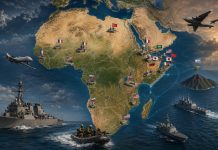
Africa-Press. A French report published by a local source titled “Emirates Secretly Building Military Base in Somaliland for the Benefit of America and Israel” reveals that the “Berbera Airport” in the internationally unrecognized region is being transformed into a military base near one of the world’s most important maritime routes, benefiting Abu Dhabi, Tel Aviv, and Washington.
Somaliland, with its capital “Hargeisa,” is located on the Gulf of Aden, one of the busiest maritime corridors in the world, and has a coastline of about 800 kilometers. The “Berbera” port occupies a strategic position on the Gulf of Aden and near the Bab el-Mandeb Strait, a crucial artery for global trade and energy supplies between Asia and Europe. This has made the region, which separated from Somalia in 1991, a focal point for global and regional powers, prompting Israel to recognize it as an independent region amid Egyptian, Arab, and Islamic rejection.
The French daily revealed on July 6 that there are secret constructions taking place away from public view, overseen by the Emirates at three sites on the runway of “Berbera Airport,” including the digging of 18 trenches between October 2025 and March of the previous year, which are underground shelters for storing ammunition or fuel tanks, alongside the preparation of elevated platforms for deploying air defense systems, similar to an Israeli radar previously deployed by the Emirates at the “Bosaso” base in Puntland, Somalia.
The report noted an increase in security cooperation between the Israeli occupation and Somaliland through mutual visits of military and intelligence delegations, training officers from Somaliland in Tel Aviv, and visits by Israeli army teams to the “Berbera” base.
It also hinted at a visit by the commander of the U.S. Africa Command (AFRICOM), General Dagvin Anderson, to the site at the end of 2025, discussing Washington’s motives in seeking an alternative to its base in Djibouti, which is close to the Chinese base that Djibouti refuses to use for operations against the “Houthis” in Yemen.
Previously, a report by the International Institute for Strategic Studies in London confirmed that “Berbera Airport” in the former British colony, which gained independence in 1960, is witnessing military infrastructure development in preparation for the arrival of the Israeli army at the site. The German Institute for International and Security Affairs stated that the Emirates is working with Israel to help establish a military presence in Somaliland.
In an analysis by “The Times of Israel,” written by a researcher in Middle Eastern security at the U.S. Army’s Strategic Research and Assessment Division, Jacob Stoil pointed out that the Emirati-Israeli-Ethiopian alliance in Somaliland is met with Cairo, Ankara, and Riyadh strengthening their relations with Mogadishu, reflecting rising tensions between the two blocs in the Middle East. He hinted that “deepening Israeli intervention in Somaliland could push the two blocs toward a proxy war in the Horn of Africa.”
While the Emirates has aligned itself with Israel, Egypt and Saudi Arabia agree on the necessity of securing navigation in the Red Sea, signing a maritime protocol in September 2025 that establishes an alliance for coordination and unified command and control, relying on the Egyptian “Berenice” naval base and Saudi facilities.
In his reading of the complexities in the Horn of Africa and the emergence of Israeli occupation and its impact on the security of the Red Sea and the Suez Canal, Egyptian academic Essam Abdel-Shafi stated that “the talk about Israeli military bases in Somaliland is no longer mere words and statements circulated here and there among media reports, but has become actions, entering into actual implementation for years.”
The head of the Academy of International Relations added: “The announcement of the Israeli entity’s recognition of Somaliland’s separation and the exchange of visits and embassies is nothing but steps toward entrenching Israeli infiltration in the region, bolstered by Emirati and Ethiopian support, at the expense of Somalia’s national security first, and the security and stability of the Horn of Africa second, and the national security of Egypt third.”
He explained that “Somalia and the Horn of Africa have for centuries formed one of the most important circles of Egyptian national security, and their importance has increased since the opening of the Suez Canal in 1869 on one hand, and with the threats facing Egyptian national water security in the Nile Basin on the other.”
Regarding the possibilities of a counter-move by Egypt, he expressed deep regret, saying: “I do not believe or expect that the ruling system in Egypt will take serious and genuine action away from media and political display and the fragile presence in the Republic of Somalia to confront the entity in Somaliland.”
He questioned: “How can we expect that with the absence of the Egyptian role in confronting the genocide war in Gaza, which is directly linked to land and maritime borders with Egypt? And how can we expect that, while the regime is signing strategic partnership agreements with the entity, whether in gas, trade exchange, or in security and military cooperation and coordination with the entity? And how can we expect that while the regime is almost absent from what is happening in Libya and Sudan?”
He concluded by saying: “If the regime has done nothing in confronting strategic threats in the first circle of Egyptian national security, which is the circle of neighboring countries with which we share borders, can we expect it to play a role in the subsequent circles?”
What does the occupation benefit?
While the establishment of this base coincided with the Israeli occupation’s recognition of Somaliland’s independence on December 26, and the adoption of the first ambassador’s papers for Somaliland, it comes amid Tel Aviv’s desire to gain a foothold near Yemen to stop Houthi attacks on the occupation’s military installations and vessels passing through the Bab el-Mandeb Strait during the bloody Israeli genocide (2023-2025) on the Gaza Strip.
An analysis by “The Times of Israel” pointed to Israel’s economic opportunities from its presence in Somaliland and opening African markets to Israeli goods, as well as access for American exporters, alongside benefits in the military strategic field in facing the Houthis closely amid the distance and difficulty of reaching Yemeni territory.
In this context, the Israeli news site “Drop Site” revealed the establishment of an Israeli intelligence presence in Somaliland and Berbera Airport, confirming that the establishment of an Israeli military base will provide a military foothold near the vital maritime corridor close to the Bab el-Mandeb Strait, emphasizing intelligence training for elements affiliated with the Somaliland occupation.
Following the Israeli recognition of Somaliland, Musa Crispus Okilo, a researcher at the Institute for Security Studies in South Africa, stated in an interview with “Al Jazeera” that “the big prize for Israel is not Somaliland, but the Red Sea.”
What about the Emirates?
Since 2017, the Emirates has begun building an airbase and a naval facility in Somaliland, developing “Berbera Port” and a railway line for shipping to Ethiopia, a move that has alarmed Egyptian decision-makers amid an ongoing conflict with Ethiopia over the Nile water file for nearly 15 years regarding the construction of the Grand Ethiopian Renaissance Dam, which threatens Cairo’s historical water shares (55.5 billion cubic meters annually).
In its commentary on the “Le Monde” report, the site “Middle East Monitor” pointed to the Emirates’ investment in “Berbera Port” and its operation through “Dubai Ports” Global, hinting that Abu Dhabi previously used Berbera facilities for logistical and military purposes during its operations in Yemen before reducing its military presence there earlier this year.
In March, Djibouti’s President Ismail Omar Guelleh described the Emirates as “Israel’s gateway to the Horn of Africa,” accusing Abu Dhabi in an interview with “Jeune Afrique” of being involved in destabilizing Yemen, Sudan, Somalia, Chad, and Libya.
Observers confirm that the Emirati role in establishing this base comes “completely ignoring the concerns of the Egyptian ally of Abu Dhabi,” clarifying that “the Israeli presence at the southern entrance of the Red Sea poses a current and future threat to Egyptian national security and to the security of navigation in the Red Sea and the movement of navigation through the Suez Canal.”
They believe that “the immediate goal for Israel, the Emirates, and America is to pressure the Houthis, prevent Iran from reaching that vital maritime area of the world, and ensure the flow of global trade, alongside an urgent goal for the Americans to counter China’s commercial projects within the framework of the Belt and Road Initiative, especially with Beijing managing the “Doraleh” port in Djibouti alongside a military base near the port to accommodate Chinese warships and submarines since 2017.”
However, they believe that “the quadrilateral move to end construction works at a port controlled by Israel may change its future objective, according to the Egyptian reading of the scene, to become targeting Egypt’s interests in the Red Sea,” emphasizing “the importance of the Egyptian move to confront the dangerous project that could control Bab el-Mandeb.”
Alongside this quadrilateral move, there is Ethiopia’s desire to gain a maritime foothold through Somaliland, which poses a threat to Egypt’s maritime interests and adds pressure on Cairo regarding the Nile water file in general, and the Ethiopian dam in particular, especially with Ethiopia and Somaliland signing a memorandum of understanding in January 2024, granting Addis Ababa a maritime outlet on the Gulf of Aden through Berbera Port.
Previous Egyptian Moves
The presence of the three allies, Abu Dhabi, Tel Aviv, and Washington in Berbera comes at a time when Egypt launched its southern fleet in Safaga in January 2017 to control the maritime operations theater in the Red Sea and Bab el-Mandeb, securing the country’s economic and strategic interests, and protecting the coasts and the navigational course of the Suez Canal.
Egypt ranks fourth globally in the classification of naval forces that possess helicopter carriers, owning two French “Mistral” class vessels since 2016, valued at 1.1 billion euros, and a French “FREMM” frigate worth about one billion euros in 2015, and two Italian “FREMM Bergamini” frigates between 1.2 and 1.5 billion euros in 2020, and German “MEKO A-200EN” frigates worth about 2.7 billion dollars, with plans to purchase four French “Barracuda” submarines at a cost between 4.5 and 6 billion dollars.
Cairo has rejected the Ethiopian and Israeli presence in Somaliland, especially following the announcement by the region’s president, Abdirahman Mohamed Abdullahi, last January, who was warmly received by the Israeli occupation in Jerusalem last month, that he does not rule out granting an Israeli company a port in the region, following the announcement by Ethiopian Prime Minister Abiy Ahmed at the African summit of his country’s insistence on reaching a maritime outlet.
Egyptian diplomacy has repeatedly affirmed its rejection of any presence from outside the eight Red Sea countries: (Egypt, Sudan, Eritrea, Djibouti), (Palestine, Jordan, Saudi Arabia, and Yemen) in its security arrangements, warning on May 25 of attempts to militarize and internationalize the Red Sea, calling for “maintaining the security and stability of the Horn of Africa, as it is an extension of Egyptian national security.”
In this context, Egypt and Somalia signed a mutual defense agreement on August 14, 2024, in Cairo, to support the capabilities of the Somali army, followed by news of Egypt sending three shipments of light weapons and armored vehicles in August, September, and November 2024, and training 3,000 soldiers from the Somali army in Egypt since 2023, then sending Egyptian forces as part of the African Union mission to Mogadishu last February.