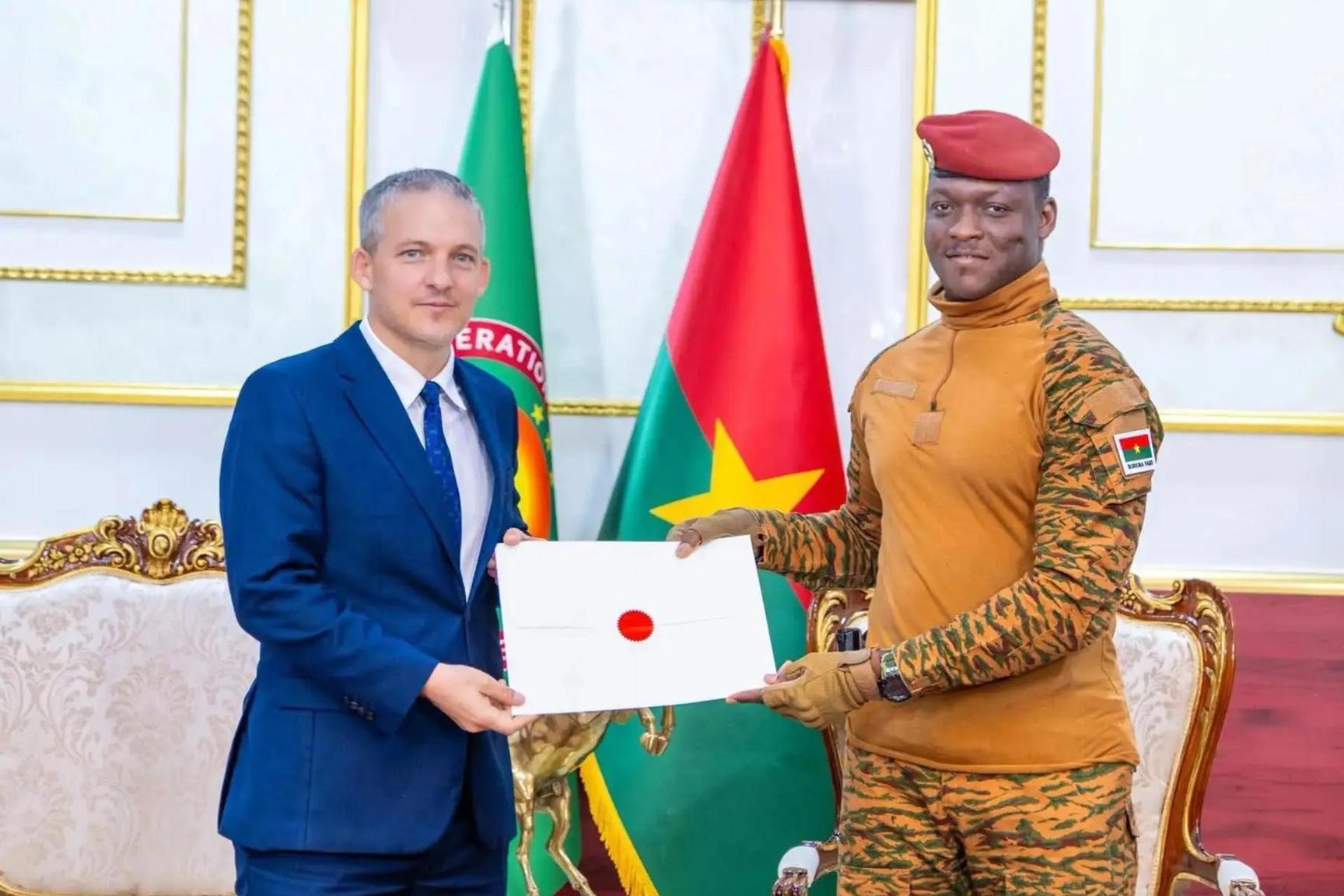
Africa-Press. The reception of the transitional president of Burkina Faso, Ibrahim Traoré, by the new Israeli ambassador Simon Seroussi comes at a politically and security-sensitive time, coinciding with an unprecedented escalation in the government’s policy towards Islamic institutions and figures under the banner of combating “radical Islam.” Although there is no publicly announced evidence linking the two events, the timing highlights an increasing intersection of interests between Ouagadougou’s need for new security partners and Israel’s desire to expand its presence in the Sahel region, which is witnessing rising international competition.
Changes in Burkina Faso
The appointment of the Israeli ambassador cannot be viewed in isolation from the transformations occurring in Burkina Faso since Traoré came to power following the coup in September 2022. The new leadership has adopted a policy aimed at reshaping foreign alliances, reducing French influence, and seeking partners capable of providing security and technical support to combat the armed insurgency threatening the state.
Appointment Beyond Protocol
The Israeli Foreign Ministry’s appointment committee selected diplomat Simon Seroussi as ambassador to four West African countries: Côte d’Ivoire, Burkina Faso, Benin, and Togo, as part of a package approved by the committee chaired by the Foreign Minister before being submitted to the government for ratification. Seroussi does not reside in Ouagadougou but manages his duties from the Israeli embassy in Abidjan, a diplomatic pattern that Israel resorts to in several African countries where it does not have independent missions.
Seroussi’s professional background indicates that his selection was not arbitrary; he joined the Israeli Foreign Ministry in 2018 and served as deputy ambassador in Cameroon, handling economic, cultural, and political files, in addition to having experience in developing agricultural and commercial businesses and analyzing African conflicts.
This background aligns with Israel’s approach in Africa, which combines “soft power” tools such as agriculture, water management, and technology with security and intelligence cooperation tools, allowing for gradual influence building in countries facing internal crises. Thus, Seroussi’s appointment appears to be part of a broader strategy aimed at enhancing Israeli presence in West Africa, rather than merely an administrative measure related to diplomatic representation.
Internal Campaign Against Radical Islam
The presentation of the Israeli ambassador’s credentials coincided with a clear escalation in the transitional government’s policy towards Islamic institutions. Ibrahim Traoré announced on July 21, 2026, that what he termed “radical Islam” would have no place in the country, threatening preachers accused by the authorities of extremism that “the battle has begun,” and he threatened to suspend the activities of imams whose sermons the government believes promote extremist ideas.
The government enacted a new law on religious freedoms, claiming it aims to enhance the secular nature of the state and tighten control over foreign funding for religious institutions, alongside subjecting religious discourse to greater scrutiny. These measures followed a security campaign that saw the arrest of several imams and the closure of the largest mosque in the capital, Ouagadougou, following protests demanding the release of Imam Mohamed Ishaq Kindo.
The measures did not stop at mosque oversight but extended to religious education, as Traoré announced a plan to repatriate students studying religious sciences in several Arab countries, claiming that hundreds of thousands of youth are receiving religious education abroad without acquiring the professional skills needed in the job market, threatening actions that could affect citizenship for those who refuse to return.
These steps reflect a shift in the government’s policy from monitoring religious discourse to attempting to reshape the religious and educational landscape in a manner more compliant with the state, amid an increasing linkage between certain forms of religious activity and security threats.
Ongoing Security Crisis
These measures come while Burkina Faso continues to face one of the most complex security crises in Africa. Since 2015, groups linked to ISIS and al-Qaeda have expanded within the country, taking advantage of state fragility, weak control over rural areas, and the intertwined borders with Mali and Niger.
These developments have led to the deaths of thousands and the displacement of more than two million citizens, while the government has lost complete control over vast areas of land, making security the biggest challenge for all successive governments.
Although Traoré came to power promising to restore security in a short period, international reports still indicate the continuation of armed attacks and the expansion of extremist groups’ activities in various parts of the country.
In this context, Israeli writer Ze’ev Abraham described Burkina Faso in an article published in a local source as one of the most dangerous countries in the world, noting that Traoré’s image as the “African savior” does not match the ground reality, where armed groups continue to expand their influence alongside a decline in democratic life.
Additionally, a local source noted the existence of a wide digital propaganda campaign using artificial intelligence techniques to present Traoré as a revolutionary leader with widespread popularity within and outside Africa, at a time when the government has not achieved the security results it promised.
Seeking Alternatives After France
Since the military coup, Traoré has made ending French influence one of his main political slogans. This policy led to the withdrawal of French troops from the country, a step the government viewed as a confirmation of national decision-making independence, but it raised a more complex question: who will fill the security vacuum?
Initially, Ouagadougou sought to enhance cooperation with Russia, similar to Mali and Niger, where Moscow emerged as an alternative security partner in the Sahel region. However, the ongoing security deterioration has prompted the Burkinabe leadership to adopt a more pragmatic policy of diversifying partners instead of relying on a single entity.
In this context, Israeli media reports have discussed the Burkinabe authorities’ desire to benefit from Israeli expertise in counter-terrorism, technical surveillance, intelligence, and drones.
Why Israel is Interested in the Sahel
Israel views Africa as one of the important arenas to enhance its diplomatic and security presence, and its relations with several African countries have seen significant expansion over the past decade. The Israeli National Security Studies Institute believes that the security dimension has become the primary driver of Israeli-African relations, even when these relations begin under civilian titles such as agriculture, water management, or health.
Researcher Yaron Salman indicates that Israel has relied on military training, developing intelligence capabilities, and transferring security technology to enhance its presence in countries facing armed rebellion or terrorist threats. Conversely, Israeli circles see the expansion of extremist armed groups in Africa as an opportunity to build long-term partnerships with local governments, opening the door for simultaneous security and economic cooperation.
The importance of the Sahel region for Israel extends beyond counter-terrorism; it also encompasses the increasing geopolitical competition on the continent, where the roles of Russia, Turkey, Iran, and China are expanding, while the traditional influence of Western powers, especially France, is declining.
In a study addressing international competition in Africa, researcher Denis Citrinovich considered Burkina Faso to have become one of the arenas of Russian influence, which drives Israel to seek a foothold that allows it to maintain its presence in a region witnessing a redrawing of power balances.
Intersection of Interests, Not an Official Alliance
Despite indicators reflecting an increasing rapprochement between the two sides, there are currently no official documents revealing direct security or intelligence agreements between Israel and Burkina Faso. There is also no evidence linking Traoré’s campaign against Islamic institutions to coordination with Tel Aviv, making claims of a direct causal relationship lack supporting evidence.
However, what can be observed is a clear intersection of interests. The Burkinabe authority seeks technical and security tools to help regain control of the country and wants to diversify its partners after the limited results of the French and Russian bets.
Conversely, Israel sees Burkina Faso as a suitable gateway to enhance its presence in the Sahel by presenting itself as a partner in security, technology, agriculture, and development, tools that grant it political influence that transcends traditional economic cooperation.
From this perspective, the appointment of the Israeli ambassador can be understood as a step reflecting the transition of relations from a limited communication level to a more public and organized level, without necessarily implying the establishment of a comprehensive strategic alliance.
Future of the Relationship
The future of relations between the two sides is likely to be determined by developments in the security situation within Burkina Faso. If armed groups continue to expand their influence, Ouagadougou’s need for security technology and intelligence partnerships is expected to increase, potentially opening the door for broader cooperation with Israel.
Conversely, Israel will remain keen to offer its cooperation within a developmental and economic framework alongside the security dimension, recognizing the sensitivity of African public opinion that rejects any Israeli military involvement or presence on their territory, as well as to avoid provoking reactions from competing regional powers such as Algeria.