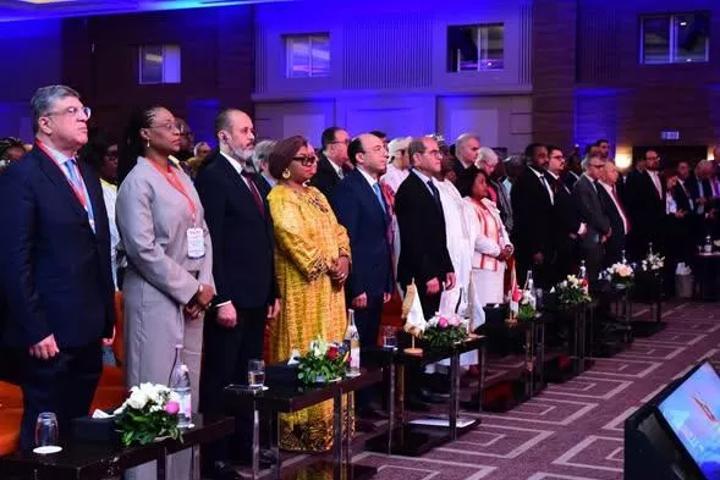
Africa-Press. Attention this week is turning to the launch of the ninth edition of the International Conference on Financing Investment and Trade in Africa, “FITA 2026,” hosted by Tunisia.
This raises questions in economic circles about the country’s ability to attract new investments, and whether it can become a locomotive and gateway for several countries to enter the African market.
Starting today and continuing until tomorrow, Tunisia is hosting the conference under the theme “African Value Chains… Developing Strategic Levers for Transforming the Continent,” with the participation of around 1,000 attendees from about 60 countries.
During the opening of the conference, Minister of Equipment and Housing, Salah Zouari, stated that “Africa stands at a significant economic crossroads and a decisive turning point in its development path, which requires an ambitious and coordinated response to address major structural challenges.” He pointed to expectations that the continent’s population will reach 2.5 billion by 2050, about 60 percent of whom will be youth.
Zouari also recalled that current indicators remain concerning, noting that “around 600 million Africans still lack electricity, about 400 million lack drinking water, 700 million do not have access to adequate sanitation services, and nearly 500 million people live more than two kilometers away from a road usable year-round.”
He also highlighted the major infrastructure deficit, explaining that financing needs for this sector are estimated at between $130 and $170 billion annually, emphasizing the scale of the challenges that must be addressed to strengthen the continent’s economic transformation.
Wide International Participation
In a statement to Sputnik, the Secretary-General of the Tunisian African Business Council, Nadia Yaich, said that the investment conference in Tunisia is being supervised by President Kais Saied, noting that this edition will demonstrate to the world that Tunisia has an active and important role on the African continent.
She added: “During the conference, we will address the issue of value chains as a key driver of economic transformation.”
Yaich also stated that “this edition is exceptional, as two countries—Canada and Guinea—will be honored as guests of honor, in addition to the participation of official and economic delegations from Burkina Faso, the Democratic Republic of the Congo, and Nigeria at the highest level, reflecting growing interest in developing structural economic partnerships across the continent.”
She explained that the African Business Council will, through this edition, work to strengthen the role of women entrepreneurs in Tunisia and connect them with their counterparts across Africa. Yaich added that understanding African markets requires first mastering on-the-ground economic data before moving to the stage of major investments.
She said: “Tunisia’s traditional orientation toward African markets has been weak, and through this forum, the work of companies and institutions exporting to Africa will be facilitated.” According to the Secretary-General, thematic sessions will also be organized on energy corridors, the labor market, and artificial intelligence and its impact on economic transformation in the continent.
Tunisia as a Gateway to Africa
In the same context, economic expert Maher Guaida stated that Tunisia can become a locomotive for many countries entering the African market. He added that “Tunisia is distinguished by a strategic geographic location, which should be leveraged to attract more foreign investment.”
He continued that “the Tunisian state has an opportunity, through this conference, to form a trilateral hub bringing together Tunisia, China, and Japan or South Korea, with the aim of supporting investment and enhancing the country’s attractiveness as a platform toward Africa.”
The economic expert also considered that Tunisia is required, in hosting this conference, to develop its economic relations, especially with South Africa. He said: “The Tunisian economic model must change and orient more toward the East, given that technology is now more concentrated in Asia than in Europe.”
Guaida added that “what is required of the Tunisian state, in light of global economic transformations, is to work on clean energy and address the challenges of drought and desertification—issues that require significant resources and broad partnerships, particularly with African countries.”
Challenges of Entering African Markets
For his part, economic expert Mohamed Salah Jenaidi told Sputnik that strengthening Tunisia’s presence in the African market currently faces a range of logistical problems that hinder support for Tunisian exports, especially toward Sub-Saharan African markets.
He explained that one of the most prominent obstacles is the lack of direct routes between Tunisia and a number of African countries. Jenaidi stressed the need to establish a direct maritime line to countries such as Senegal and Côte d’Ivoire, especially since Tunisia exports about 10,000 tons monthly to the continent.
The economic expert also indicated that Tunisia possesses a number of mechanisms that enable it to adapt within the African space and demonstrate its ability to enhance its experience in trade exchanges with various countries around the world.
Jenaidi added that Tunisia is now in the actual implementation phase of the African Continental Free Trade Area agreement (AfCFTA), after completing the African certificate of origin, which allows it to export and import with reduced customs duties.
It is worth noting that the African Continental Free Trade Area agreement came into force across the continent in July 2019, and Tunisia ratified it on August 7, 2020.
This agreement is one of the most prominent continental projects of the African Union under the slogan “An integrated, prosperous, and peaceful Africa,” covering 55 African countries, with a market of about 1.3 billion consumers and trade exchanges estimated at around $3.4 trillion annually.