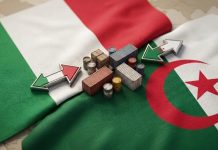

Africa-Press. Italy imported 4 billion cubic meters of Algerian gas through pipelines during the first half of 2026. This marks a 4.3% increase year-on-year, raising Algeria’s share to 34.7% of Italian demand and solidifying its position as the top pipeline gas supplier. This occurred in a market where overall consumption grew by only 0.2% and total imports declined by 0.6%.
These figures, reported by a local source, reveal that Sonatrach did not benefit from a broad expansion in Italian demand. Instead, it gained additional market share within a relatively stable market, as Algerian flows increased by approximately 470 million cubic meters compared to the first half of 2025, while Italy’s total imports decreased by about 176 million cubic meters.
Thus, Algeria has become almost the sole supplier among major pipeline providers to Italy, achieving three simultaneous elements: increased volumes, expanded market share, and sustained high flows through a direct and stable corridor. This development gains additional economic weight as Italian domestic production continues to decline, and supplies from Northern Europe and Libya shrink, while Russian gas has contracted to a marginal level, covering only 1.8% of consumption.
Sonatrach Gains Share in a Stagnant Market
Italy’s demand for natural gas reached 32.9 billion cubic meters between January and June 2026, compared to about 32.83 billion cubic meters during the same period in 2025. This represents a limited increase of approximately 70 million cubic meters.
In contrast, Algerian supplies through pipelines surged from about 10.93 billion cubic meters to 11.4 billion. This means that the Algerian increase alone is nearly seven times the net growth of Italian demand during this period, according to Italian trade data.
This comparison indicates that Algeria’s gain was not due to rising consumption but rather a redistribution of supplier shares within the market. While Algeria added around 470 million cubic meters, other routes lost a significant portion of their flows, particularly from Northern Europe and Libya.
Algerian exports also grew by 4.3% while Italy’s total imports declined by 0.6%. The difference between these two trends is 4.9 percentage points, reflecting a clear improvement in the competitive position of Algerian gas.
On average, Algeria supplied about 1.9 billion cubic meters monthly during the first six months. If this pace continues until the end of the year, pipeline supplies could approach 22.8 billion cubic meters, although the final figure will depend on winter demand, gas prices, stock levels, and maintenance schedules.
A 6.5 Billion Cubic Meter Gap with Azerbaijan
The map of Italian imports shows an expanding gap between Algeria and its closest competitor, as Azerbaijani supplies through the TAP pipeline reached 4.9 billion cubic meters, a year-on-year increase of 2.2%, covering 14.8% of Italian demand.
Thus, Algerian gas surpassed Azerbaijani gas by about 6.5 billion cubic meters, with Algerian flows being more than 2.3 times the volume of Azerbaijani supplies. Algeria’s share of Italian demand exceeded Azerbaijan’s by approximately 19.9 percentage points.
At the same time, flows from Northern Europe dropped by 17.1% to 3.4 billion cubic meters, which is less than one-third of the Algerian quantity. The gap in favor of Algeria reached eight billion cubic meters in just six months.
Libyan gas also fell by 63.7% to 188 million cubic meters, becoming limited in the Italian market. In comparison, Algeria exported through pipelines an amount equivalent to more than 60 times the volume of gas coming from Libya.
Additionally, Russian gas remained below two billion cubic meters annually, with its quantity in the first half barely exceeding half a billion cubic meters, representing 1.8% of Italian consumption. The scale of this shift is stark when compared to the first half of 2019, when Italy imported 15.9 billion cubic meters from Russia.
Consequently, Algeria in 2026 provides Italy with a quantity exceeding Russian gas by about 20 times, whereas Moscow was previously one of the dominant players in the market before the war in Ukraine. This gap confirms that the center of gravity in Italian energy security has effectively shifted from the eastern axis to the southern Mediterranean.
Algeria Covers Italian Production Shortfall
The rise in Algerian supplies gains greater significance when linked to the trajectory of local production in Italy, which declined from 1.8 billion cubic meters during the first half of 2025 to 1.5 billion cubic meters in the same period of 2026, a contraction of about 16.7%.
Thus, Italian production covers only about 4.6% of national demand, while Algeria through pipelines covers 34.7%, which is more than 7.5 times the share of local production.
Moreover, the Algerian quantity exceeded total Italian production by about 9.9 billion cubic meters. In other words, Algeria provided during the first six months a quantity equivalent to Italy’s local production for about seven and a half years, based on the pace of the first half of 2026.
These figures illustrate that the energy relationship between Algeria and Italy is no longer based on partial compensation for a temporary shortfall but has become linked to a structural imbalance between Italian demand and the country’s ability to produce gas locally.
Every additional decline in Italian fields raises the need for external suppliers capable of securing large and regular quantities. Here, Algeria benefits from its considerable gas reserves, production and marketing expertise, as well as a direct pipeline that reduces reliance on maritime transport and supply chain fluctuations.
Transmed Becomes a Strategic Economic Asset
Algerian supplies reach Italy via the Transmed-Enrico Mattei system, which transports gas from Hassi R’Mel through Tunisia and the Mediterranean Sea to Sicily before being injected into the Italian transport network.
This infrastructure gives Algerian gas an economic advantage over maritime shipments, as it shortens the supply chain and avoids liquefaction, loading, transport, and regasification processes. It also allows for more regular daily flows, with flexibility in adjusting quantities according to consumption and stock levels.
The value of this corridor is not limited to exports; it represents one of the key assets that gives Algeria negotiating weight within the European energy market. Italy does not purchase a commodity separate from its infrastructure but relies on an extended production and transport system from Algerian fields to its national network.
Additionally, Algeria’s geographical location provides an advantage that is difficult to replace quickly by distant suppliers. Shipping liquefied gas from the United States or the Gulf requires tankers, reception terminals, and regasification capacities, while Algerian gas flows directly to one of the largest consumption markets in Southern Europe.
Thus, the increase in liquefied gas capacities in Italy has not diminished Algeria’s role; rather, Sonatrach has maintained its leadership through pipelines while continuing to be among the main suppliers of liquefied gas by sea.
Dual Presence Through Pipelines and Tankers
Italian LNG terminals processed 10.4 billion cubic meters during the first half of 2026, a 2% increase, or just over 200 million cubic meters compared to the same period in 2025.
LNG covered 31.7% of Italian demand, with the United States, Qatar, and Algeria leading the list of maritime shipment sources.
It is important to distinguish between two different figures: the 34.7% share belongs to Algerian gas transported through pipelines, while the 31.7% represents the contribution of all LNG imports to Italian demand, not just the Algerian share.
However, Algeria’s presence among the largest LNG suppliers means that its total contribution, when combining Transmed flows and maritime shipments, undoubtedly exceeds 34.7% of the market. The exact percentage cannot be determined without official details on the Algerian quantities processed by each terminal during the period.
This duality provides Sonatrach with significant commercial flexibility; it can allocate part of its exports between contracts executed through pipelines and maritime shipments, depending on spot prices, long-term commitments, seasonal demand, and the availability of tankers and terminals.
During 2025, Italy’s LNG imports reached 20.9 billion cubic meters, with Algerian gas accounting for about 21.3% of that, equivalent to approximately 4.45 billion cubic meters. Algeria also exported 20.1 billion cubic meters to Italy via pipelines in the same year, according to Italian market data.
Combining these estimates, Algeria’s contribution may have exceeded 24.5 billion cubic meters during 2025, or nearly 40% of total Italian gas imports amounting to 61.3 billion cubic meters, considering that the value of LNG is calculated approximately based on the announced share.
Summer Heat Raises Supply Value
Despite stable demand during the first half, the Italian market may see an increase in gas consumption during the second half, particularly after thermal electricity production rose by 14% in July compared to the same month in 2025.
This increase was influenced by heat waves and rising electricity demand for cooling purposes, which led to a renewed operation of gas-fired thermal plants. Thus, the summer season is no longer necessarily a period of low demand, as record temperatures raise electricity consumption and the fuel used to produce it.
If this trend continues, Sonatrach may have additional room to stabilize or increase quantities, especially since Algerian gas reaches through existing infrastructure and does not require the establishment of new reception capacities.
In contrast, the level of industrial demand will remain a crucial factor, as Italian gas consumption is not only linked to households and power plants but is also affected by the performance of the chemical, metal, ceramic, glass, and fertilizer industries.
78% Stock Levels Do Not Eliminate the Need for Algeria
The level of gas storage in Italy reached about 78% of total capacity in mid-August 2026. Although this percentage is slightly lower than some levels recorded in previous years, it remains above the European Union average.
Snam announced on April 23, 2026, that it had allocated quantities allowing it to reach a storage filling target of 90% before the winter season, with a total available gas amounting to 17.5 billion cubic meters, from a national storage capacity slightly exceeding 19 billion cubic meters.
However, rising stock levels do not diminish the importance of suppliers, as replenishing them requires continued flows during the summer and autumn, and withdrawals in winter need subsequent compensation. Therefore, the regularity of Algerian gas remains a key element in managing storage, not just in covering current consumption.
Moreover, storage provides limited temporal protection, while pipelines offer continuous supplies. Thus, Italian stocks complement Transmed flows rather than replace them.
Partnership Beyond Gas Sales
Algerian-Italian cooperation has expanded in recent years from gas trade to investment in oil and gas upstream, field development, emission reduction, renewable energies, and hydrogen.
Eni has become one of Sonatrach’s key partners in Algeria, accelerating the development of discoveries in the Berkine Basin, within a model aimed at reducing the time between discovery and production start. This cooperation serves two intersecting goals: increasing Algeria’s production capacity and renewing its reserves, while securing additional supplies for the Italian market.
Sonatrach also owns the Augusta refinery in Sicily, which it purchased from ExxonMobil, allowing the Algerian group to transition from being a supplier of oil and gas to an industrial investor within the European market.
The refinery gives Sonatrach the ability to process crude oil and market refined products in the Mediterranean basin, while the Transmed pipeline supports its presence in the gas market. Thus, Italy represents one of the most integrated markets within the portfolio of foreign assets of the Algerian group.
Higher Revenues and Greater Negotiating Power
Economically, the increase in exports by about 470 million cubic meters directly raises the billable quantities compared to the first half of 2025. However, determining the value of additional revenues requires knowledge of contractual prices, which are usually linked to review formulas and indices whose commercial details are not published.
Nevertheless, the gain is not limited to direct financial returns. An increased share within a major European market enhances Sonatrach’s position in future negotiations, supports its ability to market additional quantities, and raises the strategic value of Algerian infrastructure.
Moreover, the regularity of flows reduces the risks of losing the market to competitors, at a time when Italy is expanding its LNG capabilities and working to diversify its sources. Data from the first half have shown that Italian diversification has not come at the expense of Algeria; rather, it has coincided with an increase in Algerian exports and a decline in several other suppliers.
On this basis, the results of the first six months reveal a qualitative shift in Algeria’s position: more than one-third of Italian demand was covered by Algerian gas through pipelines alone, while Sonatrach increased its quantities in a stagnant market, advancing by 6.5 billion cubic meters over Azerbaijan, and providing more than seven times the local Italian production.
These data make Algeria more than just a primary supplier; it has become an operational pillar in the Italian gas market, a key player in its supply security, and a partner whose quantities, infrastructure, and export diversity are difficult to replace in the short to medium term.