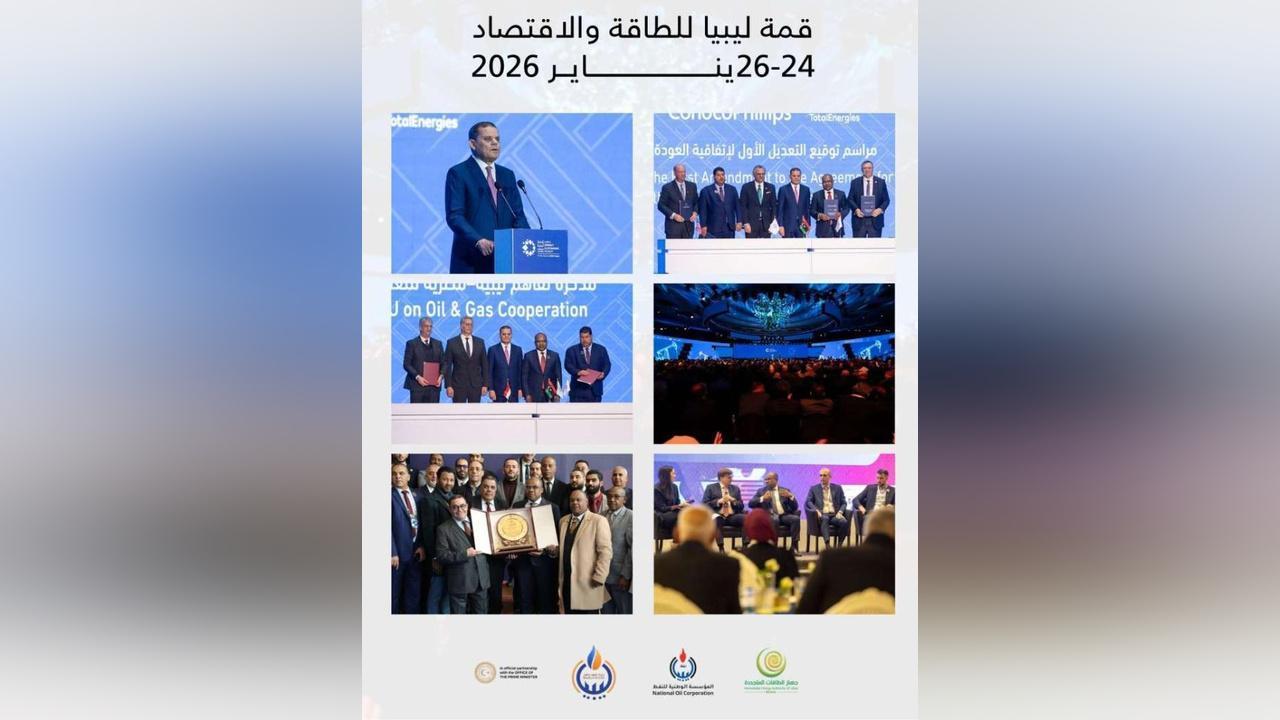
Africa-Press. The Ministry of Oil and Gas of Libya’s Government of National Unity has released the final report of the Libya Energy and Economy Summit 2026, held from 24 to 26 January, with broad participation exceeding 600 local and international entities.
The report states that the summit witnessed the signing of major agreements and memoranda of understanding that supported investment and cooperation in the energy sector, reaffirming Libya’s position as a promising destination for investors in this vital field.
It highlights the high level of international participation, the presentation of available investment opportunities, and key outcomes that strengthened economic partnerships and contributed to the development of Libya’s energy sector.
The Ministry of Oil and Gas expressed its appreciation to all partners and participants who contributed to the success of the summit and the achievement of its objectives, calling on local and international investors to benefit from the new opportunities announced during the event.
The Libya Energy and Economy Summit is an annual platform bringing together the public and private sectors alongside international investors, with the aim of enhancing cooperation in the energy sector and presenting new investment opportunities.
The summit reflects Libya’s efforts to strengthen its position as an attractive investment destination in oil and gas, particularly in light of current economic challenges, the need to develop energy infrastructure, and the diversification of strategic partnerships.
Report Text
First: Introduction
Held in Tripoli from 24 to 26 January 2026, the Libya Energy and Economy Summit achieved remarkable success through wide national and international participation. It presented an ambitious vision to enhance Libya’s role in the economy and energy sectors, attracting more than 2,000 participants and representatives from over 600 local and international entities.
Second: Participation and delegations
The summit hosted official delegations from several countries, including Namibia, Malta, Equatorial Guinea, and Saudi Arabia, as well as representatives from international organizations and leading global companies in oil, gas, and renewable energy. On the sidelines, specialized bilateral meetings were held with ministers and executives from major international companies to expand cooperation and investment.
Third: Agreements and memoranda of understanding
The summit resulted in the signing of four major strategic agreements aimed at supporting investment and strengthening partnerships between Libya and global partners.
1- Waha partners’ return agreement – ConocoPhillips and TotalEnergies
A 25-year development agreement worth over $20 billion was signed to increase production capacity to approximately 850,000 barrels per day and enhance oil revenues.
2- MoU between the Libyan Ministry of Oil and Gas and Egypt’s Ministry of Petroleum
Aimed at strengthening technical and investment cooperation in energy and oil projects.
3- MoU between the Renewable Energy Authority and US-based W16
Focused on supporting renewable energy programs and exchanging expertise in technological innovation and clean energy.
4- MoU between the National Oil Corporation and Chevron
Intended to expand cooperation in exploration, production, and advanced technologies in the oil and gas sector.
Fourth: Pavilions and exhibitions
Three major national exhibition pavilions were launched, representing 42 companies from Italy, the United States, and France—significantly higher than the previous edition—reflecting growing confidence in Libya’s investment market.
Fifth: Summit proceedings and workshops
A high-level Libya–Europe dialogue session discussed Libya’s strategic role in regional energy security and its potential as a bridge for energy transfer between Africa and Europe.
Sixth: Outcomes and recommendations
Key outcomes included enhanced international confidence in Libyan energy investment, increased foreign participation in future summits, improved business and investment environments, and preparations for an expanded 2026 Libya–Africa Gas Forum.
Seventh: Conclusion
The summit served as an effective platform for international engagement and investment promotion, laying new foundations for cooperation and confirming Libya’s ability to attract global investment in energy, oil, and clean energy sectors.