
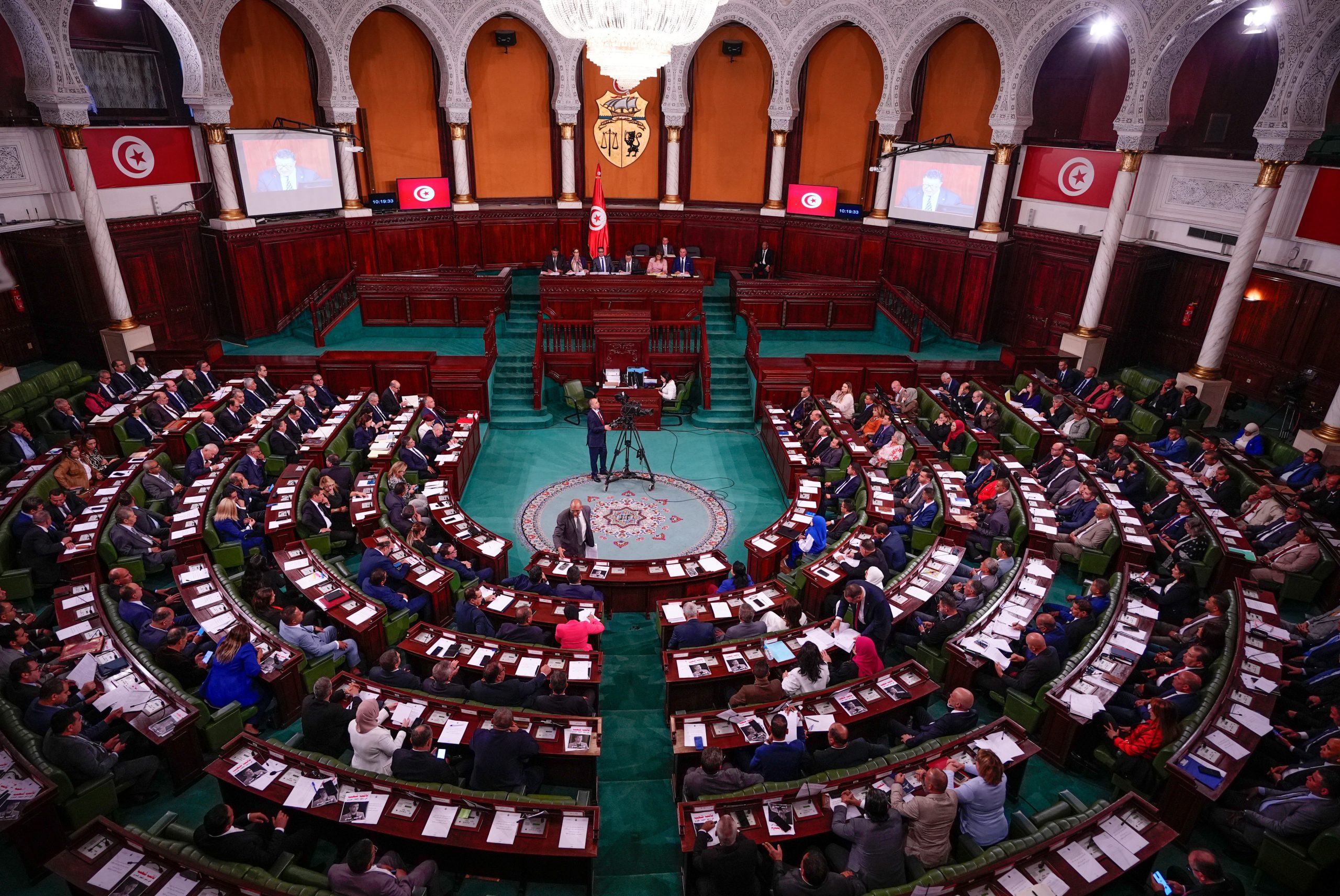
The Tunisian Parliament has approved a development plan for the period 2026-2030 with a majority vote after a day of lengthy discussions that revealed differing positions among lawmakers. Supporters viewed the plan as a framework for guiding economic policies over the next five years, while critics expressed skepticism about the realism of its assumptions and the state’s ability to implement the announced projects amid the financial pressures facing the country.
The five-year plan is the first developmental document adopted by the state under a new approach that began with proposals from local and regional councils, which were then compiled and formulated into a comprehensive national document by the Ministry of Economy and Planning. The government hopes that the plan will serve as a roadmap for economic and social policies during the 2026-2030 period, aiming to boost growth, stimulate investment, reduce regional disparities, and improve employment indicators and essential services.
The plan is based on mobilizing investments amounting to 102 billion dinars (approximately $35 billion) over five years, targeting an annual economic growth rate of 4.2%. The government considers this necessary for creating new jobs, improving incomes, and reducing economic imbalances. The program includes thousands of projects distributed across various regions, covering infrastructure development, transportation, health, education, digitization, and agriculture, along with projects in the water and energy sectors aimed at enhancing essential services and supporting local development. The plan also focuses on strengthening private investment, encouraging local initiatives, developing the green economy and renewable energies, and improving the business climate, in addition to supporting small and medium enterprises.
During the discussion of the project, the Minister of Economy and Planning emphasized that the plan represents a break from previous approaches, as it is based for the first time on proposals raised by local and regional councils, allowing for the inclusion of projects benefiting the interior regions that have suffered from a lack of public investment for decades. It also aims to reduce developmental disparities between regions, improve transportation networks and roads, support water security, and enhance the quality of health and educational services.
Criticism of Financing Assumptions
Despite the approval of the project, the parliamentary session witnessed widespread criticism from several lawmakers who argued that the plan includes ambitious goals without providing sufficient guarantees regarding funding sources. A member of parliament stated that the government’s plan did not present alternative scenarios in the event of a deterioration in the global economic situation, a rise in energy prices, or a decline in external demand. Some parliament members felt that the House of Representatives found itself faced with a ready document that could not be amended, considering that voting on it resembled “granting a blank check” to the government for five years, in the absence of clear mechanisms for monitoring and evaluation.
Lawmakers pointed out that the public investment budget for 2026 does not exceed approximately 6.8 billion dinars, which raises questions about how to secure the remaining funding necessary to implement the thousands of planned projects. Many called for prioritizing major projects capable of bringing about economic transformation, such as developing the railway network, constructing the Enfidha port, and expanding Tunis-Carthage Airport, instead of spreading resources across numerous small projects.
The session was not without protest, as the “People’s Victory” bloc announced its boycott of the proceedings, arguing that the plan did not adequately reflect the outputs of local and regional councils. Additionally, several lawmakers organized a protest inside the parliament hall, demanding urgent solutions to the water supply crisis, asserting that the plan does not provide a clear strategy for addressing this vital issue.
Conversely, the Strategic Planning Committee in Parliament recommended subjecting the implementation of the plan to periodic monitoring by requiring the government to submit an annual report to Parliament on the progress of project implementation and execution rates, allowing for performance evaluation and necessary adjustments when needed.
Tunisian authorities rely on providing more than 90% of the value of these programmed investments in the new development plan from public resources, with very limited participation from the private sector. Meanwhile, the International Monetary Fund’s forecasts indicate that the Tunisian economy will continue to experience stagnation for the coming years. The annual report on “Global Economic Outlook” issued by the IMF regarding the Tunisian economy shows that the real GDP growth rate will reach 2.1% in 2026, then decline to 1.6% in 2027, stabilizing at around 1.5% in the following years until 2031.