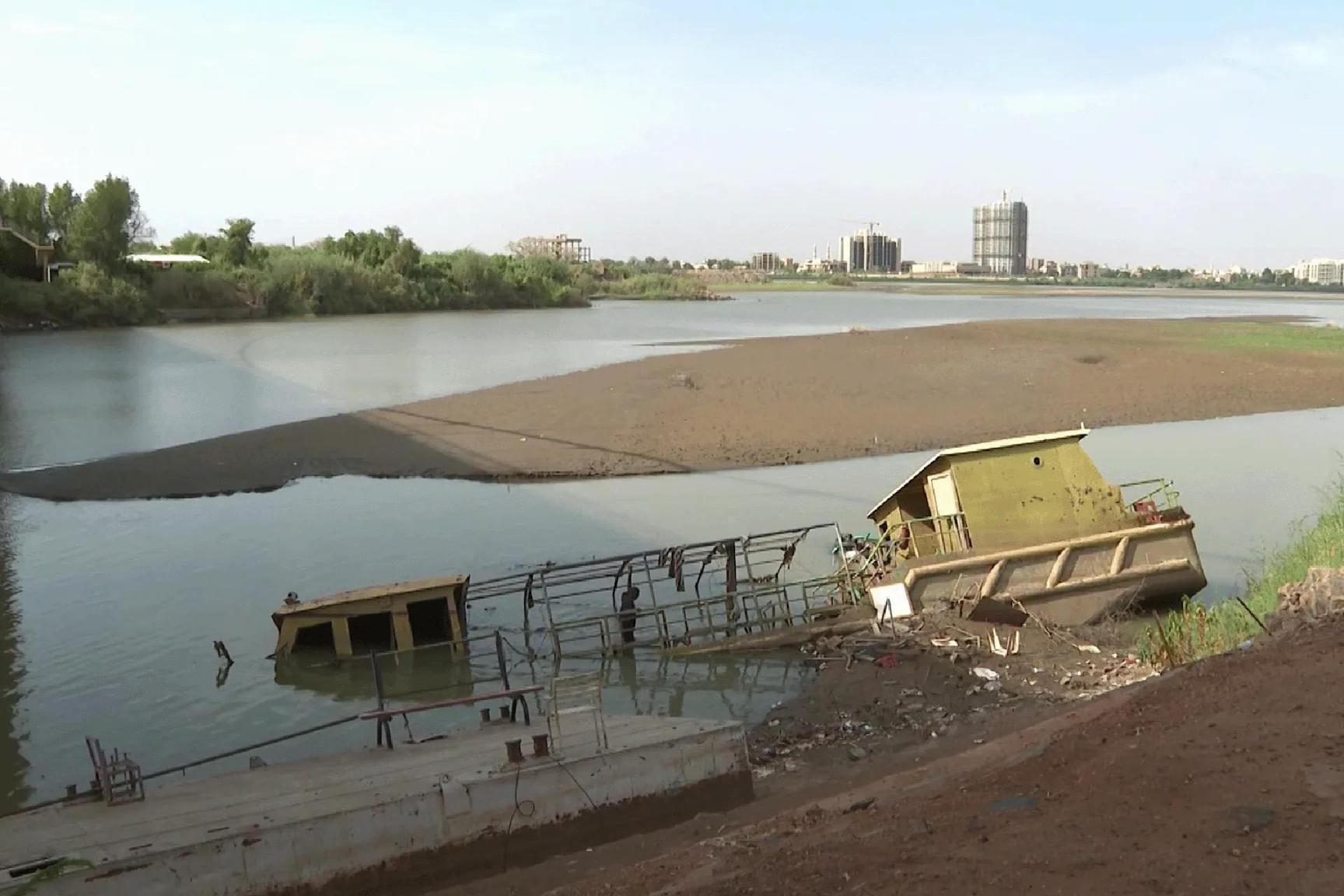
Africa-Press. The effects of the Nile’s water recession are evident in the Sudanese capital, Khartoum, where a strip of dry land appears along the riverbanks, and residents are facing an increasing shortage of drinking water.
The drop in water levels has caused some drinking water stations to cease operations after their production was reduced by half. The Ministry of Irrigation is attempting to address the crisis by opening several water reservoirs to compensate for the drinking water shortage, according to the Minister of Irrigation and Drinking Water, Ismat Sharqi, in a report prepared by a local source.
Although it is the storage season, the government decided to open some reservoirs because providing drinking water is a priority, as confirmed by Sharqi.
Residents of East Nile find water to be farther away than ever, requiring a strenuous search that may not always guarantee success, as stated by Hanan.
In more than seven areas, drinking water is no longer supplied through distribution networks but rather through tanks donated by some able individuals, while complaints from residents about the prolonged crisis continue.
Escalating Suffering
This significant shortage of clean water has made it difficult for residents to carry out even the simplest daily tasks, prompting a woman named Iqbal to try to collect donations to obtain water.
In her conversation with a local source, Iqbal mentioned that she collects one Sudanese pound (the dollar equals at least 3,500 pounds) from each person to buy two water tanks for each area, noting that the price of one tank is 200,000 pounds.
Each area needs more than two tanks, but Iqbal states that the donations are insufficient to purchase the necessary amounts, while the local source confirmed that the crisis requires solutions as it worsens daily.
Numerous studies have previously warned that the significant repercussions of the Ethiopian Renaissance Dam will not become apparent until drought years when the dam’s operational decisions and water discharge quantities become critical factors in stabilizing water supplies and agriculture in downstream countries, starting with Sudan and then Egypt.
Recently, the Ministry of Irrigation and Water Resources in Sudan stated in a post on its Facebook page that it had observed a temporary decrease in the daily inflow to the Roseires Reservoir during the period from July 7 to July 9, 2026, where it dropped from 207 to 129 million cubic meters daily, a decrease of 76 million cubic meters per day.
This situation reflected on the discharge behind the Roseires Reservoir, decreasing by 100 million cubic meters daily, and behind the Sennar Reservoir by about 82 million cubic meters daily during the period from July 7 to July 10, 2026.
The ministry explained that this led to a temporary drop in Nile levels at several key stations, including Roseires (1.50 meters), Wad Al-Ais (1.70 meters), Wad Madani (1.60 meters), Khartoum (1.08 meters), Halfaya (94 cm), and Shendi (54 cm), while levels in areas north of Khartoum remain higher than those recorded during the previous year as of July 15, 2026.
The ministry attributed this situation to the decrease in the Blue Nile inflow due to reduced discharge from the Ethiopian Renaissance Dam during that period.