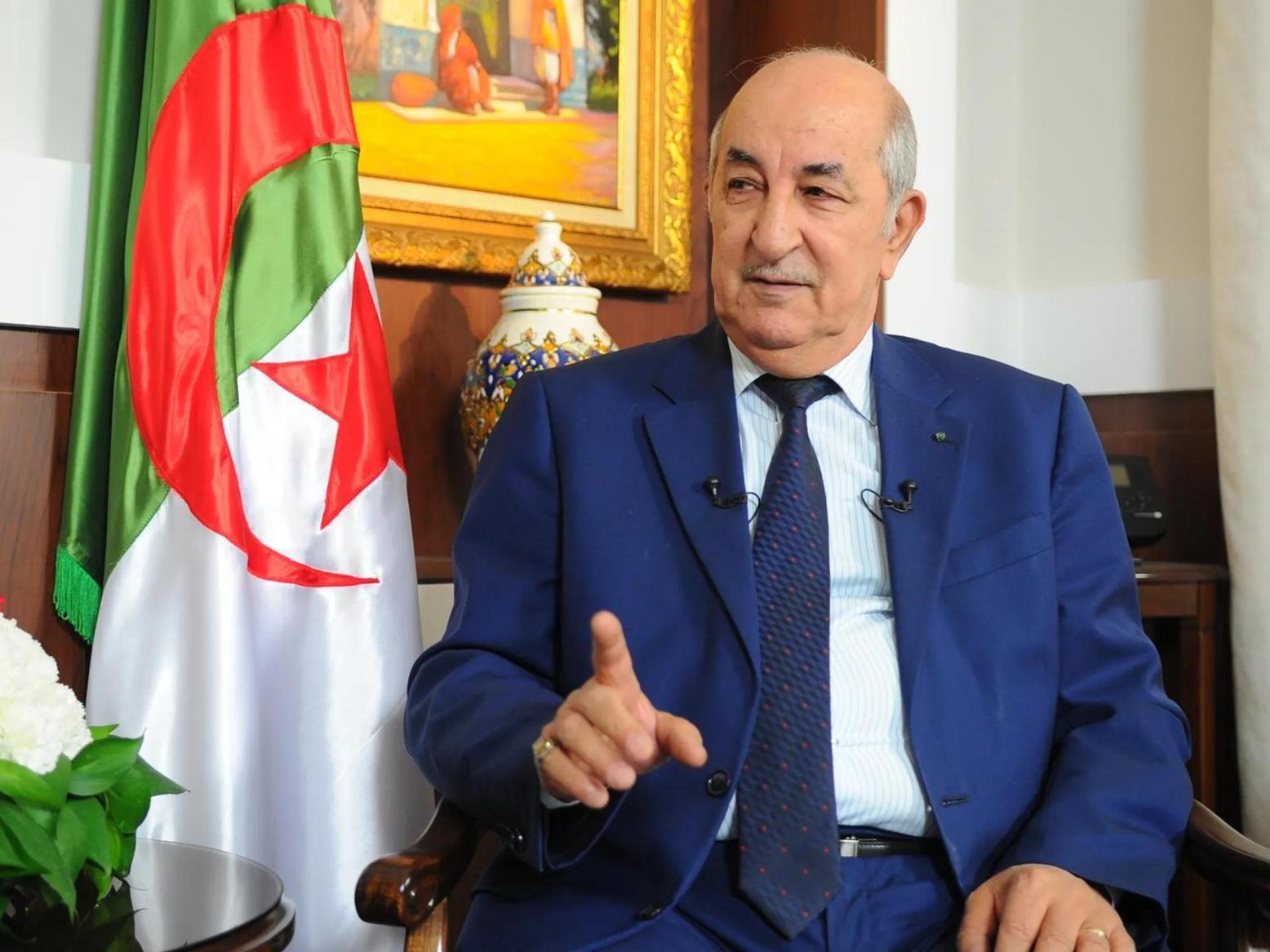
Africa-Press. Algerian President Abdelmadjid Tebboune revealed indirect communications between his country and Mali, which is experiencing a rise in coordinated attacks led by the Azawad Liberation Front and the Group for the Support of Islam and Muslims against the ruling military council.
In an interview with representatives of the national press, the Algerian president expressed his regret over the situation in Mali, urging the authorities in Bamako to engage in dialogue with the people, emphasizing the fraternal ties between Algeria and Mali.
Tebboune stated, “We knew that things would escalate because Mali entered a phase that would only lead to instability,” affirming that “the path of wisdom is dialogue, even if the transfer of power did not occur constitutionally, it can be given a constitutional character.”
The Algerian president pointed out that Algeria has not and will not interfere in the internal affairs of Mali or other countries, noting that the Algiers Agreement (2015) is a matter concerning Mali and not an Algerian issue.
Mali announced at the beginning of 2024 its withdrawal from the peace and reconciliation agreement signed between the Malian government and several Azawad movements in 2015, mediated by Algeria.
Tebboune continued, “Some are trying to portray this as Algeria’s interference in Mali’s internal affairs; no, these agreements came as a result of previous events. Each time there is a change in leadership in Mali, there is an attempt to solve the problem by force, but force does not solve problems.”
Despite the escalating tensions in Mali, the Algerian president affirmed that Malians always ultimately return to dialogue, especially with Algeria’s assistance.
He expressed his conviction in the Malians’ ability to overcome this situation, showing Algeria’s readiness to extend a helping hand if requested.
Earlier on Saturday, the Malian government confirmed its complete control over the capital Bamako and secured all its entrances, also announcing progress in the northern regions. The Malian government revealed the involvement of elements from the army in planning the recent armed attacks targeting vital sites.
These developments come a day after armed individuals set up checkpoints on several main roads leading to Bamako, coinciding with the control of Azawadi rebels over more important military points in the north of the country.
These updates follow days of coordinated attacks that resulted in the death of Defense Minister Sadio Camara and the fall of the city of Kidal into the hands of armed movements.