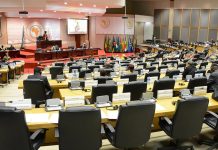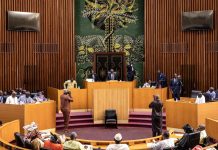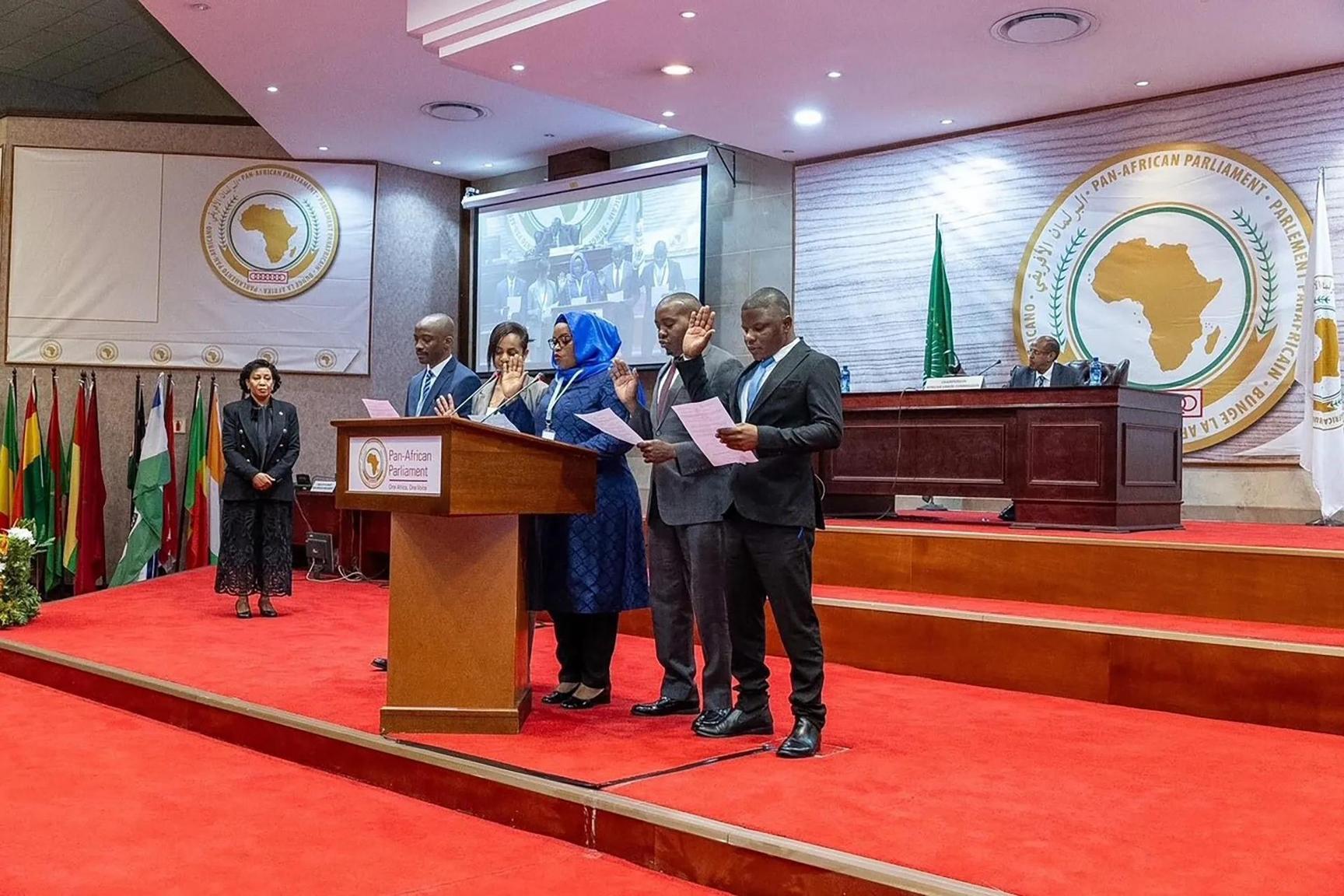
Africa-Press. The sessions of the Pan-African Parliament continue in Midrand, South Africa, on their second day as part of the extraordinary session dedicated to completing the organizational structures, electing a new bureau, and electing the president of the Pan-African Parliament, in accordance with the principle of geographical rotation. This time, the presidency will move to North Africa.
The sessions also discuss ways to enhance the parliamentary oversight role over the institutions of the African Union and review reports from the standing committees related to security, peace, and continental economic integration.
A new leadership for the parliament is expected to be elected tomorrow through a secret ballot, which will reflect the features of the upcoming phase in the journey of the Pan-African Parliament over the next three years.
The new president will succeed Fortune Charumbira, who led the parliament representing the southern region until February 2026 during a pivotal phase in which the parliament seeks to solidify its position within the Union and enhance its political presence.
Towards a New Phase
The head of the African Union Commission, Mahmoud Ali Youssef, stated in the opening session that the commission has a future institutional vision aimed at enabling the parliament to fully regain its role as one of the most important bodies of the Union.
Youssef acknowledged that the historical relationship between the commission and the parliament has not been smooth and anticipated the beginning of a new phase of cooperation, emphasizing the existence of genuine political will within the new commission to elevate the level of coordination with the parliament. He indicated that this improvement will fundamentally depend on the parliamentary leadership expected to be elected and the cooperation of the commission’s leadership with it.
Four names are leading the presidential race:
The Egyptian engineer Sherif El-Gabaly, head of the African Affairs Committee in the House of Representatives, known for his involvement in economic cooperation files.
The Algerian Fathi Boutbiq, an active figure within the Pan-African Parliament.
The Moroccan Lahcen Haddad, a former minister who held the tourism portfolio from 2013 to 2016 before continuing his parliamentary and diplomatic work.
The Libyan Youssef Al-Fakhri, officially supported by the Libyan House of Representatives in the context of his country’s efforts to regain its position within continental institutions.
The Pan-African Parliament consists of members elected from national parliaments, with five deputies from each country, ensuring at least one woman is included in each delegation to guarantee female representation in membership. However, this does not extend to leadership levels, as all presidential candidates are originally national deputies in their respective parliaments after meeting legal requirements and taking the oath.
The bureau of the Pan-African Parliament consists of a president and four deputies representing the five regions, with the region winning the presidency excluded from the vice-presidency position in the same session. The four deputies are chosen through consensus within their regions or through internal voting before being approved in the general session.
Regional Consensus Mechanisms
Despite the numerous candidates, the parliamentary rules limit the impact of public competition, as the North African region must present only one candidate to the general session. This matter is resolved within what is known as regional backrooms, where intensive consultations take place or internal voting is resorted to when consensus cannot be reached, making the backrooms the true stage for decision-making rather than the voting hall.
This mechanism will recall what happened in the 2024 elections when the southern region failed to agree on a unified candidate, leading to internal voting between candidates from Zimbabwe and Zambia, resulting in the selection of a Zimbabwean candidate who was later presented as the sole candidate and elected without actual competition. This model reflects a stable pattern where the general session becomes a station for approving results pre-formulated within the region.
Alongside regional coalitions, the women’s caucus emerges as a gathering of female deputies working to enhance women’s presence and push for expanding their representation in decision-making positions. However, its influence remains more political than legal, as it lacks the authority to impose female candidates or determine election outcomes.
Current indicators do not suggest an organized trend within the northern region to propose a female candidate for the presidency, and the electoral process does not adhere to any principle requiring a rotation between a man and a woman in the presidency or vice-presidency positions, as occurs in the elections for the president of the commission and his deputy and six commissioners. The governing criteria in the Pan-African Parliament elections remain based on regional balances and political agreements.
The Battle for the Presidency of the Pan-African Parliament
According to the nature of the elections within the Pan-African Parliament, the equation is not determined by the number of names proposed but by each candidate’s ability to secure the backrooms in the northern region, which is the regional bloc that holds the decisive word before reaching the voting session in Midrand.
The North African region within the African Union consists of seven countries and represents about 35 deputies (five deputies from each country) within the parliament, a number that creates the decisive equation within the region.
However, the most likely scenario so far does not indicate a quick consensus but rather complex negotiations among four main countries in the region: Egypt, Algeria, Morocco, and Libya, while the votes of the remaining countries will tip the balance in favor of the competitors.
According to observers, the key to victory does not lie in the general session of the parliament but in the ability to secure a majority within the 35 deputies in the northern region, then moving to the Pan-African Parliament, which makes the choice through secret ballot. Under these circumstances, the elections for the presidency of the Pan-African Parliament appear to be more than just a race between names; they are a test of the northern region’s ability to produce internal political consensus amid sharp polarizations and divisions.
Despite the intense competition among the Arab North African countries, it is certain that the presidency of the Pan-African Parliament will be Arab and will be held by an Arab parliamentarian, after Mahmoud Ali Youssef from the East African region took over the presidency of the African Union Commission, becoming the first Arab to hold the presidency of the African commission.
The Pan-African Parliament was established in 2004 as one of the bodies of the African Union, holding two regular sessions annually in addition to extraordinary sessions as needed, with its permanent headquarters in Midrand, South Africa, where the official voting process also takes place.