
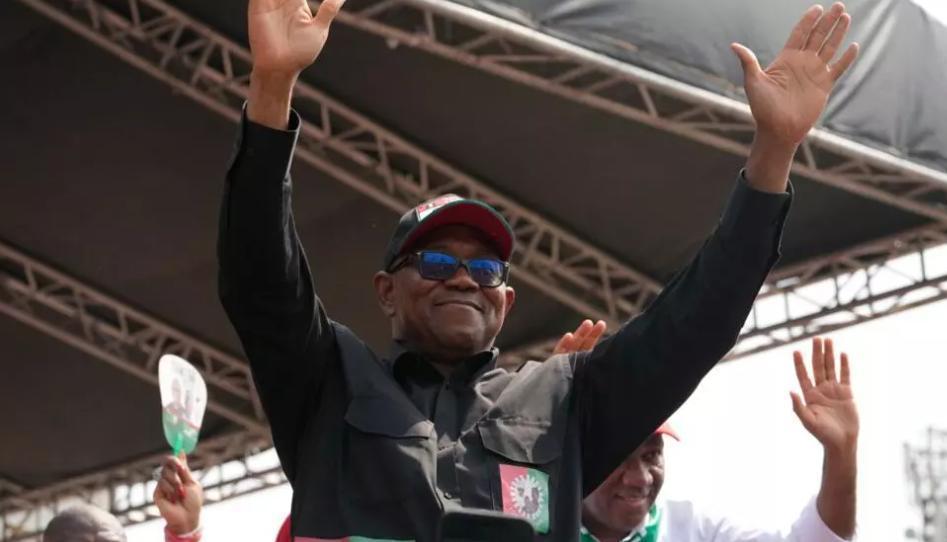
Africa-Press. Tensions and political violence have begun to surface early in Nigeria, coinciding with the start of the campaign for the general elections scheduled for January 2027, following an attack on the convoy of opposition figure Peter Obi by a group of youths in Benue State, southeastern Nigeria.
Peter Obi, who finished third in the presidential elections held in 2023, was prevented from reaching an internally displaced persons camp in Benue after dozens of youths blocked the road in front of his convoy, chanting slogans and issuing threats to the presidential candidate, according to circulating video footage of the incident.
Obi had arrived in Benue with the aim of visiting families who had been forced to flee their homes due to ongoing violence between herders and farmers. He was scheduled to head to the “Yelwata” area to meet with displaced persons residing in one of the camps there.
The visit holds particular significance given the scale of violence that has plagued the region in recent years, with over 200 people killed in a massacre that occurred in the “Yelwata” area in June 2025, resulting in the displacement of approximately 6,500 individuals from the area.
According to Nigerian observers, the incident reflects the tensions that have begun to surround the upcoming election campaign, especially with police confirming that they had to deploy security personnel to escort and protect Peter Obi after he found himself stranded on the road leading to “Yelwata,” which he intended to visit.
Following his inability to complete the visit, the Nigeria Democratic Conference (NDC) condemned what it described as a “shameful obstruction” of its candidate’s campaign, accusing the governor of Benue State, Hyacinth Alia, of orchestrating the events.
The governor, affiliated with the ruling All Progressives Congress (APC), categorically denied these accusations and rejected any involvement in preventing the opposition candidate’s visit. A spokesperson for the governor stated that Peter Obi should have informed local authorities in advance about the visit so that necessary security arrangements could be made to facilitate his reception and ensure his movements within the state.
The governor also criticized the NDC candidate for failing to “respect protocol,” asserting that the visit should have been coordinated in advance with local authorities and security agencies, especially given the security conditions in the state.
Meanwhile, Rabiu Kwankwaso, the candidate for the vice presidency alongside Peter Obi, stated that authorities must not forget that the Nigerian constitution guarantees citizens’ freedom of movement. Kwankwaso called on international observers and diplomatic missions present in Nigeria to “document” the incident, deeming it worthy of follow-up, while the NDC demanded an urgent investigation into the circumstances surrounding the event and the identification of those responsible.
The incident comes at a time when Nigeria is preparing for new general elections, amid fears that early political competition could escalate tensions, particularly in states already suffering from communal conflicts, violence, and population displacement.
After being prevented from completing his visit in Benue, Peter Obi left the state on Tuesday, heading to the neighboring Plateau State, where he visited other areas hosting thousands of internally displaced persons who had to flee their homes due to violence between local communities.