
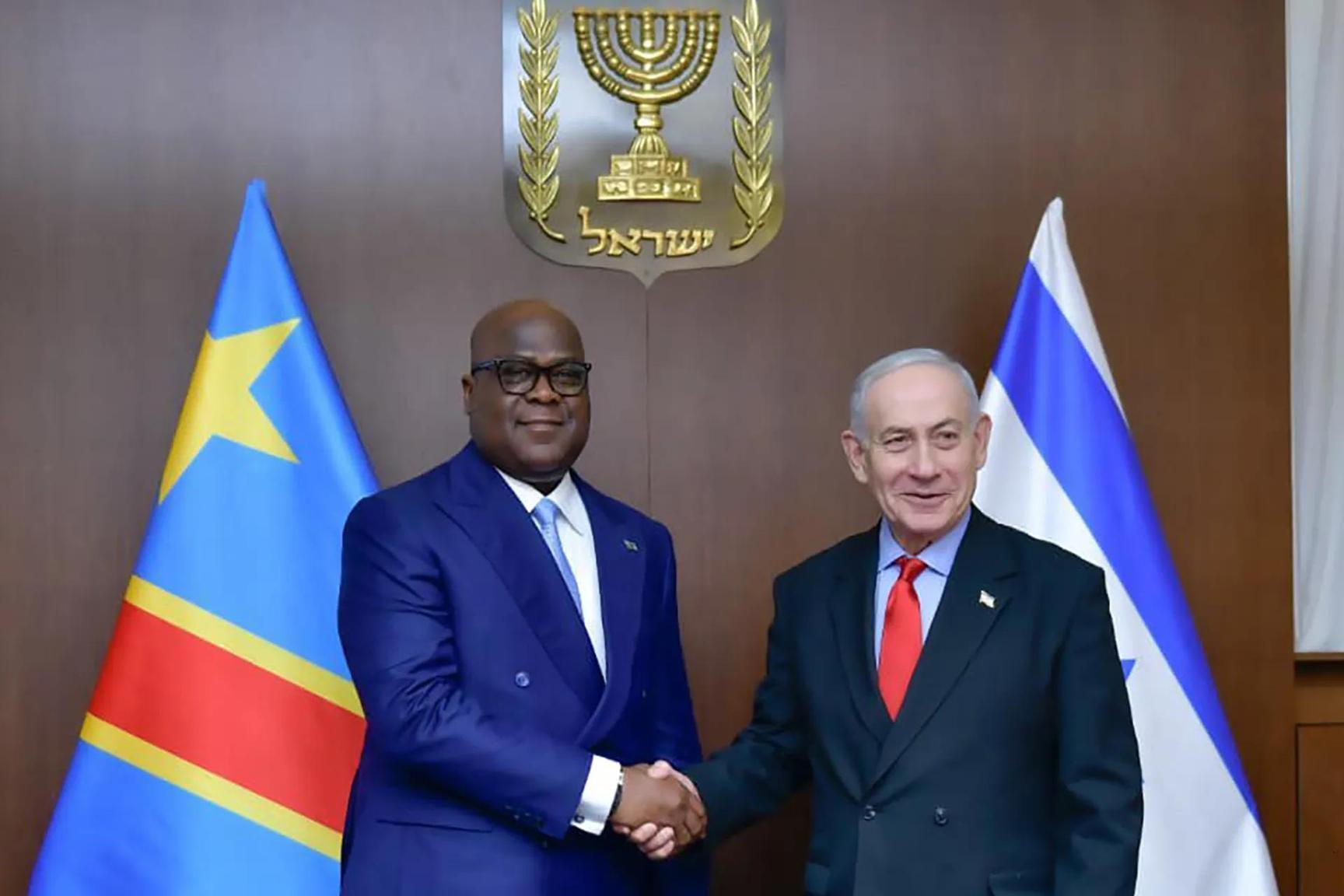
Africa-Press. “It is a great friendship,” with this phrase, Benjamin Netanyahu welcomed the internationally isolated Israeli Prime Minister, Felix Tshisekedi, the President of the Democratic Republic of the Congo, who arrived from one of the largest and richest African nations in terms of natural resources.
The African nation, with a population exceeding 100 million, holds vast wealth beneath its soil that has become the fuel for the new global economy, as it leads the world in cobalt production and is among the top copper producers. It also possesses significant reserves of lithium, coltan, gold, and other rare minerals, which are essential components in advanced technological and military industries, as well as in batteries and electric vehicles.
During the visit, Tshisekedi held meetings with Netanyahu and Israeli President Isaac Herzog, and both sides agreed to expand cooperation in security, defense, agriculture, energy, infrastructure, technology, and investment.
What Were the Key Issues Discussed During the Visit?
The discussions between the Congolese president and Israeli officials focused on enhancing bilateral cooperation in several vital sectors, including security and defense, agriculture and food security, water management, energy, infrastructure, technology and innovation, as well as training, investment, and deepening economic partnership.
The talks also addressed the security challenges facing both sides, as well as developments in regional and international situations and ways to expand the horizons of joint cooperation in various fields.
Tshisekedi emphasized that his country and Israel are linked by longstanding relations that Kinshasa seeks to elevate, noting that his discussions with Israeli President Isaac Herzog included issues of peace and security alongside regional and international matters.
The Congolese president stated that both sides renewed their commitment to adding a new dimension to bilateral cooperation, focusing on sectors such as agriculture, food security, water, health, technology and innovation, security, training, and investment. He affirmed that his country aims to build a modern, practical, and mutually beneficial partnership measured by tangible results and their impact on the interests of both peoples, not just by the number of signed agreements.
For his part, Herzog confirmed Israel’s readiness to support the Democratic Republic of the Congo in facing humanitarian and developmental challenges, emphasizing the importance Tel Aviv places on its relations with Kinshasa.
What Is the Importance of the Visit to Israel?
The visit of the Congolese president to Israel represents a step in the rapprochement between the two sides, which has begun to gain momentum in recent years. It also reflects Tel Aviv’s desire to enhance its presence in Africa by building partnerships with countries that hold political and economic weight.
The visit gains additional significance as it comes at a time when Israel faces increasing political pressure and isolation in many international forums due to the ongoing war in Gaza since October 7, 2023, prompting it to expand its network of alliances and partners within the continent to secure supportive international voices in international forums and the United Nations.
Moreover, Israel seeks to solidify its position in technological and military industries, making the Democratic Republic of the Congo one of the most strategically important arenas in the world due to its vast mineral wealth that is central to future industries.
Why Is Cobalt a Key Element in Strategic Calculations?
Estimates from the U.S. Geological Survey indicate that the Democratic Republic of the Congo produced about 230,000 tons of cobalt in 2025, accounting for approximately 73% of global production, solidifying its position as the dominant player in one of the most strategically important minerals in the modern global economy.
This reality has piqued Israel’s interest in strengthening its relations with the African nation and opening up to a broader partnership, given the increasing importance of cobalt as a fundamental material in modern military industries, as it is used in the production of high-efficiency lithium batteries used in drones, military communication systems, soldier-worn equipment, satellites, and electric or hybrid military vehicles.
Cobalt is also used in the production of super alloys capable of withstanding high temperatures and pressures, making it an essential element in fighter jet engines, large military aircraft, naval turbine systems, and some missile components. Alloys containing cobalt are also used in guidance systems, advanced electronic components, and defense-related space applications.
The Democratic Republic of the Congo also possesses significant reserves of copper, which is a crucial element in electricity networks, data centers, renewable energy infrastructure, and electric vehicle manufacturing.
What Does the Democratic Republic of the Congo Want from Israel?
The Democratic Republic of the Congo views Israel as a partner that can contribute to supporting its security and developmental priorities, especially as the country faces ongoing challenges, particularly in the east where armed groups have been active and conflict zones have persisted for years.
In this context, Kinshasa seeks to benefit from Israeli expertise in security and defense, including intelligence capabilities, security technology, surveillance systems, drones, border protection, as well as security and military training programs.
The Democratic Republic of the Congo also sees Israel as an advanced partner in several vital priority sectors, including modern agriculture, food security, water management, technology and innovation, startups, and the digital economy.
President Felix Tshisekedi reflected this direction by stating, “Our discussions confirmed our mutual commitment to giving a new dimension to cooperation between the Democratic Republic of the Congo and the State of Israel, particularly in the fields of agriculture, food security, water, health, technology and innovation, security, training, and investment.”
He added, “Our ambition is to build a modern, practical, and mutually beneficial partnership with Israel, measured not only by the agreements we sign but by their implementation and the results they achieve for our two peoples.”


