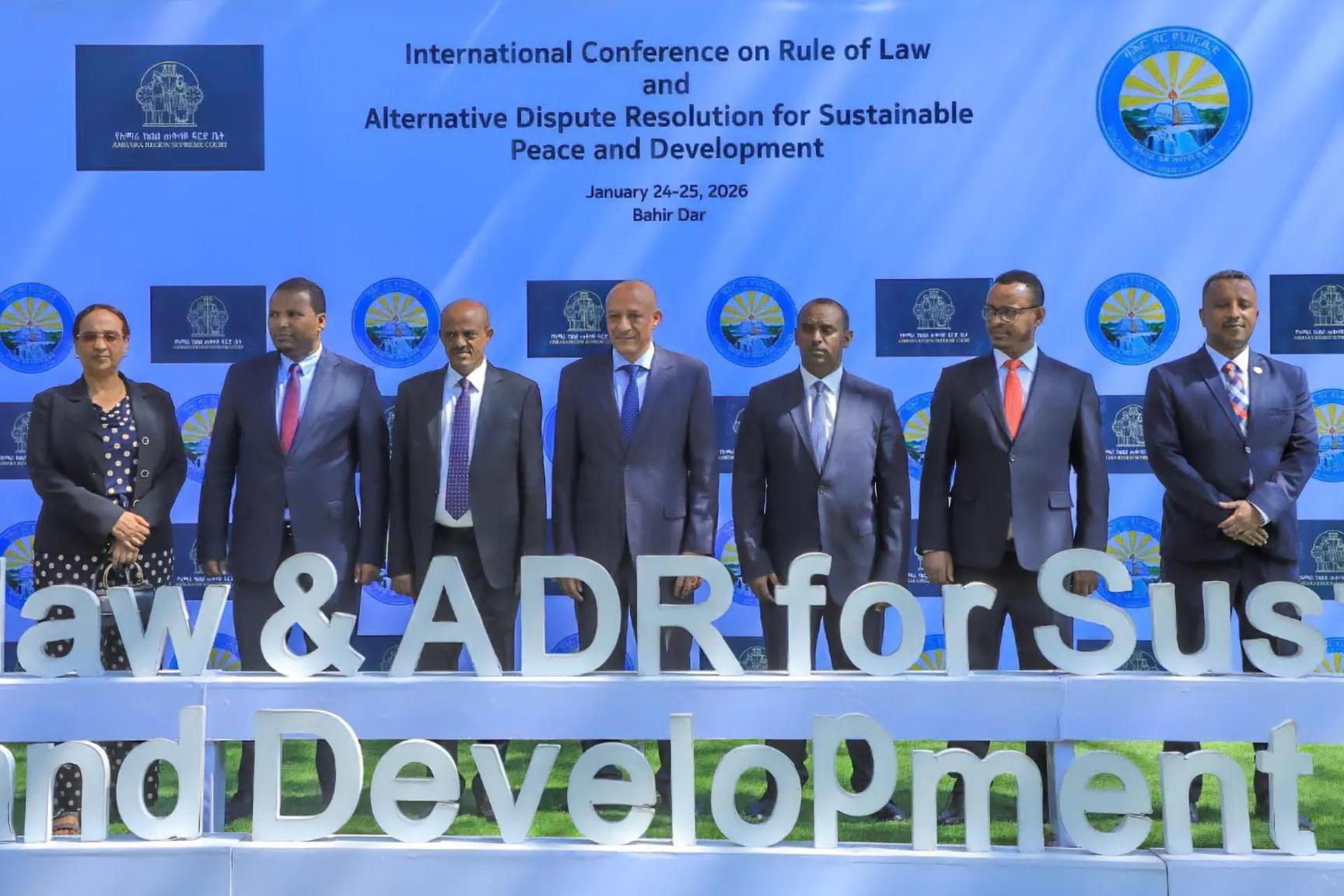
Africa-Press. An international conference on the rule of law and alternative dispute resolution mechanisms for peace and sustainable development was held in Bahir Dar, the capital of Ethiopia’s Amhara region, from January 24 to 25, 2026. Participants included Ethiopian Deputy Prime Minister Temesgen Tiruneh, AU Governance, Democracy and Human Rights Chair Salah Hamad, Ethiopian Minister of Peace Mohamed Idris, Amhara regional governor Arqa Kebede, and Supreme Court representative in Bahir Dar Alemante Agediu.
The conference was jointly organized by the Amhara Supreme Court and Bahir Dar University, attended by judges, academics, researchers, and policymakers from Ethiopia and abroad, as part of efforts to strengthen the rule of law, develop alternative dispute resolution mechanisms, and support pathways to peace and stability.
Deputy Prime Minister: Traditional Justice as a National Necessity
Deputy Prime Minister Temesgen Tiruneh emphasized that alternative dispute resolution mechanisms have become essential amid increasing pressure on the formal judiciary. He noted that Ethiopian communities have historically developed traditional justice systems that contributed to social cohesion and sustainable peace.
He added that integrating these mechanisms into the modern judicial system with legal and institutional recognition is no longer optional but a national necessity, noting that arbitration and traditional court laws adopted in Amhara represent a major step forward.
African Union: Rule of Law Must Be Close to Citizens
Salah Hamad stated that the African Union adopted a comprehensive transitional justice policy in 2019 to address the legacy of conflicts and human rights violations through truth-seeking, justice, reparations, institutional reform, and non-recurrence.
He stressed that the rule of law should not be confined to official institutions or legal elites but must be understood and shared by citizens, enabling their participation in its enforcement. Effective, transparent, accountable, and accessible judicial institutions are crucial to restoring trust in public institutions and supporting peace, stability, and development.
He noted that the AU supports integrating alternative and traditional dispute resolution mechanisms into formal frameworks, citing successful African experiences that prevented escalation of violence and resolved conflicts efficiently and affordably.
Dialogue is Essential; Armed Struggle Leads to Destruction
Minister of Peace Mohamed Idris stressed that accepting calls for peace and engaging in dialogue is now an urgent national necessity, warning that armed struggle only leads to destruction, displacement, and deprivation of basic services.
He highlighted that Ethiopia has over 75 traditional mechanisms rooted before the modern state, historically used for peaceful conflict resolution. He praised the Amhara Supreme Court’s initiative to provide these mechanisms with a structured institutional framework, enhancing community justice and fair grievance handling.
Idris also noted that the government has transformed its approach to peace by expanding political and media spaces, allowing previously banned parties and media to operate, and adopting national dialogue and transitional justice to address past violations.
Peaceful Solutions as a Strategic Choice
Amhara governor Arqa Kebede called on armed groups to commit to peaceful solutions and alternative dispute resolution, affirming the regional government’s commitment to resettling and reintegrating displaced persons and addressing root causes through dialogue and negotiation.
He emphasized that the traditional judiciary alone is insufficient to address growing conflicts and highlighted the importance of developing and adopting alternative dispute resolution mechanisms, reviewed at regional and international levels with Bahir Dar University’s participation.
He added that the regional government conducted a comprehensive judicial performance assessment last year, leading to reforms including judicial independence protection, new laws to guarantee judges’ rights, improved judicial facilities, and the implementation of electronic and remote litigation systems.
Judicial Reforms and Expanded Access to Justice
Alemante Agediu stated that judicial institution reform is a core part of the national reform program launched in 2018, including legal framework review and institutional performance improvements.
He explained that Amhara has 14 high courts and over 200 first-instance courts handling about one million cases annually, making reliance on alternative dispute resolution mechanisms essential to reduce court pressure.
He noted measures to facilitate access to justice, including public hearings, online complaint submission, court-led arbitration, and legislation allowing local traditional courts.