What You Need to Know
Fighting has intensified in eastern Democratic Republic of Congo following a peace agreement signed by U.S. President Donald Trump with Congolese and Rwandan leaders. Despite the agreement aimed at ending years of conflict, violence continues as rebel groups and government forces clash, leading to civilian casualties and displacement.
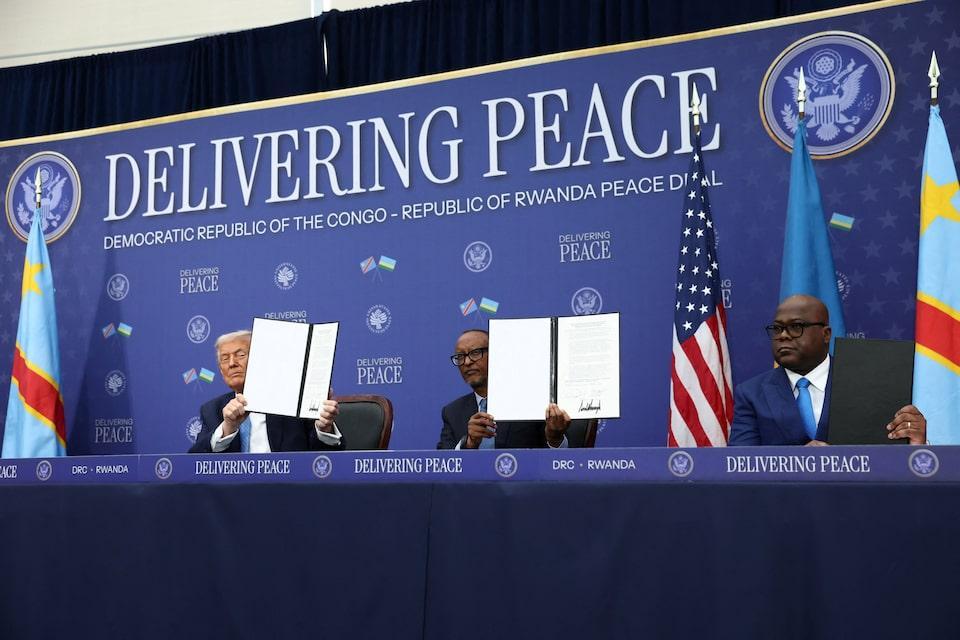
Africa. Fighting has intensified in eastern Democratic Republic of Congo, following a day after U.S. President Donald Trump hosted Congolese and Rwandan leaders in Washington to sign new agreements aimed at ending years of conflict in the mineral-rich region.
Congolese President Félix Tshisekedi and Rwandan President Paul Kagame reaffirmed their commitment to the U.S.-mediated agreement from June to stabilize the vast country and pave the way for increased Western investment in the mining sector.
Trump, whose administration has intervened in a series of conflicts worldwide to bolster his image as a peacemaker and promote U.S. business interests, stated, “We are resolving a war that has lasted for decades.” However, violent fighting on the ground continued, with the warring parties exchanging blame.
The Rwandan-backed rebel group, AFC/M23, which has controlled the two largest cities in eastern Congo this year, stated that it is not bound by the Washington agreement and that government-aligned forces are launching widespread attacks.
The M23 movement reported that bombs launched from Burundi for over three days hit villages in North and South Kivu, resulting in the deaths of women and children, injuring civilians, and destroying homes, schools, and health centers. Burundi, an ally of Congo, was accused of coordinating airstrikes using drones and heavy artillery.
Meanwhile, the Congolese army stated that it does not target civilians, but clashes continue, and Rwandan forces are executing strikes. It added that it neutralized an enemy drone that entered Congolese airspace from Bugarama in Rwanda, accusing M23 fighters of repeatedly violating the ceasefire.
The M23 movement reported 23 deaths and additional injuries, while a spokesperson for the Congolese army stated that 11 civilians were killed during the fighting. Analysts say U.S. diplomacy has halted the escalation of fighting in eastern Congo but has failed to address the underlying issues, as neither Congo nor Rwanda has fulfilled the commitments made in June.
Videos posted online showed dozens of displaced families fleeing on foot, carrying their belongings and livestock near the town of Luvungi in eastern Congo.
Lawrence Kanyuka, spokesperson for the Alliance of Forces for Change/March 23 Movement, wrote, “Many homes have been destroyed, and women and children have tragically lost their lives.” Congolese government-aligned forces continued their “ongoing attacks on densely populated areas in North and South Kivu, using fighter jets, drones, and heavy artillery,” he wrote on X.
A spokesperson for the Congolese army confirmed clashes along the Kaziba-Katogota-Rurambo axis in South Kivu province. Reagan Mbuyi Kalonji, the army spokesperson in South Kivu, stated that the Congolese army targeted fighters in the hills overlooking Kaziba and Rurambo only. He said, “There is population displacement in Luvungi due to shelling by Rwandan defense forces. They are shelling indiscriminately.”
A senior official in the Armed Forces Alliance/March 23 Movement stated that rebel forces have regained control of the city of Lubirizi and shot down a drone belonging to the Congolese army. He requested anonymity as he is not authorized to speak to the media, stating that the war continues regardless of the agreement signed in Washington.
The United Nations Office for the Coordination of Humanitarian Affairs reported that violent fighting since December 2 has led to deaths, injuries, and displacement among civilians. U.N. spokesperson Stéphane Dujarric stated that clashes and roadblocks have made evacuations impossible, preventing an unknown number of injured civilians from reaching medical facilities for treatment.
The United Nations Children’s Fund (UNICEF) expressed concern over clashes that occurred on December 3 and 4 in South Kivu, which affected three schools and another site near a school, resulting in the deaths of at least seven children and injuries to others, according to reports.
It added in its statement: “In 2025, fighting escalated to unprecedented levels in years, and children, as always, bear the brunt of the burden.”
The Democratic Republic of Congo has faced decades of conflict fueled by ethnic tensions, political instability, and competition for its vast mineral resources. The recent peace agreement, brokered by the U.S., aims to stabilize the region and attract foreign investment, but historical grievances and ongoing violence pose significant challenges to lasting peace.
In June, U.S. mediation efforts sought to address the root causes of the conflict, yet the implementation of the agreement remains fraught with difficulties. Rebel groups, particularly M23, have continued to assert their influence in eastern Congo, complicating the peace process and raising concerns about the humanitarian impact on