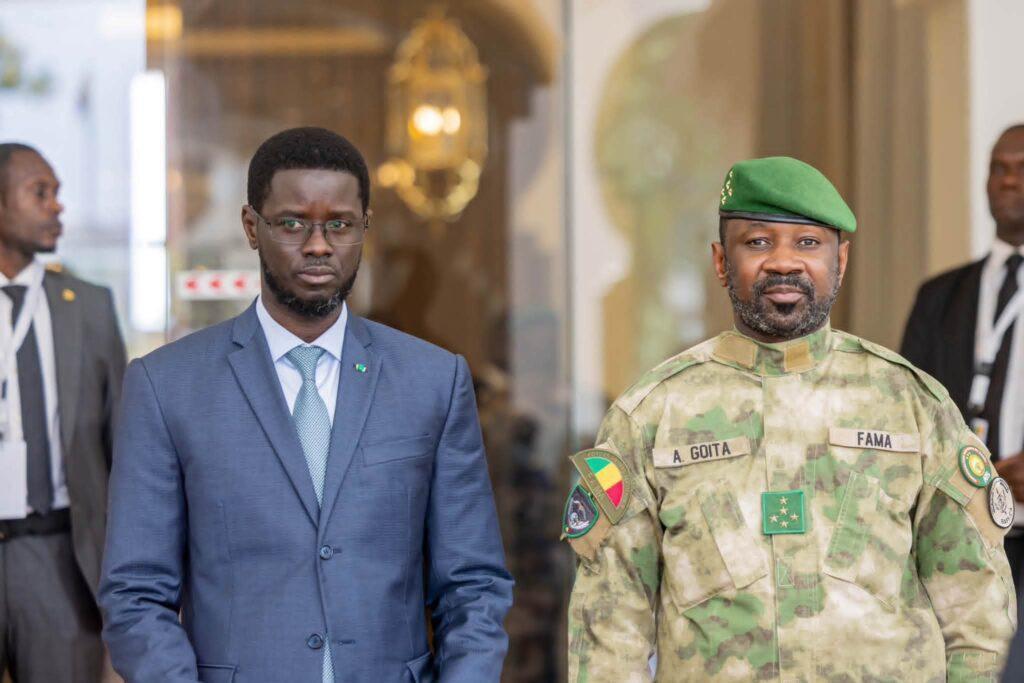
Africa-Press. The Senegalese President, Basyro Diomai Fay, confirmed his country’s readiness to provide full support to Mali in facing security challenges during an official visit to the capital, Bamako. This was his first move towards Mali since assuming the presidency of the Economic Community of West African States (ECOWAS), although he did not mention the organization in his statements.
During the visit, which lasted less than five hours, Fay held discussions with Mali’s transitional president, General Assimi Goita. The talks primarily focused on issues of peace and security and ways to enhance counter-terrorism efforts in the region amid rising threats from cross-border armed groups.
In the joint closing statement, in which General Goita did not make any remarks, the Senegalese president emphasized that security threats “do not recognize borders and are exacerbated by divisions,” reaffirming Senegal’s commitment to stand by Mali in confronting these shared challenges, including at the regional level, without referencing “ECOWAS.”
The visit is particularly significant as it came less than ten days after Fay took over the presidency of “ECOWAS,” at a time when Mali, Niger, and Burkina Faso remain outside the organization following their official withdrawal in January 2025, after announcing the decision a year prior.
The Senegalese president called for strengthening cooperation between Dakar and Bamako, both bilaterally and through “regional bodies to which Mali and Senegal belong.” This phrasing was seen by observers as a practical exclusion of any reference to “ECOWAS,” reflecting the ongoing gap between the organization and the Sahel coalition countries.
Despite Fay’s efforts over the past two years, as well as initiatives led by the African Union to rebuild communication channels between “ECOWAS” and the Sahel coalition countries, these initiatives have yet to yield any significant breakthroughs, and no official response has been issued by Mali, Niger, or Burkina Faso to these calls.
The Senegalese president urged the activation of other regional organizations, particularly the West African Economic and Monetary Union (UEMOA) and the Senegal River Basin Development Organization (OMVS), calling for summits of heads of state as soon as possible to enhance economic and monetary cooperation and improve coordination in managing shared water resources.
Fay reiterated that Mali “can rely on steadfast support from Senegal” to face shared challenges amid deteriorating security conditions along the border between the two countries.
The border areas between Senegal and Mali have seen an increase in activity from the “Support for Islam and Muslims” group linked to Al-Qaeda, which has carried out repeated attacks targeting commercial convoys and supply routes in recent months, resulting in the deaths of several Senegalese truck drivers within Malian territory. The group has also imposed restrictions on the entry of fuel shipments from Senegal into Mali.
Although the frequency of attacks on convoys has decreased in recent weeks, the security situation remains a direct threat to trade between the two countries, which is a fundamental pillar of Mali’s economy. The Malian market accounts for about a quarter of Senegal’s exports, making the stability of bilateral relations and security cooperation between the two countries a strategic priority for both parties.