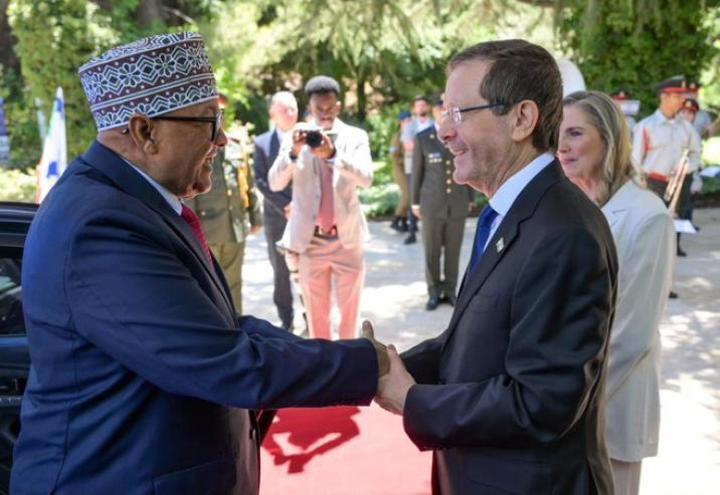
Africa-Press. In a move that sparked widespread criticism from Arab and African nations, the leader of Somaliland, Abdirahman Mohamed Abdullahi, arrived in the occupied Palestinian territories on Sunday for an official visit, marking the first of its kind, in preparation for the opening of an embassy in occupied Jerusalem. This development reflects a shift in relations between the two sides from unannounced communications to an open political and security partnership.
The visit comes amid a rapid rapprochement between Somaliland and Israel, following Israel’s announcement in December 2025 of official recognition of the region as an “independent state,” a step that has drawn objections from Arab, African, and international entities, amid warnings about its implications for the unity of Somalia and the stability of the Horn of Africa.
A “Historic” Visit or Israeli Repositioning?
Israel described the visit as “historic,” representing a turning point in bilateral relations, as the leader of Somaliland met with Israeli President Isaac Herzog in a session focused on expanding political, security, and economic coordination.
During the meeting, Herzog called for a transition from “theoretical positions” to “direct practical coordination,” referring to what he termed the common challenges faced by both sides, primarily combating extremism, ensuring stability in the Horn of Africa, and protecting maritime shipping routes in the Red Sea and the Gulf of Aden.
These statements indicate that the relationship between the two parties extends beyond the diplomatic dimension, encompassing broader strategic and security aspects, especially given the increasing geopolitical importance of the Horn of Africa, which overlooks one of the world’s most significant maritime corridors.
The second day of the visit is expected to witness the official opening of Somaliland’s embassy in occupied Jerusalem, a symbolic and political step that carries implications beyond the bilateral framework, representing mutual practical recognition between the two parties and solidifying diplomatic presence in a city that the international community refuses to recognize as the capital of Israel.
For his part, the leader of Somaliland considered the visit a “pivotal turning point” in the region’s diplomatic trajectory, noting that his authorities have sought international recognition and broader integration into the international system for over 35 years.
He added that the region values what he described as Israel’s role in supporting these efforts, expressing hope for expanded political, economic, and security cooperation.
The Horn of Africa in Israeli Calculations
Observers believe that Israel’s openness towards Somaliland goes beyond the issue of diplomatic recognition, linking it to strategic calculations in the Horn of Africa, which has become a site of increasing regional and international competition.
The region’s location overlooking the Gulf of Aden and near the Bab el-Mandeb Strait grants it special geopolitical significance, as a large percentage of global trade and international energy supplies pass through this area.
Analysts believe that strengthening relations with Somaliland could provide Israel with an additional foothold near the Red Sea, as part of its efforts to expand its security and intelligence influence in the region, particularly amid tensions related to maritime navigation and rising competition among regional powers.
This step is also viewed as an attempt to build new alliances in Africa, following a decline in some regional normalization pathways and the increasing need for Israel to find new partners in maritime and security spheres.
Arab and Islamic Rejection and Warnings Against Undermining Stability
In contrast, the move has faced widespread condemnation, with 19 Islamic countries issuing a joint statement denouncing the region’s intention to open a “so-called embassy” in occupied Jerusalem, considering it a “flagrant violation” of international law and international legitimacy regarding the status of the holy city.
The rapprochement between Somaliland and Israel has also drawn sharp criticism from the Somali government, which asserts that the region is an integral part of its territory, viewing any external recognition as a direct violation of national sovereignty and a threat to the country’s unity.
Mogadishu has repeatedly warned that external interventions in the region’s affairs could lead to further instability in an area already facing security threats related to armed movements and political crises.
Roots of the Somaliland Issue
The Somaliland issue dates back to 1960 when the region, then under British colonial rule, gained short-lived independence before entering a political union with Somalia, which was under Italian administration.
However, political and economic tensions between the north and south of the country gradually escalated, particularly with accusations from northern elites of marginalization and exclusion, culminating in armed confrontations in the late 1980s during the rule of former President Mohamed Siad Barre.
After the collapse of the central state in Somalia in 1991, the Somali National Movement declared the region’s unilateral secession under the name “Republic of Somaliland,” and since then, its authorities have managed its affairs separately, despite the lack of official international recognition.
Although Somaliland has succeeded in establishing relatively stable administrative and security institutions compared to other areas of Somalia, the international community has remained committed to the principle of Somali territorial unity, making Israel’s recent recognition an exceptional development that could open the door to new political dynamics in the Horn of Africa.
Amid these transformations, the visit of the leader of Somaliland to the occupied Palestinian territories appears to be more than just a diplomatic step, reflecting a mutual attempt to redraw the balance of influence in the Red Sea and the Horn of Africa, amid fears that this rapprochement could deepen regional divisions and open the door to new conflicts over sovereignty and international recognition.