What You Need to Know
Ethiopia and Turkey have engaged in discussions aimed at supporting Ethiopia’s quest for maritime access through peaceful means. During Turkish President Erdogan’s visit to Addis Ababa, both nations signed agreements in the fields of economy and energy, emphasizing the importance of regional cooperation and stability in the Horn of Africa.
Africa-Press. Ethiopia and Turkey discussed ways to support Addis Ababa in obtaining maritime access through peaceful means during President Erdogan’s visit to Ethiopia.
Ethiopian Prime Minister Abiy Ahmed stated that he discussed with the Turkish president ways to support his country in achieving maritime access peacefully, emphasizing that Ethiopia would not remain landlocked due to hostile conspiracies, as he put it.
Erdogan remarked that the crises in the Horn of Africa should be resolved by the countries in the region and not turned into an arena for international conflict.
During a joint conference with Abiy Ahmed in Addis Ababa, Erdogan rejected any unilateral recognition of Somaliland.
Joint Agreements
In a related development, Ankara and Addis Ababa signed two agreements in the fields of economy and energy during the Turkish president’s visit to Ethiopia.
The Turkish Ministry of Energy confirmed that Ankara and Addis Ababa signed a memorandum of understanding regarding cooperation in the energy sector, adding that the agreement would lead to joint production and projects.
It clarified that the agreement stipulates that the two countries will implement projects in renewable energy and energy efficiency, and they will cooperate in producing and installing equipment for hydroelectric power stations and electrical turbines.
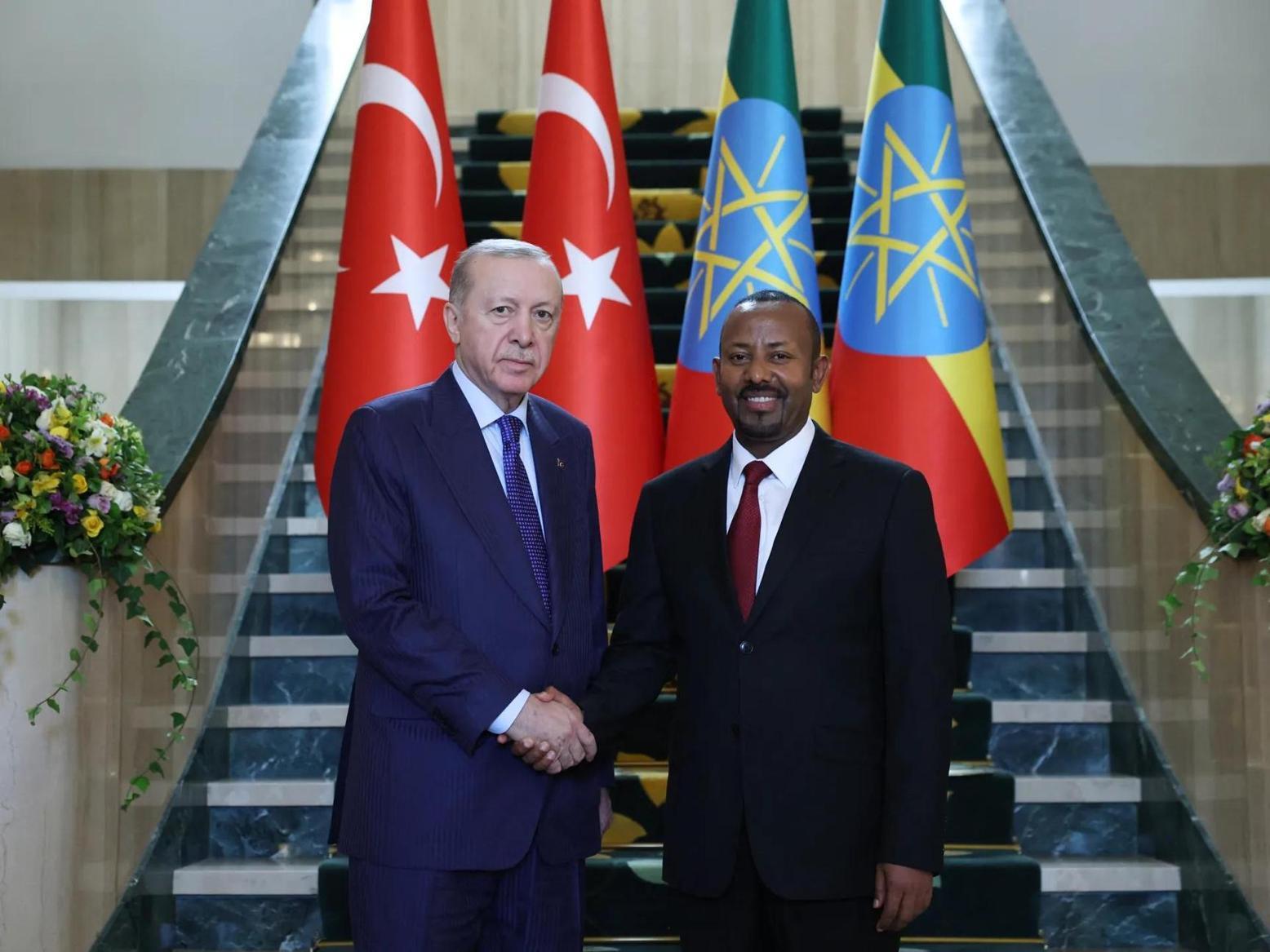
Erdogan visited Addis Ababa for one day at the invitation of Prime Minister Abiy Ahmed, marking his first visit to Ethiopia in 11 years.
The two sides signed the agreement at a ceremony held after talks between the presidents.
Turkish Energy Minister Alparslan Bayraktar stated that the agreement would serve as a roadmap for enhancing cooperation.
Earlier on Tuesday, the Ethiopian Prime Minister welcomed the Turkish president with official ceremonies in the capital, Addis Ababa. After their meeting, Presidents Erdogan and Abiy Ahmed held a joint press conference.
Addis Ababa and Ankara share close ties, with expanding trade and investment cooperation between the two countries, an increasing Turkish presence in construction and industry projects, as well as enhanced diplomatic and military coordination.
In 2024, Ankara contributed to resolving the dispute between Ethiopia and Somalia regarding Addis Ababa’s plan to build a port in the Somaliland region.
With investments nearing $2.5 billion in Ethiopia by 2025, Turkey is the second-largest foreign investor in the country after China. While this visit by the Turkish president comes at a time of renewed tensions between Ethiopia and Eritrea, it raises the question: is Abiy Ahmed, by inviting Erdogan to Addis Ababa, once again seeking to bolster his military arsenal with Turkish equipment, as Ethiopia did when it acquired Turkish drones during the Tigray War in 2021?
Independent researcher Isaias Bamlak Bishaw, an expert on Turkish-Ethiopian relations, responded: “Since the Tigray War, the Turkish government has consistently supplied the Ethiopian government with personnel and drone equipment. While there is currently a conflict in Oromia, in the Amhara region, as well as another latent conflict with Tigray forces, it is clear that the Ethiopian government is trying to acquire weapons from Turkey.”
In a bid to enhance its influence in the region, Turkey sent the deep-sea oil exploration vessel “Cagri Bek” to Somalia last Sunday, a mission described by Bayraktar as Ankara’s first maritime exploration mission outside its maritime jurisdiction.
Ethiopia has long sought access to the sea, a goal complicated by regional tensions and historical conflicts. The Horn of Africa has been a focal point for geopolitical interests, with various nations vying for influence. Turkey’s increasing involvement in Ethiopia reflects its broader strategy to enhance its presence in Africa, particularly in sectors like energy and infrastructure.