
Africa-Press. Scientists have discovered ancient “ripple-like structures” preserved in Jurassic rocks in Morocco, revealing that they formed in deep waters beyond the reach of sunlight. These findings indicate that the structures were not produced by photosynthetic microbes, but by microorganisms deriving energy from chemical reactions, reshaping how researchers interpret signs of ancient life in the geological record.
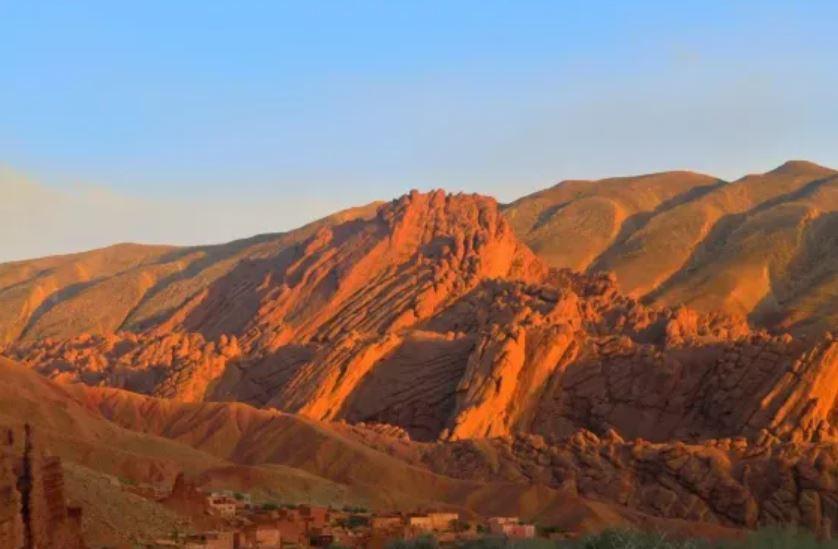
The geological discovery, made in the Central High Atlas Mountains, allowed researchers to identify unusual ripple patterns preserved in Lower Jurassic rocks, according to a recent study published in the scientific journal Geology.
The structures were found in the Tagoudite Formation near the village of Boumdour. The rocks contain small ridges and grooves, ranging from a few millimeters to several centimeters in size. What surprised scientists is that these ripples formed at depths of around 200 meters, in an environment devoid of sunlight.
Because of this depth, researchers concluded that the structures could not have been formed by photosynthetic microbial communities, but rather by chemotrophic microbes that rely on chemical energy instead of sunlight. The study notes that “given their ancient depth (~200 m), it is unlikely that they were formed by phototrophic communities.”
The rocks date back approximately 182 million years to the Early Jurassic period. During that time, heavy rainfall increased the flow of sediments and organic matter into deeper marine environments, where they were deposited by underwater currents known as turbidites.
To confirm the biological origin of the ripples, scientists conducted detailed microscopic and geochemical analyses, detecting elevated concentrations of carbon directly beneath the ripple surfaces—strong evidence of ancient microbial life.
Although the shapes of these ripples resemble those found in older rocks and shallow marine settings, their depth of formation and chemical signature tell a different story. Researchers suggest that the microbes fed on chemical compounds released during the breakdown of organic matter in sediments, particularly sulfur-based compounds.
Typically, microbial mats are destroyed by animals before they can be preserved. In this case, however, toxic chemicals produced during decomposition likely deterred animals, allowing the structures to harden and become part of the rock record.
This discovery is considered especially significant because it shows that ripple structures are not necessarily indicators of shallow, sunlit environments, as previously thought, but can also form in deep, dark waters. Researchers describe this as a “previously overlooked mode of preservation,” opening new avenues for the study of ancient life.