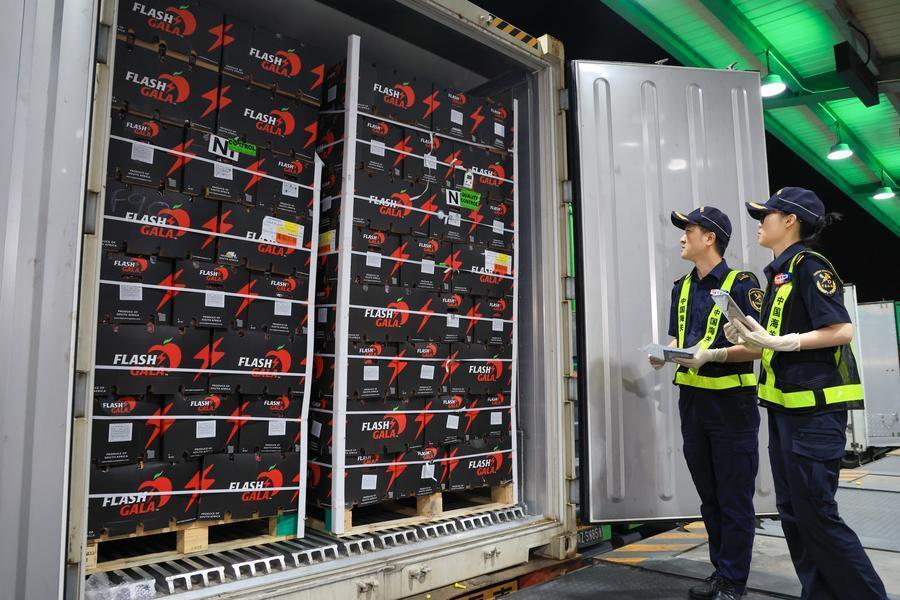
Africa-Press. In the early hours of Friday, 24 tons of South African apples became the first shipment to enter China under the “Zero Tariff” initiative, following Beijing’s expansion of its tariff exemption policy to include all African countries with which it has diplomatic relations.
This move comes after the Chinese president announced in February the provision of a comprehensive “Zero Tariff” exemption for African countries that maintain diplomatic ties with China. This decision took effect on Friday, May 1, 2026.
The zero tariffs apply to all African countries except Eswatini, which has diplomatic relations with Taiwan.
For the shipment of South African apples, tariffs were reduced from 10% to zero, giving it an immediate competitive advantage in one of the world’s largest consumer markets.
China had already begun implementing a tariff exemption policy for least developed countries with which it has diplomatic relations, including 33 African nations, starting December 1, 2024.
The expansion of the “Zero Tariff” policy represents a new step aimed at supporting trade and investment cooperation between China and Africa, and enhancing development pathways on the continent.
The shipment of South African apples entering the Chinese market duty-free is more than just a trade deal. It reflects the beginning of a new phase that could reshape economic relations between China and Africa.
However, the success of this phase of the “Zero Tariff” initiative will depend on the ability of African countries to seize the available opportunities. This requires improving the business environment, enhancing infrastructure, and developing production capacities.
China will continue to push for negotiations and the signing of joint economic partnership agreements, and will work to expand access for African exports to the Chinese market through developed mechanisms such as the “Green Corridor.”
In this context, initiatives like the “Green Corridor” play a crucial role, aiming to expedite customs clearance procedures and facilitate the entry of agricultural products into China.
This initiative has already contributed to the entry of several African products into the Chinese market in recent years.
In addition to agriculture, manufacturing represents a promising area to benefit from this policy. Despite having significant natural resources, Africa still contributes a limited share to global manufacturing, reflecting a clear gap in value addition.
The tariff exemption could encourage African countries to expand local manufacturing instead of exporting raw materials, particularly in sectors such as textiles, leather, and metals.
It may also help attract new investments, especially from Chinese companies seeking low-cost production opportunities.
However, achieving this transformation requires substantial investments in infrastructure, technology, and education, factors that trade policies alone cannot compensate for.
The new transformation lies in generalizing the exemption to almost all African countries, removing discrimination among them and creating a more equitable trade environment in terms of tariffs. However, it simultaneously opens the door to increased competition among African economies themselves.
The shipment of South African apples under the “Zero Tariff” initiative cannot be separated from a broader context of transformations in China-Africa relations.
Over the past two decades, China has become Africa’s largest trading partner, with trade volume between the two sides reaching approximately $348 billion in 2025, marking a growth of 17.7% compared to the previous year.
However, these figures simultaneously reveal a structural imbalance, as Chinese exports dominate the scene, amounting to $225 billion, while African imports total only about $123 billion.
This trade deficit has faced increasing criticism, as it reflects Africa’s continued reliance on exporting raw materials and importing manufactured goods.
Thus, the tariff exemption is viewed as an attempt to address this imbalance by improving the opportunities for African products to access the Chinese market.
This policy is not a sudden development but an extension of a path that began in 2005 when China granted tariff exemptions to least developed African countries, numbering around 33.
However, that policy had limited impact due to challenges related to infrastructure, high transportation costs, and difficulties in meeting the required technical standards for export.
The “Zero Tariff” initiative comes at a time when global trade is facing tensions, with rising protectionist policies and increased tariffs in several regions. In this context, the Chinese market provides an important opportunity for African countries to boost their exports and diversify their economies.
Data indicates that China’s imports from least developed African countries have already increased by 15.2% during the initial months of implementing partial exemptions, reaching over $21 billion.
The agricultural sector is one of the main beneficiaries, accounting for about one-third of Africa’s gross domestic product and providing jobs for nearly half of the population.
The tariff exemption is expected to open broader horizons for African agricultural products, which previously faced difficulties in accessing global markets.
Despite the optimism surrounding the Zero Tariff initiative, concerns arise that this policy may deepen the gap between African countries. More advanced nations, such as South Africa, Morocco, and Kenya, have better infrastructure and higher production capacities, making them more prepared to benefit from the opening of the Chinese market.
Conversely, less developed countries may find themselves in a more vulnerable position after losing the preferential advantage they enjoyed under the previous system. Additionally, weak transport and energy networks, along with difficulties in complying with standards, may limit their export capabilities.
One proposed scenario involves developing cross-border supply chains within Africa, distributing production stages among countries according to their relative advantages. This approach could enhance the continent’s collective competitiveness, especially with an open Chinese market.
It also aligns with the goals of the African Continental Free Trade Area, which seeks to enhance intra-African trade and reduce reliance on external markets.
These developments come at a time when Africa faces a significant demographic challenge, with its population expected to reach 2.2 billion by 2054.
This growth represents a significant opportunity if properly invested, but initiatives like “Zero Tariff” could become a burden in the absence of sufficient job opportunities.
Estimates indicate that the continent needs to create about 15 million jobs annually, while the number of available jobs remains far lower. In this context, increasing exports and investments can support economic growth, but this requires integrated policies that go beyond tariff exemptions.
By applying the tariff exemption to almost all African countries, China has succeeded in removing one aspect of discrimination in its previous policy. Previously, some countries enjoyed special export advantages, prompting investors to localize production there. However, this model has not always been effective due to the challenges faced by least developed countries, such as weak infrastructure and power outages.
Today, with the generalization of the exemption, production decisions may shift to benefit from regional supply chains rather than relying on tariff differentials. This could provide greater opportunities for economic integration within the continent and enhance intra-African trade.
China has also announced the expansion of trade facilitation measures, including the development of “green corridors” to expedite customs clearance and simplify health procedures. A specialized center for facilitating trade between China and Africa has also been established in Changsha, aimed at supporting companies and enhancing trade cooperation.
In this context, the African Union welcomed the Chinese step, with the Chairperson of the African Union Commission expressing support for the decision through his diplomatic representative. The ambassador confirmed that the tariff exemption represents an important step towards enhancing the mutually beneficial partnership between Africa and China.