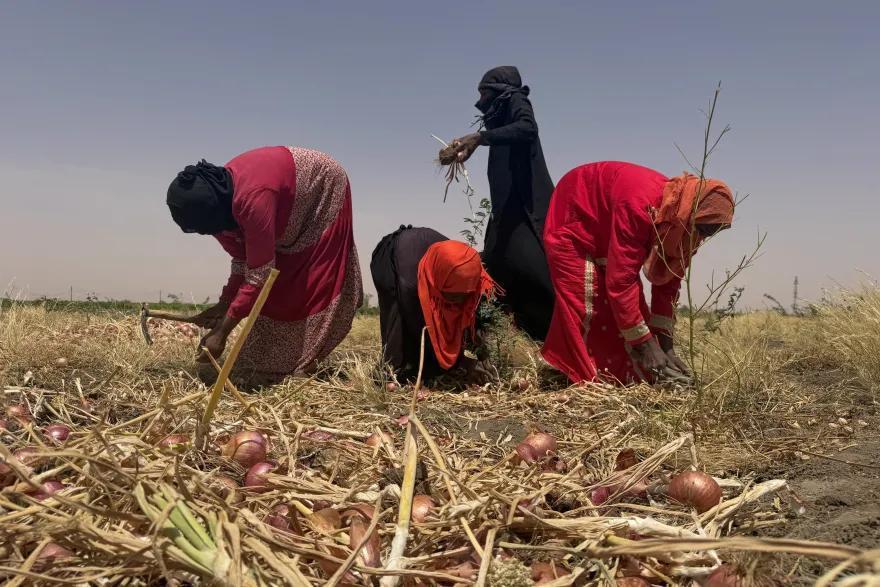
Africa-Press. Farmers in Sudan have stated that rising fuel and fertilizer prices worldwide, due to the American-Israeli war on Iran, will force them to reduce the areas cultivated this summer, limiting food production in a country already suffering from severe famine due to civil war.
Eight farmers from various regions in Sudan and sector experts reported that the increase in fuel and fertilizer prices will exacerbate the problems caused by the civil war, affecting essential local crops such as sorghum and millet, as well as exports like sesame.
Data from a local source indicated that Sudan is particularly vulnerable to the repercussions of the Iranian crisis, as it relies on Gulf countries for more than half of its fertilizer needs. Additionally, the war between the Sudanese army and the Rapid Support Forces has made it entirely dependent on fuel imports.
Sudan is also among the countries that will be most affected by a looming global food crisis as aid budgets shrink. A global hunger observatory supported by a local source reported that approximately 19.5 million people, or more than 40 percent of the population, are facing crisis levels of hunger, with some areas at risk of famine.
The agricultural potential of Sudan has attracted the interest of Gulf investors, but the sector has suffered from mismanagement and war for decades. About two-thirds of the population relies on agriculture for their livelihood.
Sadiq Amin, a senior food security analyst working for a local source in Sudan, stated that the regional war has “made matters worse,” warning that overall production could decrease by “at least 40 percent.”
A local source reported this month that the continuation of this shock threatens to exacerbate hunger “beyond the current food crisis.”
War Prices
More than three years into the war in Sudan, the army controls the central and eastern regions of the country, while the Rapid Support Forces have strengthened their control over Darfur in the west. Both sides are fighting for control of the vast Kordofan region between them, which is crucial for agriculture.
For farmers in the Jomouiya project in South Omdurman, the farming season was supposed to be promising after the expulsion of the Rapid Support Forces, accused of damaging irrigation channels and water pumps in the area near the capital Khartoum last year.
National surveys revealed that farmers are now facing a 67 percent increase in fertilizer prices compared to last year, and fuel prices, including diesel used in irrigation pumps, have more than doubled.
Farmer Bashir Ismail stated that they are not making any profits at this price because they spend all their earnings on diesel.
Omar Al-Obeid, secretary of the farmers’ committee for the project, mentioned that only 500 acres of a total of 10,000 acres have been cultivated as the middle of the farming season approaches.
Lack of Support
Farmers are also complaining that the army-aligned government, which has cut its budget in favor of the war effort, has not assisted them.
Mohamed Bella, head of the farmers’ association in the Gezira project, which used to produce about half of Sudan’s sorghum and wheat crop before the war, said, “The Rapid Support Forces left in February last year. Nothing has been repaired since then.”
Crop prices have remained stable despite the rising costs of fuel and fertilizers.
A local source stated that Sudan’s grain production, which has already decreased by a quarter from pre-war averages, is declining further.
Bella added, “Two bags of wheat are enough to buy one bag of urea. Therefore, we will not plant it again.”
The Sudanese Agricultural Bank is supposed to assist farmers in financing, but it has been affected by the conflict like the rest of the financial sector. Bella and others stated that the bank has set agricultural input prices too high and product prices too low, forcing farmers to borrow.
The bank’s president stated that he will work to “ease the burden” on Sudanese farmers by providing inputs on better terms and for longer periods.
Fatima Youssef, director of agricultural production at the Ministry of Agriculture, stated that the ministry has agreed with the bank to establish a new fund to finance as much as possible.
She added that the ministry is exploring ways to support farmers regarding fuel costs and is working on rehabilitating irrigation channels after repairing pumps in several locations.
Theft of Machinery
The continued absence of law in Kordofan and Darfur threatens the production of sesame, peanuts, gum arabic, and millet.
Mohamed Adam, a farmer who fled from West Kordofan to the army-controlled city of Al-Obeid in North Kordofan, said, “There is no funding for farmers, no machinery to plant and till the land, and no security because the Rapid Support Forces and other gangs are stealing crops and demanding money at every checkpoint.”
The spokesperson for the Rapid Support Forces did not respond to a request for comment. The Rapid Support Forces have previously denied targeting civilians and civilian infrastructure.
Three farmers from the area stated that tractors were looted in raids, farm workers were recruited to fight, and entire communities were displaced, meaning that only a very few plots of land have been prepared for the upcoming season.
Khaled Abdel Latif, a manager at CTC Group, one of the largest agricultural supply companies in Sudan, stated that sending supplies to those areas is costly and risky, and small farmers who grow for subsistence are facing difficulties.