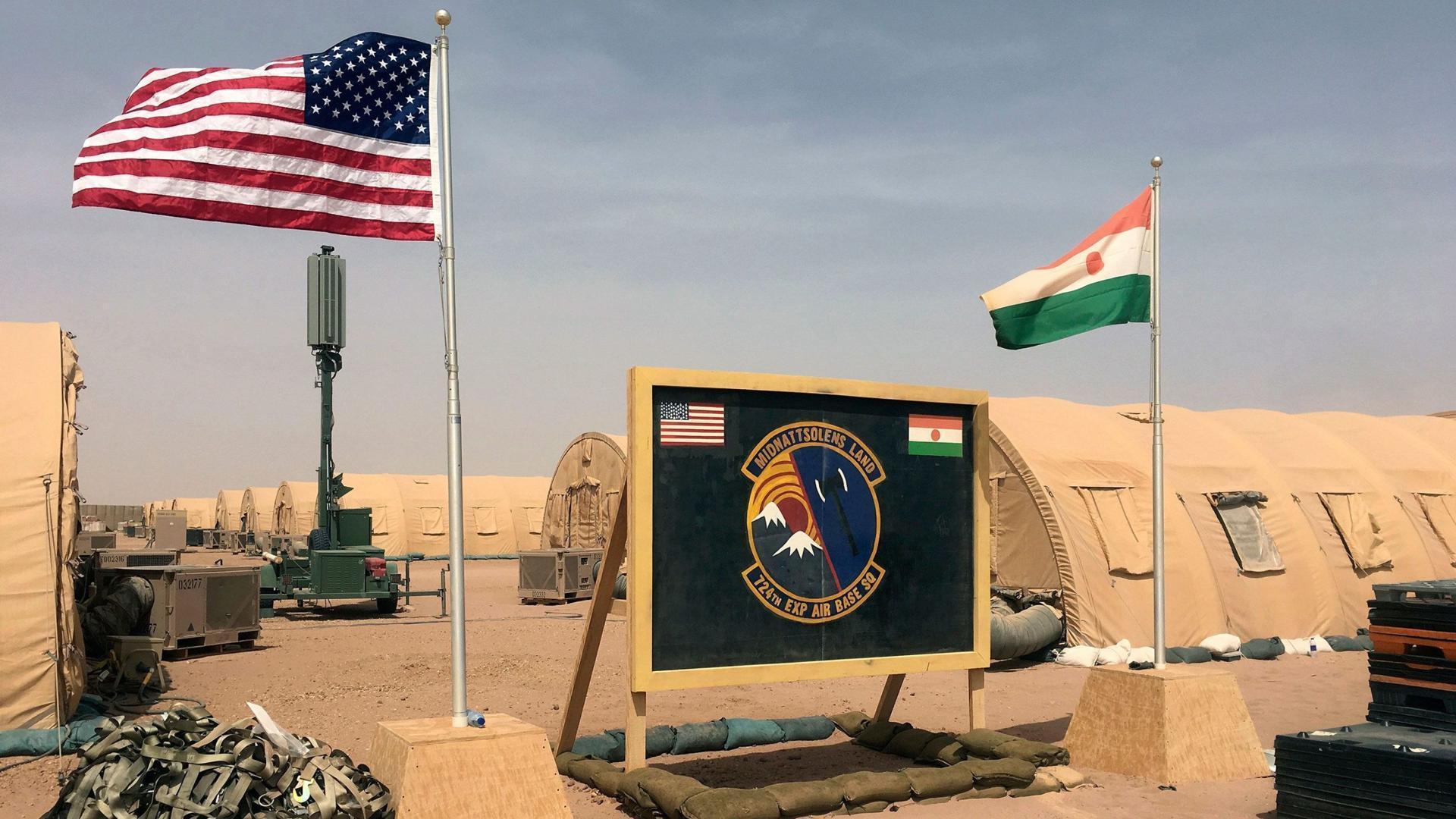
Africa-Press. The United States has reopened a new window for security cooperation with Niger by delivering military equipment worth $2.3 million. This move comes less than two years after the withdrawal of U.S. forces from the country and the closure of military bases, at a time when the Sahel region is witnessing a reshaping of security alliances and an increase in threats related to cross-border armed groups.
The U.S. embassy in Niamey announced that the military shipment was delivered to the Nigerien armed forces and included nine containers of military equipment and logistical supplies intended to support security operations.
The shipment included military uniforms, protective gear, medical supplies, and rescue equipment. The embassy confirmed that the assistance is part of the ongoing security cooperation between the two countries.
The U.S. embassy stated that this assistance reflects the shared interests between Washington and Niamey in combating terrorism, addressing criminal networks, ransom kidnappings, and enhancing border security.
This announcement comes at a time when the Sahel region is facing complex security conditions, with continued activity from armed groups linked to Al-Qaeda and ISIS in several border areas between West African countries.
According to the U.S. embassy, the value of the provided equipment is approximately $2.3 million, equivalent to more than 1.2 billion West African francs.
The shipment was delivered to the logistics services center of the Nigerien armed forces as part of security coordination arrangements between the two sides.
The embassy clarified that the equipment is intended to support field operations conducted by Nigerien forces against armed groups and active criminal networks within the country and along border areas.
It also confirmed that the assistance is part of efforts to enhance the operational capabilities of the armed forces in facing increasing security challenges.
This step comes after a period of tension in relations between the United States and Niger since the military coup that occurred in July 2023.
The political change in Niamey has led to a redefinition of Niger’s relations with its international partners, including the United States and France.
During this period, the new authorities moved towards reviewing existing security and military agreements with Western powers.
The country has also witnessed significant shifts in its foreign and security policies, paralleling similar trends in Mali and Burkina Faso.
Despite this deterioration in relations, both parties have maintained limited communication channels on several security issues of mutual interest.
The U.S. military presence in Niger has been one of the key pillars of the American strategy in the Sahel region for over a decade.
During those years, U.S. forces participated in training Nigerien troops and provided support for counter-terrorism operations carried out by governments and regional partners against armed groups, allowing the U.S. to expand its military influence in the Sahel region.
However, this presence officially ended in 2024 following an agreement between Washington and Niamey on the withdrawal of U.S. forces from the country.
The process included the withdrawal of troops and equipment from Air Base 101 in the capital Niamey in July 2024, followed by the withdrawal from Air Base 201 in Agadez (northern Niger) in August of the same year.
The coordination team from the U.S. Africa Command, which included officers and military support personnel, also departed.
Air Base 201 in Agadez was one of the most prominent American military facilities in Africa, costing around $100 million to establish, and housed nearly 1,000 American soldiers.
The base was used to operate drones and monitor the movements of armed groups spread across the Sahel, playing a pivotal role in intelligence gathering and espionage in West and Central Africa.
With the completion of the U.S. withdrawal, the base was closed, and military activities associated with it were terminated.
Developments in Niger coincided with significant political and security transformations within the Sahel region; Niger, Mali, and Burkina Faso established a Sahel alliance after withdrawing from the Economic Community of West African States (ECOWAS).
The three countries accused the regional organization and Western powers of interfering in their internal affairs and failing to provide effective solutions to the security challenges they face.
Currently, the three countries are led by military councils that came to power through successive coups in recent years.
The alliance has become a new framework for political and security coordination among these countries in facing common challenges.
Additionally, the Sahel region has witnessed an expansion of relations between the alliance countries and Russia in recent years.
In Mali, Russian elements participated in security operations conducted against armed groups following the withdrawal of French forces.
Burkina Faso has also strengthened its military and political cooperation with Moscow through a series of agreements and reciprocal visits.
As for Niger, it has taken similar steps following the 2023 coup, including ending the French military presence and then the U.S. military presence.
Sahel governments present Russia as a security partner that provides military support without conditions related to political reforms, governance issues, or economic influence.
Despite the decline in formal security cooperation, the United States revealed in recent months that communication channels with the armed forces of Sahel countries remain open.
General John Brennan, deputy commander of U.S. Africa Command, previously stated that Washington is still in contact with several military partners in the region.
He explained that the United States has shared specific intelligence information in some cases that helped target terrorist elements and groups.
He added that communication has continued with some armies in the Sahel within a limited operational scope.
He noted that the exchange of information does not mean the restoration of previous military partnerships but is limited to files related to counter-terrorism.
According to U.S. statements, current cooperation focuses on the exchange of specific and limited intelligence information regarding the movements of armed groups.
Niger, Mali, and Burkina Faso have faced repeated attacks for years by armed groups linked to ISIS and Al-Qaeda, supported by Western security agencies.
These attacks have resulted in thousands of deaths and the displacement of millions of people within the region.
Recent months have seen an escalation of violence along the shared borders between Niger, Benin, and Nigeria, with Niger accusing France of destabilizing the Sahel region following its declining influence.
Authorities in Sahel countries are seeking to enhance their military and security capabilities to confront these increasing threats.
The delivery of military equipment came about two months after a visit by a senior U.S. official to Niamey.
This visit marked the first public indication of improved communications between the two sides since the period of tension that followed the military coup.
It was also preceded by other U.S. steps reflecting a trend towards maintaining communication channels with Sahel governments.
In February, Washington lifted sanctions imposed on three senior officials in Mali due to their ties to the Russian Wagner Group.
This step was seen as an indication of adopting a more flexible approach in dealing with countries in the region.