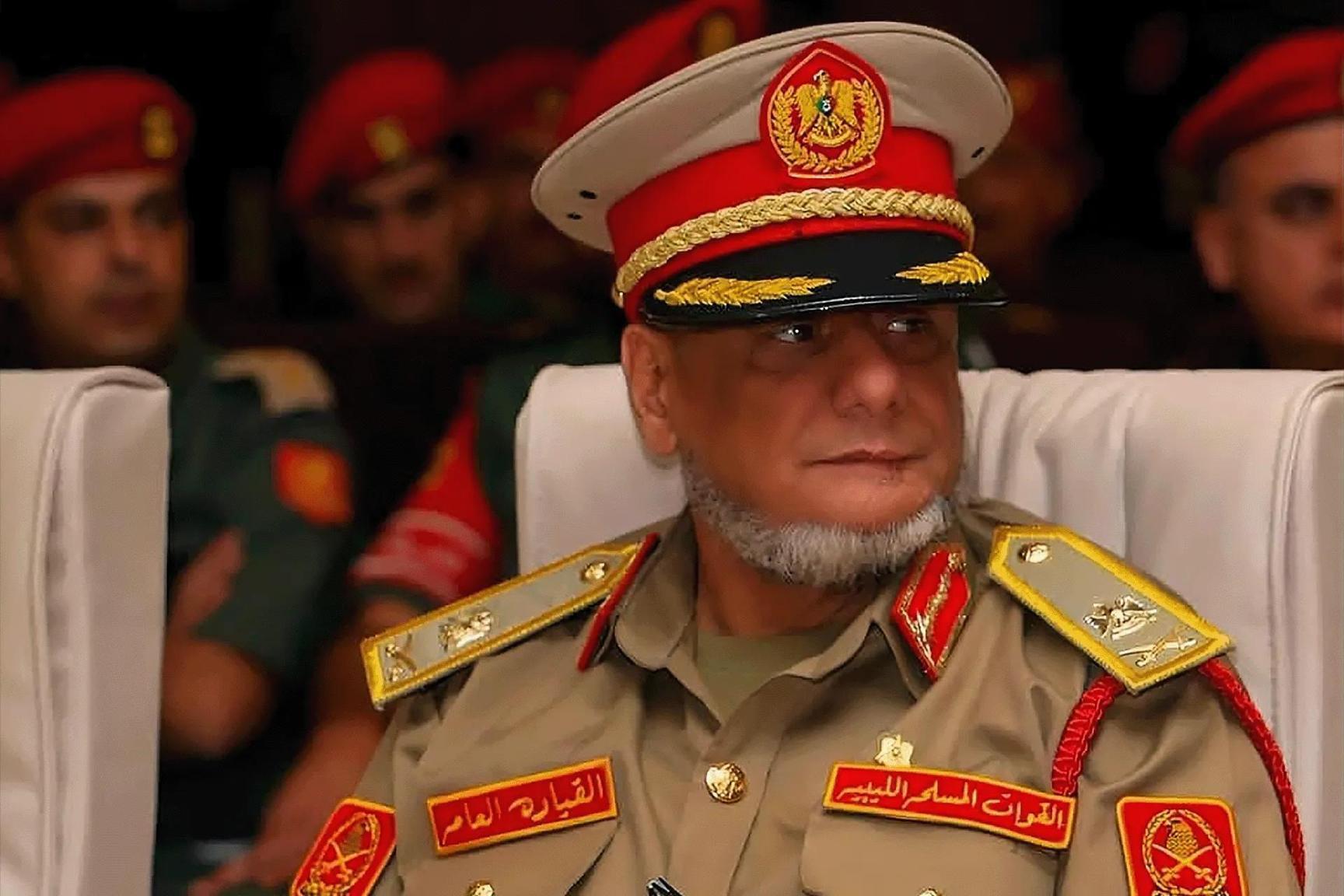
Africa-Press. The killing of Fawzi Al-Mansouri on the evening of August 10 in Benghazi was not merely an incident added to the record of assassinations and conflicts that Libya has experienced in recent years. The man who led the Sebha military region for years before taking over the military intelligence in eastern Libya had worked in one of the most sensitive areas of the country, where the Libyan borders intersect with Chad and Sudan, and where networks for smuggling, migration, fuel, arms, and fighters operate across the desert.
Thus, the assassination gains a dimension that transcends his personal case, especially since southern Libya has become, in recent years, part of the logistical environment for the war in Sudan, which has turned into a regional conflict involving intertwined supply lines, alliances, and economic and security interests.
However, this does not mean that Al-Mansouri was necessarily part of these networks or that his assassination was carried out due to his previous role in the south. There is still no independent public evidence proving a direct link between him and the networks transporting arms or fuel to the Rapid Support Forces. Therefore, the more precise question is not: Was Al-Mansouri assassinated because of the war in Sudan? But rather: Does the timing of his assassination with the conflict over supply routes and influence in southern Libya warrant an investigation into this possibility?
Southern Libya: A Back Front for the War in Sudan
International data over the past years reveal that southern Libya is no longer just a remote border area; it has turned into a strategic knot in the movement network between Libya, Chad, and Sudan.
UN reports indicate the use of routes through southern Libya, particularly the Kufra region, for transporting fuel, vehicles, and equipment, with networks involving armed groups and entities linked to human trafficking and smuggling of goods and fighters. Other reports have tracked routes extending from southeastern Libya towards the Chadian and Sudanese borders, confirming that the area has become part of a cross-border supply system.
These routes gain particular importance due to their geographical nature. The Libyan borders with Chad and Sudan stretch across vast desert areas that are difficult to subject to permanent central oversight, allowing for the emergence of alternative routes and unofficial paths away from traditional crossings.
In June 2026, Sudanese accusations before the Security Council highlighted routes starting from ports and airports in eastern Libya and extending overland through Kufra towards Sudan. Although these accusations include disputed political claims regarding supporting entities, they underscore the importance of Libyan territory in the logistical calculations of the Sudanese war.
From Sebha to Intelligence
Al-Mansouri’s significance in this context lies in his military career.
He emerged in the ranks of Khalifa Haftar’s forces from the early years of Operation Karama, later taking on leadership positions in various military fronts, before reaching the command of the Sebha military region in 2021.
Sebha was, for the military institution in eastern Libya, more than just a military area; it was the gateway to the south and one of the most important keys to controlling routes extending towards Chad and Sudan.
During his time in Sebha, the file of the southern border, smuggling, and movement across the desert was among the issues within the security environment that any military leader in the region would handle. His appointment as head of military intelligence in May 2024 raised the sensitivity of his position, as he transitioned from leading a geographical area to a role associated with gathering information and monitoring security and military files.
Here arises one of the most intriguing points in the case of his assassination: Did Al-Mansouri bring with him to the intelligence management accumulated knowledge of the actors and interest networks active in the south?
There is no confirmed answer yet, but the nature of his career makes this question legitimate, especially given the rising value of information related to desert routes, crossing points, and military movements.
The Sudan War Redefines Geographical Value
The Sudanese war is no longer confined within Sudan’s borders.
As the fighting extends, Darfur and the Libya-Chad-Sudan triangle have become strategic areas in the equation of war. Recent reports indicate that the Rapid Support Forces have maintained supply networks linked to border areas, while the Sudanese army has attempted to target supply sites and lines along the borders with Libya and Chad. In March 2026, reports spoke of strikes targeting supply sites belonging to the Rapid Support Forces near the border, indicating that supply lines have themselves become part of the battlefield.
International assessments have concluded that the Rapid Support Forces’ control over large parts of Darfur has enhanced the importance of communication routes with Libya and Chad, while the movement of arms, fuel, and fighters across the region has become a fundamental factor in the continuation of the war.
Thus, controlling the desert road is sometimes as important as controlling a city; because the road means the ability to bring in fuel, ammunition, vehicles, and personnel, or to prevent the opponent from obtaining them.
Assassination or Internal Purge?
Nevertheless, the hypothesis linking Al-Mansouri’s assassination to the war in Sudan is one of several hypotheses.
The manner in which the operation was carried out, according to the circulating data, could also align with the pattern of assassinations and intelligence conflicts that have characterized Benghazi and eastern Libya at various stages.
The motive may be related to an internal struggle for influence within the military institution, or competition among power centers, or sensitive information that the man possessed due to his previous and current position.
Another possibility is that the operation is linked to a rearrangement of power balances around issues of the south, borders, resources, and informal trade routes. In this case, it is not necessary for Al-Mansouri to be a direct party in any smuggling network; his knowledge of the file or his security position may have been sufficient to make him a target in a larger conflict.
This is an important point, as the elimination of a security official does not necessarily mean that the person was managing a specific network. In irregular conflicts, the information possessed by the official may become more valuable than the actions they take.
Why Now?
The timing is one of the most intriguing elements of the case.
The assassination of a senior security official in eastern Libya comes at a time when the southern borders are receiving increased attention due to the Sudanese war, changing supply routes, tightening oversight on certain paths, and the emergence of new routes linking southeastern Libya with Chad and Sudan. Analyses based on satellite images have indicated ongoing activity on new or unofficial routes in the area during late 2025 and early 2026.
At the same time, other data indicate that arms and mercenary networks in Libya, Chad, and Sudan have become more interconnected, so that political borders no longer necessarily reflect the actual boundaries of armed networks’ activity.
Therefore, any change in the leadership of a security or intelligence apparatus responsible for monitoring these files could have implications that extend beyond Libya’s interior.
A Link in a Larger Network?
If investigations later prove a connection between Al-Mansouri and the supply files heading to Sudan, then his assassination will acquire a completely different dimension, possibly indicating an attempt to target an informational or security link within a complex regional network.
However, even in this case, his assassination would not necessarily mean the collapse of those networks; networks operating across the desert typically do not rely on a single individual, but rather on a group of intermediaries, armed groups, routes, logistical centers, and financial ties.
If investigations prove that the operation was the result of an internal struggle in eastern Libya, then its connection to the war in Sudan would merely be a geographical and political coincidence, nothing more.
Here lies the importance of an independent investigation: to determine who planned the operation, the nature of the information Al-Mansouri was monitoring before his death, the files he possessed, the communications he made in the days prior, and who benefited from his absence.
A Question Larger than the Assassination of One Person
The case of Al-Mansouri sheds light on a broader reality: the war in Sudan has redefined the strategic value of southern Libya.
The area, long viewed as a remote desert margin far from decision-making centers, has now become a meeting point between the Sudanese war, smuggling networks, mercenary movements, fuel trade, and regional influence.
Thus, the assassination of a military official who had spent years leading one of the most important gateways to the south cannot be separated from this security environment when formulating questions, even if it is still too early to provide definitive answers.
What is certain is that the war in Sudan is no longer fought solely in Khartoum and Darfur. Its extensions reach into Chad, Libya, and desert corridors, where an abandoned road, a remote base, or a small transport network can influence the balance of power of an army or militia hundreds of kilometers away.
From this perspective, the question posed by Al-Mansouri’s death is not only about who killed him, but also about what he knew, who could be harmed by his knowledge, and whether the battle over supply routes in the desert has begun to shift from targeting convoys to targeting those who know the map of these routes and their networks.