
Africa-Press. The war in Sudan is entering a new phase, marked by shifting dynamics on the ground alongside an increasing escalation in drone warfare. The Sudanese army continues to bolster its positions across several fronts, particularly in North Kordofan, while the Rapid Support Forces attempt to offset ground pressures by expanding aerial attacks targeting cities and vital sites.
The city of Al-Obeid, the capital of North Kordofan, stands at the center of this transformation, serving as a key military and logistical hub in the heart of the country, where the struggle for routes and supplies intersects with the broader battle for control over Kordofan.
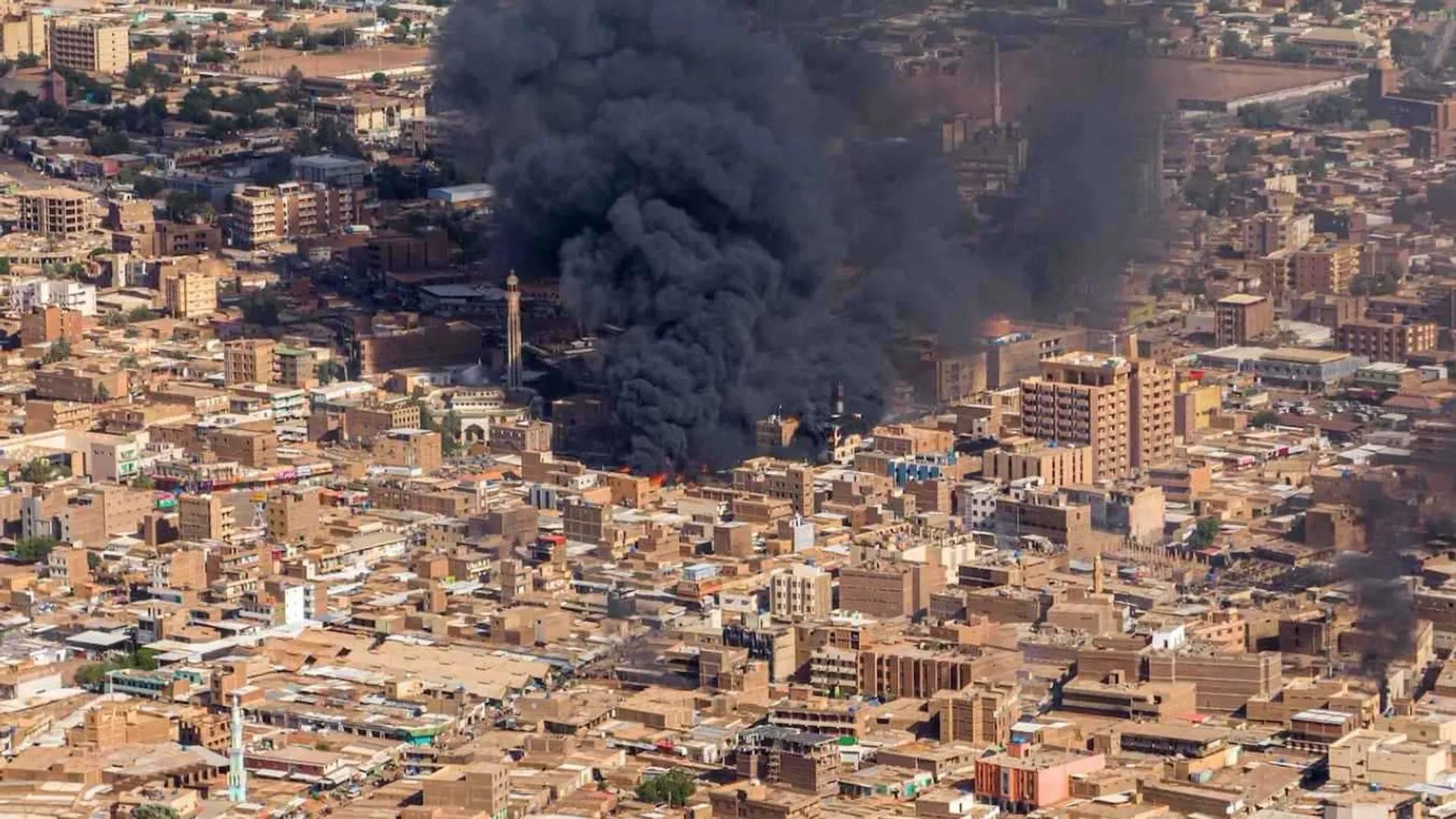
On Wednesday, Al-Obeid experienced a drone attack, which military sources attributed to the Rapid Support Forces. Ground defenses managed to shoot down several drones before they reached their targets.
The crash of one drone into a civilian facility in the large market area caused significant material damage, while medical sources reported the deaths of two civilians and injuries to six others.
This attack followed days of targeting vital installations in the city, including facilities related to electricity, fuel, and water, indicating that military pressure is not only aimed at forces on the front lines but also extends to the infrastructure that the city relies on for daily life.
Al-Obeid: More than a Regional Capital
Al-Obeid’s significance stems from its geographical location, making it a link between central Sudan and its western and northern regions, in addition to being an important administrative, economic, and military center.
In recent weeks, the army has strengthened its positions around the city and regained important sites and routes, including Bara, Um Qirfa, and Jabrat al-Sheikh, areas that enhance its ability to control movement between Al-Obeid and regions to the east.
The importance of what is known as the “Export Road” is particularly highlighted, as it represents one of the main routes that can connect Al-Obeid to the hubs of Omdurman and Khartoum. Controlling this road not only shortens distances but also provides the army with greater maneuverability and the ability to transport troops and supplies.
Thus, the battle in North Kordofan transforms into a struggle over geography as much as it is a military confrontation; the side that controls the routes can influence the movement of troops, fuel, ammunition, and food supplies, thereby affecting the opponent’s ability to continue fighting.
Drones: A Weapon of Compensation
In contrast to the army’s ground advances, the Rapid Support Forces appear increasingly reliant on drones, particularly in targeting areas that are difficult to reach with direct ground forces.
This tactic allows the attacking force to keep cities and military sites far from the front lines under threat without needing to physically control them.
Recently, attacks have extended to Omdurman and Khartoum North, as well as Al-Obeid, Atbara, and Al-Damer, reflecting the expanding reach of drones.
This strategy has two intertwined objectives: the first is to inflict direct losses on forces and installations, and the second is to compel the army to distribute its defensive capabilities and protect a larger number of cities and sites instead of concentrating its forces on fronts where it is making ground advances.
In this sense, drones have become a tool for “dispersing ground victories”; the army may achieve gains on the ground, but it remains compelled to retain military and defensive resources to protect areas that have become behind its lines.
Multiple Fronts
The Rapid Support Forces’ strategy is not limited to aerial attacks; it is also accompanied by attempts to keep the army facing multiple challenges in different regions.
The fronts in the Blue Nile and border areas hold particular importance in this context, alongside ongoing developments in Darfur.
Moreover, the rapprochement between the Rapid Support Forces and the Sudan People’s Liberation Movement – North, led by Abdel Aziz al-Hilu, within the “Foundation” alliance theoretically opens the door for distributing pressure on the army across geographically distant fronts.
However, the nature of these alliances and their developments on the ground remains fluid, and thus their actual military impact depends on their ability to coordinate and provide stable supply lines.
Darfur and the Supply Battle
In western Sudan, the war takes on a different character, as control of the land is linked to managing supply routes crossing the borders.
The army is attempting to limit the Rapid Support Forces’ ability to consolidate their influence in Darfur and secure supply routes coming from Chad, while the Rapid Support Forces seek to maintain corridors that enable them to transport fighters, weapons, and fuel and strengthen their positions in the region.
Here, the battle in Darfur intersects with the battle in Kordofan; any advance or retreat in one of the regions can affect the other, as control over routes and corridors determines each side’s ability to transport resources between battlefields.
Will the Balance of War Change?
Recent developments reveal a fundamental paradox in the Sudanese war: the army appears more capable of achieving ground gains in certain areas, while the Rapid Support Forces attempt to compensate for this with a greater ability to launch long-range strikes.
However, this does not mean that the intensity of drone attacks alone is sufficient to change the balance of control. Sustainable military control requires forces on the ground, the ability to protect routes and installations, and the management of areas that are seized.
Conversely, the impact of drones cannot be underestimated; they can raise the cost of any army advance, disrupt supply lines, and keep cities located behind the fronts in a state of constant threat.
Most critically, the shift of attacks to Atbara and Al-Damer, alongside renewed targeting of Omdurman and Khartoum North, indicates that the geographical depth of the war is gradually expanding.
Thus, the Sudanese battle is no longer confined to clear front lines but has become a multi-layered war: ground advances to control cities and routes, drone strikes to exhaust the opponent, a struggle over supply lines, and attempts to open new fronts.
In this equation, Kordofan appears to be one of the most important keys to the next phase. If the army manages to solidify its gains around Al-Obeid and secure its routes toward the center, it may enhance its ability to link its controlled areas and reduce the Rapid Support Forces’ maneuverability. Conversely, if the Rapid Support Forces succeed in disrupting these routes and exhausting advancing forces through drones while opening parallel fronts, ground gains could turn into a long-term burden.
Therefore, the most crucial question is no longer simply: who controls a new city? But rather, who can protect what they control, secure their routes, and force their opponent to distribute their strength over the largest possible area? This is the battle that may determine the shape of the next phase of the Sudanese war.