By Amin Habla, Journalist and Media Figure
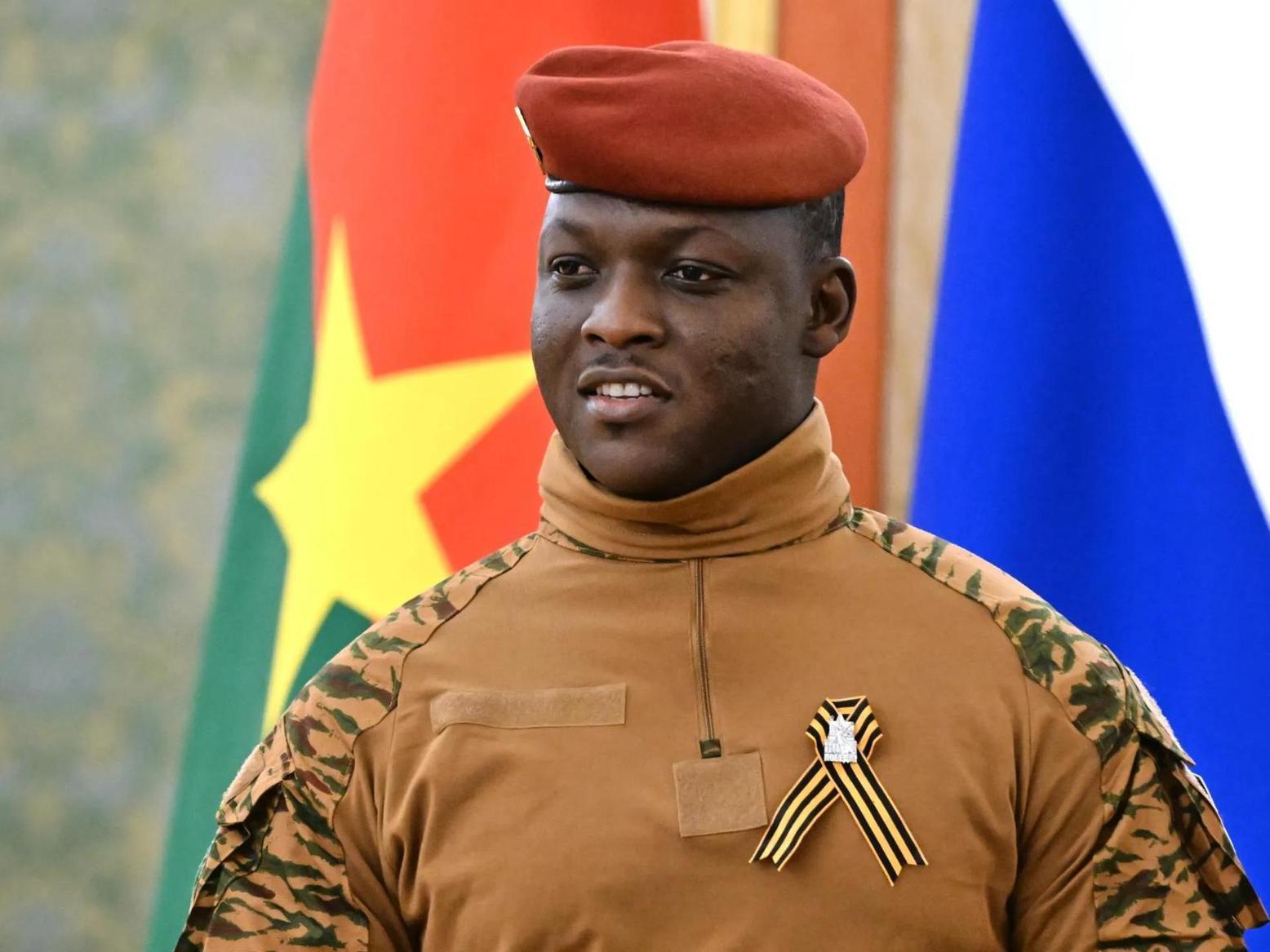
Africa-Press. The military ruler of Burkina Faso, Captain Ibrahim Traore, is a figure who cannot escape controversy. Since this young man, marked by a deep scar on his left cheek, led a military coup that ousted transitional President Paul-Henri Sandaogo Damiba—who himself came to power through a coup—Traore has remained a divisive character, attracting attention both domestically and internationally.
Ibrahim Traore hails from a Muslim family belonging to the ancient Diola tribes of West Africa. He joined the military in 2010 and quickly rose through the ranks before leading a coup on September 30, 2022, that removed his partner in governance, taking charge of Burkina Faso just 12 years after entering the army, marking one of the fastest ascents from military ranks to the pinnacle of power on the continent.
However, Traore did not enter the presidential palace in Ouagadougou with the keys to stable power; instead, he inherited a country trapped in intertwined crises. Since then, the young captain has engaged in complex wars and confrontations that have not been limited to a single front but have continued to expand by adding new issues to the list of open conflicts, some related to identity, history, and ethnicity, before more recent issues emerged as the most controversial.
The Fourth War: Arabs and Islamic Studies Students
As crises multiply and paths close before the young officer, it seems that Arabs and Islamic studies students are the next targets in the war of a man who is fighting battles on multiple fronts without yet achieving the breakthroughs and victories he promised in his country’s most pressing issues.
In his latest statements, which sparked widespread controversy, Traore opened highly sensitive and complex files, prominently featuring the history of slavery in African memory, alongside the reality of religious education in Burkina Faso, raising questions about his orientations and priorities for the upcoming phase.
While many described it as a major historical fallacy, Traore stated on July 19 that Africans endured over a thousand years of enslavement at the hands of Arabs, asserting that “the last slave market did not close until 1962,” remarks that reignited a heated historical and political debate regarding the continent’s history with European oppression.
Traore’s statements did not stop at revisiting the past; they extended to reshaping his country’s policy towards religious education. He announced his intention to halt sending Burkinabe students abroad to study Islamic sciences and to begin repatriating around 800 students currently pursuing their Islamic studies in various Arab countries.
He threatened unprecedented measures against those who refuse to return, warning that insisting on completing their studies abroad could jeopardize their Burkinabe citizenship.
He justified this unusual step by claiming that students returning from abroad carry with them, as he described, extremist views and ideologies that seek to impose their agendas within society, while lacking the professional skills needed in a country burdened by escalating economic and security crises.
Traore’s remarks did not go unnoticed by African Arabists, especially regarding the implication that they are, by extension, potential terrorists, and that their studies at Arab universities do not benefit Burkina Faso.
Traore’s recent statements opened a fourth front in the series of battles he has been waging since coming to power. While Arab capitals remained silent regarding his claims about Arab history in Africa, social media platforms ignited with widespread criticism, as many considered it a historical fallacy that burdens Arabs with the legacy of slavery while overlooking the responsibility of Western powers for centuries of slave trade and colonialism in Africa.
The debate was equally intense in African academic and intellectual circles, particularly among Arabists and graduates of Arab universities, who viewed his comments about students of Islamic sciences and Arab-Islamic culture as an implicit skepticism of their academic paths, portraying them as potential incubators of extremism, and reducing their years of study abroad to mere extremist ideas, while denying the scientific and intellectual contributions they could offer to their country.
Ironically, the “Burkinabe revolutionary” chose the language of his former colonizer and current adversary to speak about a fictitious history of enslavement, forgetting the recent history of African slave trade and its transportation via European ships to the shores of crime and suffering.
As the repercussions of Traore’s statements escalate, both in terms of their historical credibility and the escalating measures taken against Islamic institutions and symbols in his country, the actions taken so far include:
– Enacting a law on religious freedoms that restricts missionary and educational activities and prohibits the construction of mosques in public institutions, while banning religious education in public educational institutions, working through its various provisions to strengthen and enhance the secular nature of the state and system.
– Closing the largest mosques in the capital amid concerns about the level of security and legal restrictions facing mosques across the country under the new conditions.
– Arresting senior scholars and several Islamic figures and youth, reportedly sending them to military camps where they faced severe beatings and humiliation.
– Threatening students studying abroad in Arab countries with the loss of citizenship if they return to the country, as they are deemed a danger and do not possess beneficial knowledge for the nation.
While Traore tightened his grip domestically, different messages were being sent to Israel; he officially received the new Israeli ambassador, Simon Sarosi, in Ouagadougou to present his credentials, after months of uncertainty surrounding his accreditation request.
Africa Intelligence revealed that the accreditation request had been pending since the summer of 2025 before finally receiving approval away from the spotlight.
This public reception seems to mark the end of a cautious phase surrounding any rapprochement with Israel, as Traore sought to avoid damaging his image as an anti-Western leader.
However, the new scene reflects an increasing pragmatism in managing foreign relations, at a time when Israel seeks to intensify its intelligence and security presence in the Sahel region, benefiting from the interest of coalition countries in its technologies and expertise in security and counterinsurgency.
While most observers expect this war to tighten the noose around Traore’s regime, it is also anticipated that it will not be his last, just as it was not the first.
The Third War: A Revolution on the Ruins of Democracy
The Arabs and their history on the continent, along with the Islamic symbols and their associated prestige in the hearts of Muslims in Burkina Faso, are not the only fronts Traore is fighting on; democracy also has its share of the flames of war that are erupting in multiple directions in this landlocked African country.
Traore explicitly announced his complete rejection of democracy when he addressed his people on April 1, 2025, stating, “We are not in a democracy, but in a progressive popular revolution, and everyone must understand that.”
To ensure everyone understands this, he began implementing a continuous tightening of public freedoms in the country. After coming to power in September 2022, he launched a transitional phase extending for five years, before issuing a decree in January 2026 to dissolve political parties, claiming that the proliferation of parties led to deviations that exacerbated divisions among citizens and weakened social cohesion.
In the following months, the government launched a fierce campaign against associations and civil organizations, resulting in the dissolution and suspension of 929 of them, under accusations of failing to renew their bodies, espionage, or suspected funding of terrorism, according to government justifications.
Student organizations were not spared from this fierce war, as the General Union of Students of Burkina Faso was dissolved after criticizing the tightening of freedoms in the country.
The Second War: Ibrahim Traore Against France
France represents one of the key words in the speeches of “revolutionaries” in the Sahel region, as it is often the target of criticism and threats, especially given its colonial history in Africa, characterized by the plundering of resources and the humiliation of peoples.
Traore has not hidden his animosity towards Paris since his early days, but the tension reached its peak in June 2026 when he announced the severance of his country’s relations with France, accusing Paris of harboring new colonial ambitions that are clearly manifested in its active support for destructive networks and terrorists “who are drowning our country and the Sahel region in mourning.”
Since France, with its culture and history, has become an integral part of African identity, the military council in Burkina Faso has been keen to clarify that the decision to sever ties “strictly concerns the institutional framework of relations between the two countries at the diplomatic level and does not in any way call into question the historical, humanitarian, cultural, and social ties that bind the two peoples.”
As anti-French sentiment grows in West Africa and the Sahel, particularly, and becomes a lottery ticket in the hands of young rulers in the region, this animosity has yet to bring stability to the Sahel, and the Russian ally has not been able to fill the void left by France in its African world that it created crises in and many of whose leaders it has shaped.
The First War: Terrorism, Rising Casualties, and Ethnic Cleansing
Burkina Faso accounted for a quarter of the deaths resulting from attacks by armed Islamic groups worldwide last year, and it also suffered 9 of the 20 deadliest attacks globally in 2024. Many of the country’s residents continue to live between the fires of armed groups and the military council.
According to Human Rights Watch, the casualties from the military council’s actions exceed those from terrorism by more than double, while the internally displaced and refugees have exceeded two million people.
While the revolutionary government in Ouagadougou occasionally announces its success in eliminating hundreds of militants, the flames continue to consume the land and people of Burkina Faso (the land of honest men).
In the “terrorism file” in the Sahel, ethnicity intertwines with politics, as many opponents of the military council accuse its leadership of practicing ethnic cleansing against the Fulani ethnic group, which includes a significant number of fighters from the group known as the Support Group for Islam and Muslims, the most violent and deadly arm against the armies and governments in the Sahel region.
To date, the Burkinabe president does not claim to have achieved victory over terrorism in his country, and despite boasting multiple times that he has managed to liberate road axes previously held by armed groups, attacks continue, and the army loses several of its soldiers and its prestige almost every week, with the war still raging among its parties in Burkina Faso.
Amid these four wars, the Burkinabe revolutionary moves at a rapid rhetorical pace, with much tightening of freedoms and little victory in multiple, multifaceted battles that have resulted in numerous casualties and flames.
Sankara’s Legacy: The Last War on the Image of the Revolutionary
In his early period, Traore presented himself and his supporters as an extension of the legacy of Thomas Sankara, the Burkinabe leader known as “Africa’s Che Guevara” for his anti-colonial rhetoric and calls for economic independence and social justice, along with his stances against French hegemony and support for liberation movements, including the Palestinian cause.
However, Sankara’s legacy seems to be eroding in Traore’s hands, who has turned his back on the Palestinian cause and embraced Israel, as well as indulging in radical secularism, which has long been criticized by enlightened Africans regarding the Western colonizer, particularly France, which they say has made combating Islam and its symbols an integral part of its cultural policy in Africa for decades.
As Traore’s steps become increasingly complex, they also reveal the absence of a cohesive renaissance or intellectual project, contrasting sharply with what characterized Sankara, as authoritarianism, a rhetoric of power, and a haughty march through the minefields of politics and security seem to be the most prominent features of the young revolutionary, who remains the most explicit enemy of African Arabism to date.