Mamadou Basir Dambly
Africa-Press. West Africa today is often portrayed as a space where religion intersects with politics, and identity with power; the concept of “jihad” is invoked in public discourse in multiple, varied ways. In the contemporary reality, this concept is no longer confined to its preaching or reformist meanings. Rather, some armed groups have redeployed it within confrontational narratives that claim to apply Sharia, oppose secularism and globalization, and present themselves as heirs to earlier religious experiences in the region.
Yet this claim rests on a conflation of different contexts and conflicting aims: the concept is stripped from its ethical and social frameworks and reproduced within a violent discourse—described in contemporary literature as terrorism—that justifies coercion and grants legitimacy to violence.
From here, this reading turns to analyzing contemporary jihadist thought that employs violence in West Africa, and to understanding its claimed relationship to Sufi jihadist heritage, while deconstructing its discursive structure and explaining the reasons for its spread and its appeal among segments of local societies in the current context.
Jihadist thought in West Africa and its Sufi past
Jihadist thought, in its African context, is an old current whose roots and early beginnings go back to the Almoravid movement in its jihad against African kingdoms, and then to those ancient African empires and kingdoms whose wars sometimes took on an Islamic religious coloring, thereby being endowed with the label of religious jihad.
However, during the nineteenth century, the Western Sudan witnessed the rise of a “fashion” and a wave of Sufi jihad as a religious revolt against paganism and “animism,” which were—and still are—deeply rooted in some areas of the West African space in the form of states and kingdoms founded by pagans and animists, as described by Abdullah Abd al-Razzaq and Shawqi al-Jamal in their book Studies in the Modern and Contemporary History of West Africa: “West Africa witnessed in the nineteenth century a wave of jihad revolutions by Muslims against their local rulers—pagans, or those who professed the religion in name only. This jihad was led by sincere men from the Fulani people who spearheaded the religious revolution; Islamic jihad movements were led in Hausa lands by Sheikh Uthman ibn Fodio, and by al-Hajj Umar al-Futi al-Takruri and other Islamic leaders who shook the thrones of pagan rulers, made jihad their focus, struggled to spread the Islamic creed, and armed themselves with piety and success. They were blessed revolutions that brought about a radical change in the structures of society in West Africa.”
The most famous of these Sufi jihad waves in the Western Sudan can be traced in three well-known versions: that of Sheikh Uthman dan Fodio, that of Sheikh Ahmad Lobbo al-Masni, and that of al-Hajj Umar Tall al-Futi—each beginning from the same starting point: a series of persecutions against them and against their students and followers.
Invoking self-defense—legitimate in Islam—they took up arms against pagan enemies and animist rivals. Thus, “the declaration of jihad by Muslim leaders was enough to rally followers around them: they saw the call to jihad as a religious duty and fought fiercely, whether against pagans to force them to embrace Islam, or against the French who had begun to invade the region.” They defeated a number of emirs, such as the Emir of Katsina, the Emir of Kano, the Emir of Zozou, the Emir of Doura, the Emir of Azbin, the Emir of Borno, and the Emir of Gobir; and they seized control of a range of pagan kingdoms and fortresses such as the kingdom of “Bembek,” the kingdom of “Baldug,” the Bambara (Masasi) kingdom of “Karta,” the Bambara kingdom of “Segou,” as well as the people of “Tamba,” the people of “Kafoudi,” and others.
In the nineteenth century in West Africa, jihadist thought pursued a set of lofty objectives, foremost among them: – spreading Islam and its tolerant teachings in the lands of the Western Sudan among both commoners and elites;
– combating paganism, pagans, and animist beliefs supported by pagan kingdoms;
– confronting European colonial ambitions that had begun to penetrate the Western Sudan;
– establishing Islamic societies in the earliest model within African environments and by African hands, grounded in knowledge and insight.
Perhaps these objectives and aims constitute, at this point in time, the grounds on which African Islamic jihad is justified in popular practice; for some pagan customs became intertwined with Islamic ideals and values, making it necessary for reformers and renewal-minded leaders to emerge—men who traveled on pilgrimage to Mecca and then returned to their countries to declare jihad against pagans and to establish Islamic states that would adopt the radiant Sharia as the path and method of governance.
Thus, we notice that the inherited Sufi jihad in the Western Sudan went beyond merely calling for conversion to Islam, becoming a broader movement that sought to establish an Islamic society in African settings. Ihām Muhammad ‘Alī Dhinī underscores this when she says: “The nineteenth century is a fertile field for historical studies related to West Africa. In it, the idea of jihad to spread Islam emerged and developed greatly, and the movement was no longer limited to spreading Islam and fighting pagans; rather, the aim of its pioneers became to confront European colonial ambitions.”
And, as Abdullah Abd al-Razzaq describes, the founders of these Islamic kingdoms “stood as an impregnable barrier against attempts at European expansion, inflicted losses on the enemy beyond its capacity, succeeded in laying the foundations of Islamic belief on a sound basis, and the Islamic peoples of West Africa remain indebted to the leaders of these reform movements.”
Jihadist thought in West Africa in its violent present
In recent years, West Africa has witnessed a new version of jihadist thought, embodied in a wave of armed movements that practice violence in the name of religion under various, multiple labels, yet with closely aligned objectives and aims. They organize criminal offensive operations through coordination and cooperation. The differences among them lie in branches and minor particulars—something that does not necessarily justify the striking proliferation observed. These groups, branded as violent in the name of religion, have passed through several stages in the region, as follows:
1- The phase of consolidation and control: when they seized control over large parts of the Sahel states—especially the border triangle between Mali, Niger, and Burkina Faso—which they adopted as a base from which they launched offensive operations and to which they returned, in a clear challenge to national armies, inflicting successive defeats and leaving major losses on multiple fronts.
2- The phase of divergence and infighting: arising from disagreements among the leaders of these groups branded as violent in the name of religion, their struggle over top leadership, and their resort to ethnic partisanship, with the emergence of factions framed around ethnic identities—such as the Fulani-leaning Katiba Macina and the Tuareg-leaning Ansar Dine.
3- The phase of weakness and fragmentation: an inevitable outcome of divergence and infighting. Their weakening is attributed to a set of field factors the groups were unable to resist, foremost among them the French military intervention. According to a report by Stephanie and Michael, it states: “The France-led military intervention in Mali, which began on January 11, 2013, succeeded in dispersing the Islamist groups that had controlled the northern half of the country over the past year and seriously weakening them. The French campaign brought most areas back under the control of the Malian government.”
After the military intervention came the campaign of the United Nations peace mission in Mali (MINUSMA) on April 25, 2013, against groups labeled as violent, as the strongest international reaction to them. These and other factors—including more recently the build-up of the armies of the Union of Sahel States (Mali, Burkina Faso, Niger) during the current transitional period after being supplied with modern, advanced military equipment, especially aerial weapons such as drones, which pose a major threat to the groups and endanger their existence—have confined them to caves and forest thickets.
Recently, these groups have entered a hazy situation in which it is difficult to determine their true condition and field strength, as they no longer have stable areas of control. While regional governments declare that they have weakened to the point of entering a phase of defeat, the groups still carry out high-impact offensive operations that refute that claim.
Ahmed Askar notes that many violent armed organizations remain active in the region and are involved in numerous extremist attacks, foremost among them: al-Qaeda—represented by the Group for the Support of Islam and Muslims (JNIM)—and ISIS, represented by ISIS in West Africa and ISIS in the Greater Sahara, which together have shaped the region’s violent armed landscape in the recent period.
These violent armed groups have recently realized their grave mistake—division and infighting—and sought to unify their ranks under a single umbrella: the “Group for the Support of Islam and Muslims” (JNIM). This saved them from a certain defeat at the hands of the Sahel States’ special force, and brought them back to the center of events, as seen in their armed operation targeting fuel tankers in Mali in recent incidents—making talk of their defeat premature and a matter of pre-empting events.
A comparison of jihadist thought in West Africa: its Sufi past and its violent present
At first glance, a genealogical study of jihadist thought in West Africa may lead one to view the Sufi version in the nineteenth century as the origin of the violent version in the present era. This is what groups marked by violence in the name of religion have exploited when they declared themselves heirs to the region’s “authentic” Sufi jihadist thought. As the researcher Sidi Ahmed Ould Al-Amir states: “It is striking that the two movements ‘Boko Haram’ and the ‘Movement for Oneness and Jihad in West Africa (MUJAO)’ often take the Sufi shaykh, Uthman dan Fodio, as a point of reference, even though they are two Salafi movements.”
Today we also observe that the leader of the “Macina Katibas,” Mohamed Koufa—an ally of Iyad Ag Ghali, the leader of Ansar Dine—together with others, formed on March 1, 2017 what has come to be known as the “Group for the Support of Islam and Muslims,” which considers itself an extension of the Macina kingdom, even though its three kings were Qadiri Sufis.
Researcher Haroun Al-Mahdi Miga supports this by saying: “They seek to establish a Fulani Islamic emirate in the Macina region in central Mali, following the model of the Fulani Islamic state, the ‘Dina State,’ which Ahmad Lobbo established in the nineteenth century.”
Thus, these armed groups that practice violence in the name of religion deliberately and intentionally employ certain religious interpretations of nineteenth-century Sufi masters to justify their present-day jihad. It is a contrived strategy to confer legitimacy on their criminal acts, given the sanctity of these models among both ordinary people and elites in West Africa. For “they present themselves as heirs to the jihad traditions and as a resistance to colonial rule led by Sufi masters in West Africa in the nineteenth century—traditions that enjoy great respect among Muslim populations in the region,” with violent groups adopting a slogan of continuity with the inherited jihad in these lands, as Abu Al-Ma‘ali has observed.
However, this contemporary violent groups’ attempt at local rooting—searching for a suitable “homeland” for this armed jihadist thought, described in media literature as terrorism, within the local African environment—results in a scholarly objection that applies to all rooting operations in their various forms: it ignores historical and social transformations that make it difficult to reach “origins” without passing through what developed in the life of Islamic societies, according to Al-Ruwaili and Al-Bazghi.
This means that violent groups’ attempt to ground their violent idea and frame it through the inherited Sufi jihadist thought is an explicit disregard on their part for the historical changes and differing social conditions between the nineteenth and twenty-first centuries—conditions from which they claim to derive their intellectual reference and the legitimacy of its acceptance and palatability among both the public and elites.
Despite this scholarly dilemma in the process of rooting contemporary ideas and principles, examining historical events and reflecting on field realities related to jihadist thought in the past and present reveals points of connection and shared elements between the two versions—the Sufi jihadist thought of the nineteenth century and the contemporary violent version in the twenty-first century—which create a degree of rapprochement, even if only on a horizontal level. The most important of these are:
First: convergence in textual evidentiary references between Sufi jihadist thought and violent jihadist thought—meaning that the legal proofs and religious texts used by the bearers of the banner of Sufi jihad, such as Shaykh Uthman dan Fodio, Ahmad Lobbo, and al-Hajj Umar Tall al-Futi, are almost the same religious reference base used by modern groups labeled violent in the name of religion, in terms of well-known Qur’anic verses and prophetic hadiths.
Second: targeting a particular social class, namely the ruling elite—represented by kings and emirs in the old Sufi jihadist thought, as guardians of “paganism” and its idolatrous systems—and, in contemporary violent jihadist thought, the governments of modern states and their leaders, as bearers of secular ideology and as colluding with Western countries and their “infidel, satanic” organizations, as they describe them.
Third: reliance on external armament through illegal routes and means to procure weapons and military equipment—such as rifle sellers, artillery dealers, and the colonial administration in Sufi jihadist thought, especially in the “Umarian” version that armed itself through these routes—and, in contemporary violent jihadist thought, through smugglers of weapons and drugs and cross-border operatives, who in their own way obtained various advanced modern weapons, including drones, electric motorcycles, inflatable off-road vehicles, and others.
There are, nevertheless, other shared elements and points of linkage between Sufi jihadist thought and contemporary violent jihadist thought, which may reach the level of very close resemblance, even to the claimed outright identity asserted by violent groups.
In the opposite direction: differences that refute the claimed closeness
But in the opposite direction, there are many points of difference and numerous elements of contrast that undermine the claim of identity and of genuine closeness. Among the most important are the following:
First: a clear difference appears between the reformist Sufi reference framework on which inherited Sufi jihadist thought relied, and the Salafi-jihadist reference framework on which contemporary violent jihadist thought is built. The former adopted Sufism as its guiding frame of reference and directed its efforts toward spreading Sufi orders and their spiritual teachings as an entry point for religious reform within African societies.
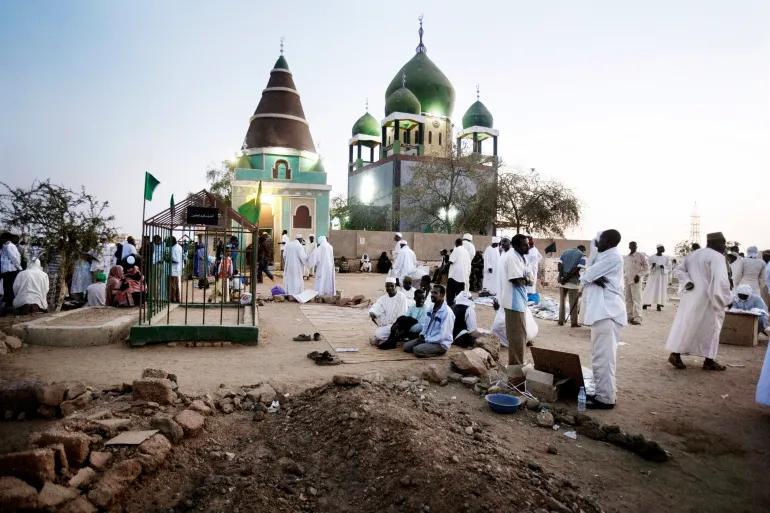
By contrast, the latter took Salafi thought as its cognitive starting point, seeking to entrench its own conceptions in matters of creed and monotheism (tawhid). This divergence in reference frameworks was reflected in hardline stances toward religious “others,” including questioning certain doctrinal practices and adopting a negative posture toward symbols and manifestations of Sufism—up to and including assaults on some graves, shrines, and sanctuaries, and the destruction of historical heritage landmarks, as occurred in the incident of demolishing shrines in the city of Timbuktu in July 2012.
Second: religious motivation formed a central element in Sufi jihadist thought; joining it was often tied to the spiritual and religious drive of disciples and students connected to their shaykhs. In contrast, the manifestations of contemporary violent jihadist thought show a diversity of motives for joining, where religious factors intersect with ethnic, economic, social, and political considerations, making the phenomenon more composite and complex in terms of its social structure.
The economic factor stands out among these motives as an influential element for some individuals, especially in contexts characterized by weak livelihood opportunities, disparities between needs and capacities, and the availability of organizational networks that provide quick material resources. This helps explain why certain groups resort to patterns of organized violence within such frameworks.
Third: Sufi jihadist thought shows greater adherence to the legal-religious constraints regulating jihad, as articulated in juristic writings and Prophetic tradition, especially regarding the protection of non-combatants and the safeguarding of property and the environment. By contrast, some practices associated with contemporary violent jihadist thought show a retreat from these constraints through patterns of violence that include targeting civilians, infrastructure, and economic and agricultural resources. This reflects a difference in how the limits of jihad practice and the mechanisms for implementing it are understood. Such divergence in interpretation and application leads to sidelining Prophetic guidance aimed at restraining violence, with broad humanitarian and environmental consequences in local settings.
Fourth: Sufi jihadist thought displays a clear concern for the educational and formative dimension of the fighter’s character before engaging in jihad campaigns. Disciples and students were relied upon as the organizational nucleus, with emphasis on cognitive formation connected to the concept of jihad—its rulings and its ethics—thereby shaping this character within a disciplined pedagogical framework. In contrast, some manifestations of violent jihadist thought tend to privilege mobilization and emotional zeal in building the participant’s character, with weaker presence of structured educational and training programs. This reduces the chances of systematically grasping the legal constraints related to jihad practice.
Beyond these, further differences and contrasts separate the Sufi jihadist version from the violent jihadist version, making each an independent sphere with its own distinctiveness in thought, reference framework, field practice, and intended goals.
Finally, one can pause at a prominent feature of contemporary violent jihadist thought: what is known as the “manufacturing of jihadist memory.” This refers to the totality of written or recorded statements produced by violent armed groups to document their activities, present their own narrative of events and field realities, and build a storyline that portrays their members as central actors in the experience, alongside spreading their ideological conceptions. This practice is one of the distinguishing marks of this current: modern media tools and social media platforms are employed widely, enabling the creation of an extended jihadist memory that sometimes goes as far as establishing dedicated media channels—such as the channel known as “Al-Fath Channel,” affiliated with the Group for the Support of Islam and Muslims—through which statements and recorded speeches are broadcast and through which its own version of operations and field events is presented.
This jihadist memory has enjoyed notable spread and wide engagement, sometimes reaching large numbers of views and followers among both general and specialized audiences, with its content circulating across different social media groups—contributing to the expansion of this discourse without consistent awareness of its impact.
Part of this popularity is attributed to these groups’ use of local languages in their media discourse by selecting spokespersons with strong expressive ability. This is seen, for example, in the Group for the Support of Islam and Muslims’ reliance on Abu Hamza al-Bambari, known locally as “Bina Diarra,” whose eloquence in the Bambara language—widespread in West Africa—enabled him to convey the group’s messages and narrative to a broad audience, sometimes generating interaction that exceeds official messaging delivered in foreign languages that do not receive the same level of attention among wide segments of the population.
The spread and circulation of this jihadist memory among both general and specialized audiences is also linked to limited awareness of the dangers of this type of media discourse and the influences it may entail—effects that can sometimes exceed the impact of direct material means.
This has contributed to a degree of confusion in the public sphere by reshaping perceptions and raising doubts about official narratives and statements, while encouraging their monitoring and reception with growing attention and trust, and citing them in daily discussions in streets and diverse social spaces. This occurs in a context marked by weak targeted awareness campaigns and by the absence or limited scope of legal frameworks regulating the viewing and circulation of such content—revealing ongoing challenges in cybercrime-combat systems in the countries of the region, despite repeated attempts at activation.
Conclusion
It is clear that jihadist thought in West Africa is neither a single, unified bloc nor a homogeneous narrative. Rather, it is a multi-layered, context-dependent phenomenon shaped through complex interactions among religion, history, society, and politics. Between the inherited Sufi jihad—linked to religious reform and social formation within its own temporal and cultural conditions—and the contemporary version that deploys violence in the name of religion within fragile arenas marked by structural imbalances, a deep rupture appears in reference frameworks, aims, and modes of action, no matter how much superficial similarity may seem to exist in language or symbolic invocations.
The analysis shows that attempts to root contemporary violence in the heritage of Sufi jihad are not grounded in a solid historical reading as much as they rely on a deliberate selection of symbols and texts, along with a disregard for the social, political, and epistemic transformations that reshaped African societies between the nineteenth and twenty-first centuries. It also highlights that what grants these contemporary movements a degree of presence and spread is not limited to the military factor; it is also connected to their ability to produce effective media discourse and to manufacture a digital “jihadist memory” that leverages local languages and fills gaps of trust and knowledge within the public sphere.
Accordingly, approaching this phenomenon requires moving beyond reductive explanations toward a composite understanding that integrates the historical dimension with social, cultural, and media analysis, and that restores attention to the fine distinctions between religious heritage as a historical experience open to plurality and its contemporary deployment in contexts of violence.
Without this analytical awareness, confusion persists and the possibilities for addressing the issue remain limited, in a space where questions of religion, authority, and identity in West Africa remain open to multiple possibilities