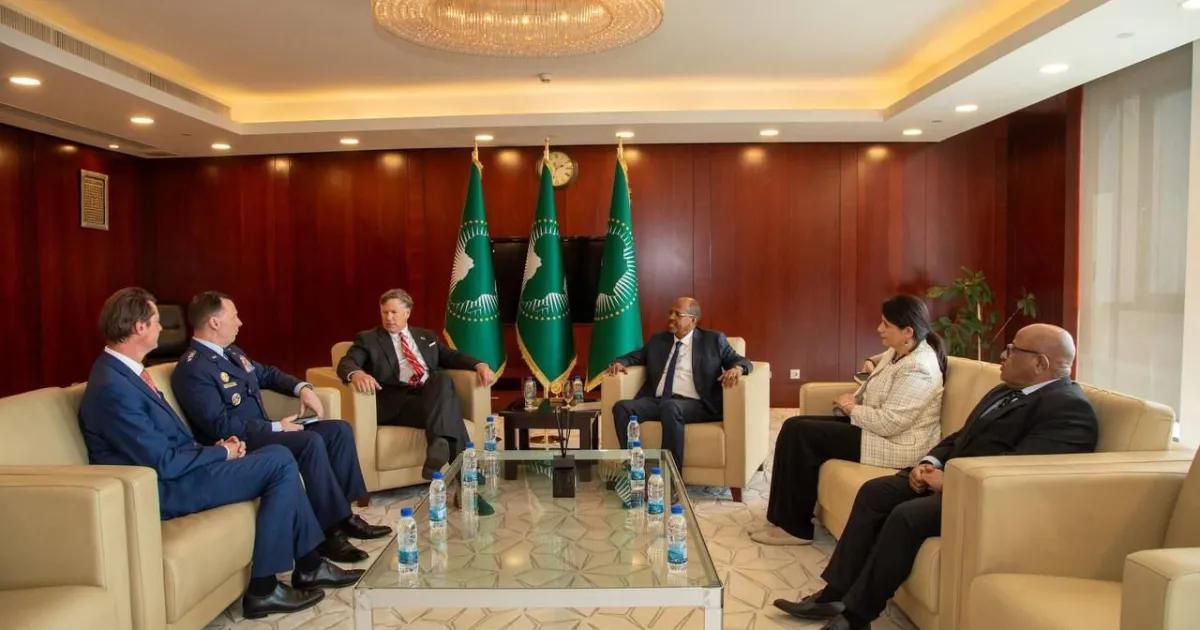
Africa-Press. The Chairperson of the African Union Commission, Mahmoud Ali Youssouf, expressed Africa’s desire to understand a number of decisions taken by the U.S. administration—particularly visa restrictions—stressing the importance of clarifying the course of U.S.-Africa relations in the coming period. He made the remarks during a joint press conference in Addis Ababa with Christopher Landau, the U.S. Deputy Secretary of State, on Wednesday evening.
Youssouf affirmed that the African Union, as a multilateral institution, seeks to play a greater role in international issues, especially after the African Union joined the G20 as a full member. He also expressed hope that current tensions between the United States and South Africa could be overcome in a way that strengthens stability and understanding between the two sides.
Youssouf stressed that the world is becoming increasingly interconnected and that African and U.S. interests are complementary. He explained that the continent has resources Washington needs, while Africa needs American expertise, technology, and investment. He emphasized that security issues, counterterrorism, and securing maritime routes—foremost among them the Bab el-Mandeb Strait—are cross-border challenges that require stronger coordination and joint cooperation.
Washington’s position
For his part, U.S. Deputy Secretary of State Christopher Landau reaffirmed his country’s commitment to strengthening security cooperation with African states and the African Union, warning that conflicts and external interference undermine the continent’s stability. He emphasized Washington’s rejection of any external interventions that could destabilize the region.
The two sides reviewed opportunities for economic cooperation. Youssouf pointed to U.S. investment in the Lobito Corridor linking Luanda to Zambia, and to Africa’s desire to propose 11 additional economic corridors. He also underscored the importance of renewing the memorandum of understanding between the Africa Centres for Disease Control and Prevention (Africa CDC) and the U.S. government, particularly in the health sector.
Landau, in turn, said Africa represents a promising market with growing human and natural resources, noting the United States’ desire to partner with the continent on projects that deliver mutual benefits, foremost among them economic corridors.
Ethiopian-U.S. meetings
The U.S. delegation led by Landau also met Ethiopian Prime Minister Abiy Ahmed to discuss ways to strengthen bilateral relations and review regional developments of mutual interest. The delegation also held talks with Ethiopian Foreign Minister Gideon Timothewos on bilateral ties and expanding areas of partnership.
The Commander of the U.S. Africa Command (AFRICOM), General Dagvin Anderson, held discussions with Ethiopian Defense Minister Aisha Mohammed on strengthening military cooperation, particularly in counterterrorism. The defense minister affirmed her country’s commitment to elevating military relations with the United States to an advanced strategic partnership.
During his participation in celebrations marking the 90th anniversary of the Ethiopian Air Force, Landau said his country views Ethiopia as an important regional power, noting that joint action delivers more effective results than unilateral moves.
General Anderson, for his part, warned of escalating security threats in the Horn of Africa, pointing to increasing activity by terrorist groups such as Al-Shabaab and داعش (ISIS), which coordinate across the Red Sea with the Houthi group.
Economic reforms and aviation-sector cooperation
Landau held talks with Ethiopian Finance Minister Ahmed Shide, Minister of Planning and Development Fitsum Assefa, and National Bank of Ethiopia Governor Ayob Tekalign, focusing on economic reforms and investment opportunities. Landau praised the progress made, affirming Washington’s interest in expanding the involvement of U.S. companies.
Landau also met with Ethiopian Airlines CEO Mesfin Tasew, and the two sides discussed ways to enhance cooperation in the aviation sector and explore future partnership opportunities.
Regional tour
These meetings come as part of a regional tour by the U.S. Deputy Secretary of State and the AFRICOM Commander, covering Ethiopia, Kenya, and Djibouti. The tour aims to discuss security cooperation, counterterrorism, and strengthening political and economic partnerships in the Horn of Africa.