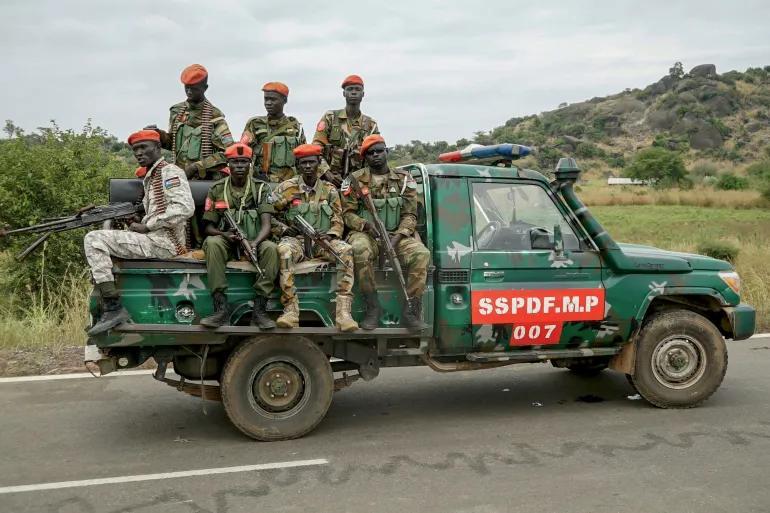
Africa-Press. South Sudan has witnessed a rapidly accelerating military escalation over recent weeks, raising fears of the country’s return to full-scale war. This comes amid expanding attacks by armed opposition factions led by Riek Machar, the First Vice President, alongside the formation of an alliance that includes prominent factions coordinating their operations against government forces on multiple fronts.
These developments coincide with growing political and security fragility, as the challenges facing the peace process intersect with Machar’s arrest and legal prosecution. At the same time, the government continues preparations for the country’s first general elections since independence from Sudan, amid a stifling economic crisis threatening the cohesion of the government army.
In a notable field development, opposition factions announced last week that they had taken control of the strategic area of “Fajout” near the city of Bor, the capital of Jonglei State, adjacent to the capital Juba. Observers described the move as a qualitative escalation, given the area’s proximity to vital supply routes linking central and eastern states.
Armed Escalation
In the same context, these factions launched an attack on the city of Kapoeta in Eastern Equatoria State, resulting in the displacement of thousands of civilians amid deteriorating humanitarian conditions marked by severe shortages of food, water, and health services, according to local sources and aid organizations.
As fighting spread, the government began deploying military reinforcements to Jonglei State in an effort to protect the city of Bor, following opposition forces’ capture of the strategically located town of Pajut, raising fears of a possible rebel advance southward.
Security sources reported that a convoy carrying troops, armored vehicles, and supply trucks departed from Juba in what was described as a defensive move to reinforce the security cordon around Bor, to be followed later by larger troop deployments aimed at expelling armed factions from the state.
This development represents a notable military precedent, marking the first time opposition forces have seized control and penetrated areas traditionally considered part of the government’s core stronghold in Jonglei and Eastern Equatoria states, reflecting a qualitative shift in the trajectory of the conflict and its geographical expansion.
The United Nations Commission on Human Rights in South Sudan warned of a catastrophic escalation of violence as the opposition advances in Jonglei and clashes intensify in multiple areas. In a statement, it said these developments represent a serious erosion of the peace agreement that ended the civil war in 2018.
Arrest of the Opposition
The Commission stressed that the escalation exposes civilians to risks of death, displacement, and deprivation, calling for an immediate de-escalation and an end to hostilities in residential areas, including airstrikes and ground attacks, emphasizing that protecting civilians is a “legal obligation” of the government.
It also reported that more than 100,000 people have been forcibly displaced from Jonglei State since late December 2025, amid repeated destruction of markets and health facilities in the counties of Uror, Ayod, and Nyirol, exacerbating the humanitarian crisis.
In a related context, Edmund Yakani, Executive Director of the Community Empowerment for Progress Organization, warned of the dangers of the rapid military escalation. Speaking to Al Jazeera Net, he said that “the formation of alliances among armed groups, coupled with declining morale within the government army due to delayed salaries and increased forced recruitment, makes the outbreak of a large-scale war a real possibility.”
Yakani called for the urgent launch of a political dialogue among the parties to prevent state collapse and further violence, stressing that “the alternative to dialogue will be more bloodshed and displacement.”
Continuing Tensions
In Unity State, in the northwest of the country along the Sudanese border, new clashes erupted in Koch County between government forces and the Sudan People’s Liberation Movement-in-Opposition, killing at least 15 soldiers, indicating the persistence of field tensions despite repeated calls to halt the violence.
Observers believe this escalation is linked to the arrest and trial in Juba of Riek Machar, opposition leader and First Vice President, along with several opposition figures—a move the opposition views as an attempt to sideline him politically and prevent his participation in the upcoming electoral process.
The opposition argues that the government’s insistence on proceeding with general elections by the end of the year, without Machar’s participation, provides an incentive to adopt military pressure to impose a new political equation, amid stalled dialogue and frozen implementation of transitional agreements. This further increases security fragility and warns of broader repercussions for stability.
As part of the escalation, the military spokesperson for the opposition in South Sudan, Peter Lam Gabriel, said in a statement that “the door to joining the ranks of the resistance remains open to members of the government army in Upper Nile, Bahr el-Ghazal, and Eastern Equatoria states.” He called on them to side with the people and take part in a “national change project” aimed at toppling the Salva Kiir regime.
Gabriel confirmed the existence of a new alliance bringing together all opposition factions, including the United Front, the National Salvation Front, and the movement led by General Stephen Buay, “working in full coordination to overthrow the regime and establish civilian rule that reflects the will of the people.” He also urged civilians to stay away from military sites, noting that “upcoming battles will target strategic areas.”
Fragile Truce
In a move reflecting the deepening political crisis, the African Union’s Peace Agreement Monitoring and Evaluation Commission called on Friday for intervention to secure the release of Machar and several opposition leaders, warning that their continued detention threatens an “irreversible collapse” of an already fragile truce.
Retired General George Aggrey Owinow, Acting Chairperson of the Commission, told the African Union Peace and Security Council that the situation has “deteriorated significantly” and that implementation of the 2018 peace agreement has been severely undermined.
The Commission called for the urgent opening of political dialogue and a return to full implementation of the Revitalized Peace Agreement, including the restoration of government portfolios allocated to the opposition movement, warning that failure to take immediate steps could push the country toward full-scale civil war.
Owinow added that the ceasefire has effectively collapsed across wide areas, with clashes expanding between government forces and the opposition movement in Jonglei, Upper Nile, Unity, Western Bahr el-Ghazal, and the Equatoria region, noting that “field realities confirm armed clashes in 6 out of 10 states and 3 administrative areas.”
For their part, government authorities insist that the elections represent a “decisive transitional phase toward stabilizing the state and building its institutions.” However, this stance faces broad rejection from the opposition, which views it as an attempt to exclude it from the political process amid the continued detention and trial of Machar.
These electoral milestones come at a time when the 2018 peace agreement continues to face rejection from multiple armed groups, increasing the risk that the elections could become a new trigger for escalating conflict rather than a gateway to comprehensive peace.