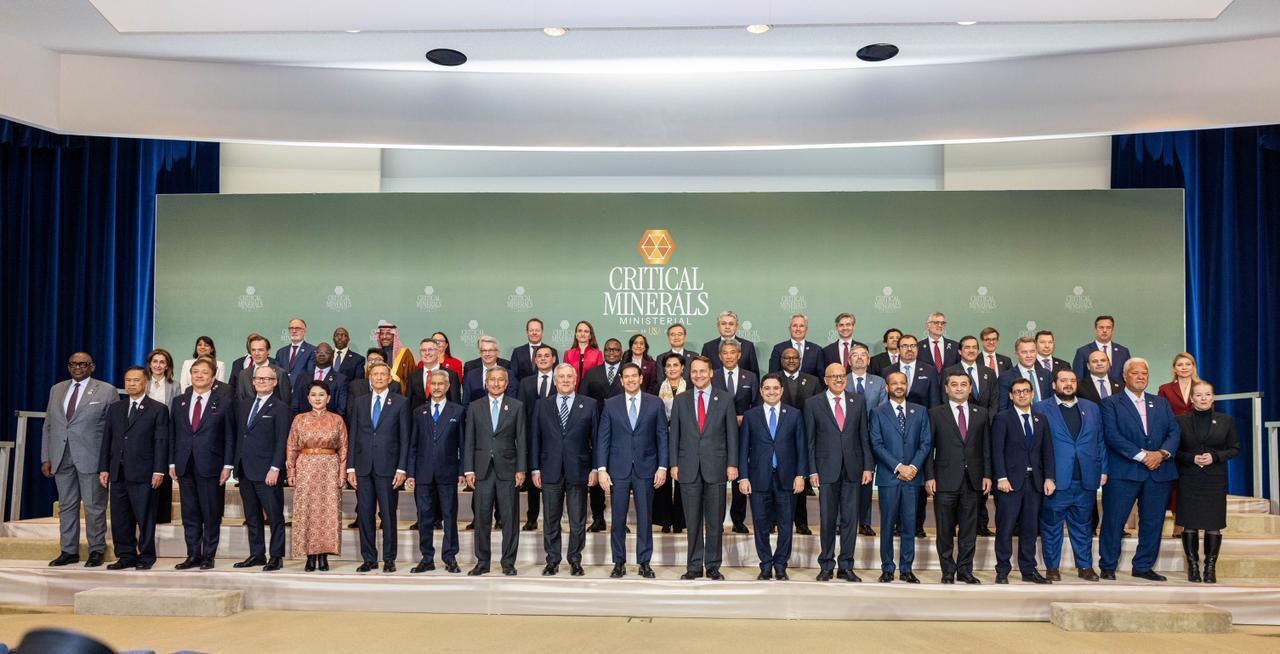
Africa-Press. The Washington ministerial meeting on minerals, held on February 4, comes as part of a U.S. effort to institutionalize the reshaping of the global minerals sector, particularly in Africa, which is seen as a central hub in critical mineral supply chains.
This move fits within a growing Western narrative that portrays China as the dominant and exploitative actor in Africa’s resources, in an attempt to justify a redistribution of influence in this strategic sector.
Against the backdrop of the complex crisis in eastern Democratic Republic of the Congo, the nature of the Trump administration’s involvement in this file, and the outcomes of the Washington meeting, it becomes clear that the current U.S. approach — prioritizing access to resources over peacebuilding and state-building — is likely to have negative repercussions across African conflicts, as well as on efforts to resolve disputes, enhance security, and achieve sustainable stability.
Timing and geopolitical implications
The timing of the meeting carries political significance beyond economics. It intersects with the so-called “Washington process” between Kigali and Kinshasa following the June 4, 2025 agreement, running in parallel with the “Doha process” between the Congolese government and the March 23 Movement aimed at ending one of the longest conflicts in the Great Lakes region. Despite these tracks and agreements, the situation on the ground remains fragile, with repeated violations by all parties raising concerns that the peace may remain merely symbolic.
In this context, Washington emerges as a political sponsor of the agreement, not out of a priority to end the conflict or address its humanitarian dimensions, but rather to secure its strategic interests in the minerals sector and curb China’s growing influence in eastern DRC, despite the persistence of a complex political and humanitarian crisis.
Western narratives on China and the “debt trap”
Western discourse has long focused on accusing China of greedy domination over Africa’s minerals, resource extraction, and plunging African states into a so-called “debt trap,” particularly through resource-for-debt arrangements. However, this narrative often overlooks local contexts, weak governance, and the historical practices of Western powers themselves in exploiting African resources.
While criticism of China’s mineral policies is partly justified, reducing the issue solely to China’s role is a selective approach that ignores a long history of Western collusion with proxy resource-looting networks, especially in eastern DRC, where regional actors such as Uganda and Rwanda have played functional roles serving the interests of major powers.
Objectives of the Washington minerals meeting
Since Donald Trump’s return to the White House, Washington has shown increased interest in the minerals sector as part of a selective strategy focused on strengthening partnerships with resource-rich countries rather than pursuing a comprehensive continental approach.
Within this framework, around fifty countries — including key African states such as Angola, Zambia, and the Democratic Republic of the Congo — were invited to discuss ways to stabilize supply chains, attract investment, and address governance and infrastructure challenges.
Some argue that, despite advances in multilateral global mineral governance initiatives aimed at linking the Global North and South toward a “new international economic order,” supported by civil society and NGOs monitoring conflict minerals, the U.S. approach follows a parallel path characterized by a clear retreat from multilateralism and the entrenchment of the “America First” principle in managing strategic resources.
Overall, the Washington meeting seeks to reassert U.S. dominance over the minerals sector through:
1- Long-term bilateral agreements with producing countries.
2- Activating the Lobito Corridor to connect Central African mining zones to the Atlantic Ocean.
3- Imposing alternative governance standards claiming environmental and labor compliance.
4- Providing incentives and financing to reduce investment risks for U.S. companies.
A New U.S. Framework: From MSP to FORGE
In this context, Washington is leading new international initiatives to control supply chains of minerals essential to technology and clean energy. The Minerals Security Partnership (MSP) served as a preliminary framework bringing together 14 Western countries, the European Union, and producer states.
Some analysts view this partnership as the nucleus of a “minerals NATO” led by Washington to counter China. However, following the Washington meeting, the Trump administration announced the launch of a new framework — the Forum for Geostrategic Resource Engagement (FORGE) — intended as a permanent entity to replace the MSP, based on high governance standards but under explicit U.S. leadership.
The Trump administration’s approach to the conflict in eastern Democratic Republic of the Congo, for example, signals a particularly dangerous trend: trading economic deals for symbolic peace agreements that ignore the structural roots of conflict, in favor of arrangements serving short-term external interests. This approach marginalizes African institutions and regional frameworks, risking the exacerbation rather than the sustainable resolution of conflicts.
Moreover, the administration’s growing drive to secure resources “at any cost” could lead to a revival of past interventionist models, similar to the Venezuelan case, in several resource-rich African countries. This risk is heightened by the erosion of international norms and institutions, frequently undermined by the United States, which in this context appears as a “rogue great power,” posing threats to international security and stability.
For Congolese President Félix Tshisekedi, intensifying international pressure on Rwanda — through sanctions, forcing troop withdrawals from eastern Congo, and ending support for the March 23 Movement — represents a key bargaining tool to secure U.S. backing and redirect external influence away from China.
A new global scramble for minerals
Competition is not limited to the United States and China; it also involves the European Union and regional powers. In February 2025, the EU signed a memorandum of understanding with Rwanda on critical minerals value chains, aiming to secure strategic supplies for the green and digital transition.
The Washington meeting is widely seen as a direct response to this European move and a sign of a new wave of international competition over Africa’s resources. President Tshisekedi has leveraged this context to strengthen his negotiating position with Washington against both Rwanda and China, with Kigali accused by Congolese officials of organized resource looting and support for the March 23 Movement.
The African Union’s dilemma in resource governance
Despite adopting strategies such as the African Mining Vision and a continental minerals strategy, weak political will and the absence of enforcement mechanisms have rendered these frameworks largely ineffective. As a result, continental approaches are giving way to national strategies that fuel “resource nationalism” and conflicts.
These dynamics further isolate the African Union, which has failed to translate its continental visions into enforceable policies embraced by member states and recognized by global powers. This exposes a widening gap between declared frameworks and the reality of resource governance in Africa.
Additionally, the Trump administration’s recent engagement with resource-rich Sahel states such as Mali — despite coups and sanctions by the AU and ECOWAS — carries troubling implications. It risks undermining an already fragile regional order and weakening efforts in democracy, conflict resolution, and political mediation, thereby diminishing prospects for long-term stability.
Rwanda between partnership and accusation
For decades, Rwanda and Uganda have faced repeated accusations of involvement in the plundering of eastern Congo’s resources amid widespread violence.
Despite a peace agreement signed between Kigali and Kinshasa in December 2025 and continued U.S.-Congo cooperation, the March 23 Movement remains a key source of instability, controlling resource-rich areas and establishing parallel administrative structures that enable it to dominate mineral extraction and access in North and South Kivu.
In an apparent effort to appease Kinshasa, Rwanda was excluded from the Washington meeting, despite being a central player in both the minerals sector and the regional conflict. This reflects a pragmatic U.S. approach linking mineral deals with conflict management, potentially further complicating the Great Lakes region.
The outcomes of the Washington meeting show that what is presented as a “new governance” of the minerals sector essentially reproduces old patterns of resource exploitation — whether those practiced by former colonial powers or those the West criticizes in China’s experience.
The practical outcome remains the same: exporting raw materials abroad rather than empowering African states to develop their extractive industries and become fully integrated industrial actors within global value chains.