
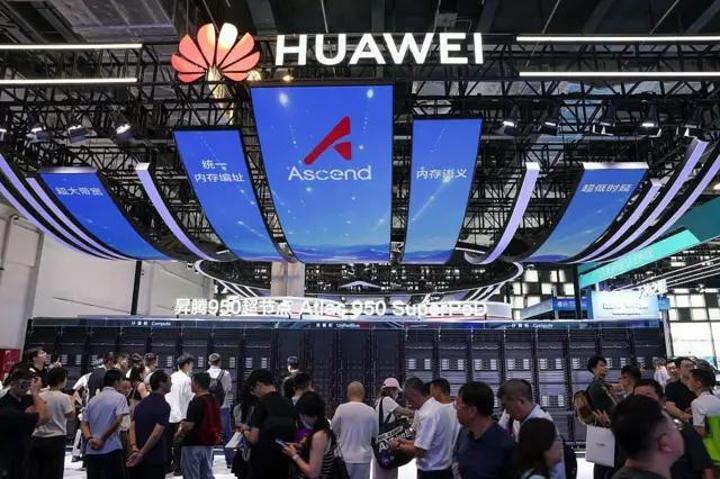
Africa-Press. The tender for establishing an artificial intelligence data center in Egypt may seem straightforward, but its details reveal a much broader competition than just a commercial contract. A Chinese company has submitted a proposal to the Egyptian government to create an AI computing infrastructure, utilizing over 2,000 advanced chips produced by the company. Meanwhile, the administration of the U.S. president is reportedly attempting to gather a coalition of American companies to present a competing offer. Thus, Egypt finds itself at the heart of one of the most significant technological rivalries between the United States and China. The Egyptian government has not yet announced its choice between the two proposals.
What is the new project?
According to information published, the Chinese proposal includes supplying 1,408 chips from the Ascend 950 series for use in a cloud infrastructure dedicated to training AI models, along with an additional 600 chips of the same type or the older Ascend 910B model, to operate two centers dedicated to what is known as “inference,” meaning running AI models after they have been trained. Documents indicate that the company proposed to implement the infrastructure within 12 months. However, experts believe that the project’s significance for the company is not just about the size of the deal. If agreed upon, it would be one of the first known tests of the Chinese company’s ability to export advanced Ascend chips after more than a year of attempts to enter markets outside China. Additionally, the execution of the deal may be affected by U.S. restrictions on Chinese technology. Since 2023, shipments of certain advanced AI chips to Egypt have been subject to U.S. licensing requirements, and the administration has warned that using some advanced chips without Washington’s approval could expose users to sanctions.
What is an AI data center?
AI data centers differ from traditional data centers, particularly in the scale of computing power they require. An information systems and cybersecurity consultant explains that a data center is the physical and digital infrastructure through which vast amounts of data are stored, processed, and managed. However, with artificial intelligence, the data center transforms into what resembles a “digital factory,” housing storage units, networking equipment, and thousands of servers, alongside specialized processors capable of handling massive amounts of data in a short time. The consultant adds that training and running AI models requires enormous computing capabilities, making these centers an essential part of the infrastructure underpinning AI economies. An expert in information technology and AI notes that the proposed project falls under what is known as “hyperscale data centers,” which are designed to continuously expand their capacity by adding more processors and computing resources. Therefore, the proposed project is not just a place for data storage but a computing infrastructure that can grow with the demand for AI applications. The expert also mentions that Egypt already has data centers and has been working for years to expand its digital infrastructure, but a dedicated AI data center at this level serves a different function. The presence of these capabilities within Egypt could reduce reliance on computing resources outside the country or on foreign cloud computing services, allowing for faster development and operation of AI models, as well as enabling universities, startups, and government institutions to utilize these capabilities. However, there is another more sensitive aspect, which is “digital sovereignty.” The consultant explains that a data center of this size could handle governmental, financial, health, and commercial data, as well as data from millions of users. Therefore, having servers within Egyptian territory represents a facet of sovereignty over data, but it is not sufficient on its own.
Why Egypt?
Experts interviewed believe that the competition for the project is not only about Egypt’s internal needs. Egypt is one of the largest countries in Africa by population and enjoys a location that connects Africa, the Middle East, Europe, and Asia. The consultant notes that its telecommunications infrastructure makes it an important hub in the region, as international submarine cables connecting different parts of the world pass through it. What distinguishes Egypt, according to the expert, is the combination of “market size, human resources, and geographic location.” The presence of Egyptian talents and startups working in AI could make the center a base for developing applications across multiple sectors, rather than just a facility serving the Egyptian market. A researcher in AI at a university believes that the center could become part of a regional infrastructure providing computing and AI services to other Arab and African markets that are still in the early stages of building their infrastructure in this field. Other countries in the region, particularly the UAE and Saudi Arabia, are already trying to build their capabilities, investing heavily in data centers and AI. However, Egypt offers a different mix of a large market, geographic location, telecommunications infrastructure, and human resources. Technological cooperation between Egypt and China has expanded in recent years to include cloud computing, data centers, chip design, AI, and training personnel. In September 2024, agreements were signed between Cairo and Beijing in the telecommunications and information technology sector, including the establishment of a research and development center for chip design, collaboration in developing an open-source Arabic language model, and the creation of a $300 million technology fund, alongside projects with Chinese companies. This is part of broader economic relations, with trade between the two countries reaching approximately $17 billion in 2024, according to the Egyptian Minister of Investment and Foreign Trade.
Why is the project important for the company?
The consultant states that the deal represents an opportunity for the company to test its ability to transfer the AI system it has developed outside the Chinese market. He adds that Chinese chips are still lagging behind the best American chips in terms of capabilities and available production volume. He also points out that U.S. restrictions on China’s access to advanced semiconductor manufacturing technologies hinder the company’s ability to produce large quantities of AI chips. Therefore, a successful deal in Egypt would be significant for the company for two reasons: it would mean international demand for its chips and provide an opportunity to demonstrate its ability to deliver the necessary infrastructure outside the Chinese market.
Why is the United States interested?
A researcher in AI believes that Washington is not only seeking the deal with Egypt but also aiming to limit the spread of advanced Chinese technology. Conversely, Beijing views U.S. restrictions as an opportunity to present itself as an alternative supplier to countries looking to build their AI capabilities. Independent estimates suggest that the United States and China together control about 90 percent of global AI-related computing capabilities, while they account for between 70 and 80 percent of global investments in this field. Both countries are also preparing for a new round of dialogue on AI in September. The two sides agreed, following a summit between the presidents, to establish government channels for dialogue regarding AI, with discussions set to take place in September.