By Mustafa Al-Mu’tasim
Africa-Press. Journalist Tim Eaton revealed in an article published on June 30, 2026, in a local source, details of a meeting that took place between Saddam Haftar, the son of Khalifa Haftar, and the U.S. Secretary of State, Marco Rubio, during Saddam’s visit to Washington.
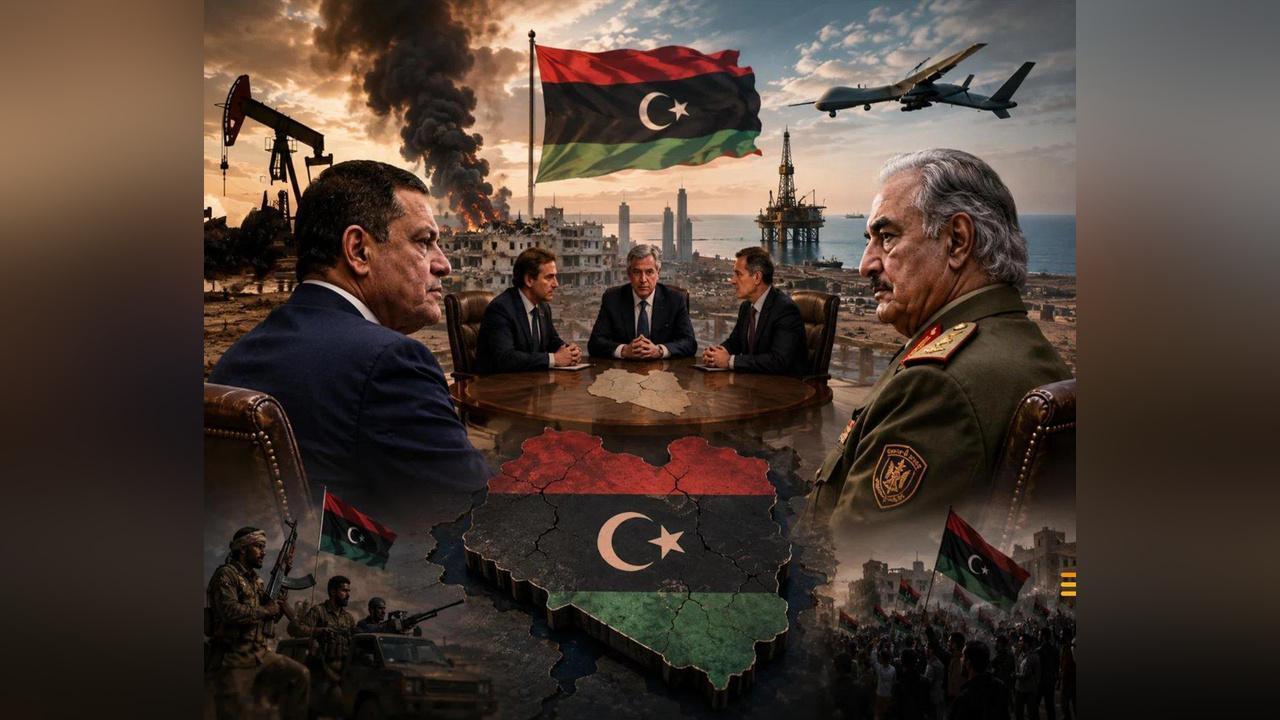
The article stated that both sides discussed “ongoing Libyan efforts to unify military, economic, and political institutions in the country.” It added that the U.S. envoy, Mas’ad Paul, is working on arrangements for power-sharing in Libya between the Haftar and Dbeibah families, granting the Dbeibah family the premiership and the Haftar family the leadership of the presidential council composed of three members, with two members from the west and south of the country.
Is the U.S. truly serious about finding a radical solution to the Libyan crisis with this arrangement, or is it, by entrenching the rule of two rival families, opening the door wide for further crises, potentially leading to the official division of Libya?
The Outcomes of a Libyan Spring That Did Not Blossom
Muammar Gaddafi did not realize that he was signing his death warrant and exposing Libya to the risk of disintegration and division when he decided in the summer of 2003 to abandon Libya’s nuclear program and accept the destruction of the weapons of mass destruction held by the Libyan army, especially the long-range missiles that threatened southern Europe. Not only that, but he also announced the Libyan regime’s responsibility for the Lockerbie incident and accepted to compensate the victims with $2.7 billion, delivering an official letter of acknowledgment to the United Nations Security Council.
However, these major concessions did not save him; his attempts to win over Western countries, led by Britain with which he signed major economic deals in the oil sector, failed. His attempts to win over French President Nicolas Sarkozy, who received bribes for his election campaign and signed huge contracts worth tens of billions of dollars when he hosted him in Paris in December 2007, also did not succeed in buying Western loyalty.
Gaddafi was completely assured of Western approval after all the concessions he made when the Libyan people rose in February 2011 demanding freedom, justice, and democracy. Therefore, he did not think of positively responding to his people’s demands and preferred to use force to suppress the protesters. However, NATO, led by the U.S. and France, quickly exploited Gaddafi’s miscalculations to wage war against him, with Gulf parties intervening under the pretext of protecting human rights in Libya and preventing the regime from brutalizing the Libyan people.
After Gaddafi’s death, Libya experienced a complex situation that nearly turned it into a failed state, engulfed in chaos and armed conflicts, with areas of influence divided among the warring parties. Events clearly showed that Western countries were not concerned with defending human rights or establishing democracy in Libya; they were only interested in winning Libya’s oil and reconstruction contracts for what the war had destroyed. After getting rid of a troublesome leader, they agreed on his ousting, then later disagreed on dividing the spoils.
Italy leaned towards supporting the Government of National Accord, while France supported Khalifa Haftar, believing that the chaos that would settle in Libya would allow it to achieve a hope it had since the approval of the “Befin Sevorza” project, in which Britain and Italy agreed on March 10, 1949, to impose Italian trusteeship over Tripoli, British trusteeship over Cyrenaica, and French trusteeship over Fezzan, rich in oil and bordering Niger, where uranium mines are located.
As for Washington, it played both sides; it publicly supported legitimacy, meaning the Government of National Accord, but secretly extended its hand to retired General Khalifa Belqasim Haftar, who has held U.S. citizenship since 1993, and whom U.S. newspapers insist on describing as “the general” despite him being merely a retired general. Haftar, who spent twenty years as a refugee in Virginia, returned to Libya in 2011 and held senior positions in the forces that ousted Gaddafi, then became the leader of what is known as the “Libyan National Army” in 2014, launching a campaign against the Government of National Accord. Meanwhile, Russia, seeking to return to Libya as it was during Gaddafi’s time, insisted on entering the conflict alongside Haftar under the pretext of fighting terrorism, albeit indirectly through Russian mercenaries.
Gulf countries, led by Qatar, Saudi Arabia, and the UAE, also agreed to support the rebels in Libya with money, weapons, and media to overthrow Gaddafi’s regime, but later disagreed on who should rule Libya. While Qatar leaned towards supporting the Government of National Accord in Tripoli, recognized by the United Nations, Saudi Arabia, the UAE, and Egypt supported Haftar in eastern Libya, accusing the Tripoli government of being close to the Muslim Brotherhood. The UAE continues to support Haftar, as he facilitates the passage of weapons and mercenaries to the Janjaweed militia in Sudan.
The Turkish intervention restored a kind of balance of power among the warring factions in Libya, making a military resolution in favor of one side nearly impossible and rendering Libya’s future and unity dependent on agreements and compromises among the various political players. This was well understood by Libyan political actors and external parties, allowing for the launch of a dynamic culminating in the Libyan political agreement under the auspices of the United Nations, known as the “Skhirat Agreement,” which was signed on December 17, 2015, followed by the meeting on February 5, 2021, in Geneva, where an agreement was reached to form a national unity government to prepare Libya for general elections in December 2021.
On March 10, 2021, the Libyan parliament voted in favor of a national unity government headed by Abdul Hamid Dbeibah. The new Libyan presidential council, composed of three members led by Mohamed Menfi, took the oath before the constitutional court in Tripoli on March 15, 2021, more than a month after its appointment within a political process sponsored by the United Nations. However, despite all efforts to unify the Libyan situation, Libya continues to live in the rhythm of intense power struggles.
Normalization… A Passage to the White House
Normalization today is a passage to the U.S. administration, which is significantly influenced by the American Jewish lobby (AIPAC). Regarding Libya, President Trump, who operates with a business mentality, believes that expanding U.S. influence in Libya will enable his country to achieve economic gains and profitable deals, allowing American companies to return to this country and expand their operations in the reconstruction and Libyan oil sectors, as happened with Chevron.
In November 2021, international media reported that Saddam Haftar, who has held the position of Deputy Chief of Staff of the Libyan National Army and commander of the Tariq bin Ziyad Brigade since 2017, visited Israel during his return from a trip to Dubai. During this visit, he held meetings with Israeli officials, conveying a message from his father requesting military and political assistance from Tel Aviv in exchange for establishing diplomatic relations between Libya and Israel in the future.
In May 2025, discussions about the relationship between the eastern Libya camp and Israel resurfaced when Mahmoud Al-Masrati, a journalist who previously served as the media advisor to the Libyan parliament loyal to Haftar, revealed that he personally attended meetings that brought together Saddam Haftar and officials from the Israeli Mossad, who offered him support to reach power in Libya in exchange for his father’s resignation, which he refused, according to his testimony. Of course, Israel does not hide its public bias towards the eastern camp.
These communications caused significant discontent among Libyans and a wave of anger on social media, raising questions and doubts about the depth of the relationship between some eastern Libyan parties and the Zionist entity. Whether these meetings represent a genuine trend towards normalization or merely an attempt to make Saddam acceptable to Washington and the West supporting Israel, the mere communication with the Mossad amid the aggression on Gaza places Haftar’s camp in the crosshairs of the Libyan street, which considers the Palestinian cause one of its national constants.
Saddam Haftar’s Visits to Washington
Haftar the elder understands that the significant exit of Europe, led by France, from the Libyan equation, the Turkish-Egyptian rapprochement, the tension in relations between Saudi Arabia and the UAE, and the evolution of the Egyptian stance due to the eastern Libya camp’s position on the ongoing crisis in Sudan, where Cairo tends to support the Sudanese army led by Abdel Fattah al-Burhan in its fight against the Rapid Support Forces led by Mohamed Hamdan Dagalo (Hemeti), who is supported by the eastern Libya camp in line with the positions of regional and Arab parties, led by the UAE, all of this will negatively impact his camp. This prompted him to seek to strengthen his relationship with Washington and support the position of the eastern government, even politically, through Saddam Haftar’s visit to Washington.
So far, there have been two announced visits by Saddam Haftar to Washington. The first was in April 2025, when he visited Washington at the head of a delegation as an envoy of the general command in eastern Libya, during which he met with the U.S. president’s advisor Mas’ad Paul, in the presence of officials from the U.S. State Department, including Richard Norland and Tim Lenderking. The discussions focused on supporting the unification of Libyan institutions and enhancing cooperation between the U.S. and Libya, especially in security and economic fields. The American network CNN reported on an offer made by President Trump’s administration to Saddam Haftar during this visit, which involved resettling Palestinian refugees from Gaza in Libya. This is the same offer that Israel presented to Saddam during his visit to Israel, according to Channel 12, which was rejected by the Libyan parliament.
The second visit took place in June 2026, where Saddam met with U.S. Secretary of State Marco Rubio, in addition to Mas’ad Paul. The discussions, according to official statements, focused on the U.S. initiative regarding the Libyan crisis, the unification of military, political, and economic institutions, and prospects for cooperation between the two sides.
During this visit, Mas’ad Paul presented the initiative revealed by the local source, which entails power-sharing in Libya between the Haftar and Dbeibah families, granting the Dbeibah family the premiership and the Haftar family the leadership of the presidential council composed of three members, with two members from the west and south of the country, and Saddam Haftar will control it as the deputy commander of the armed forces of Khalifa Haftar, providing him with a platform to expand the influence of his armed forces in western Libya, after their long-standing failure to control Tripoli between 2019 and 2020. Since Saddam Haftar and his father do not genuinely wish to share power, it is likely that the Haftar family will not accept being confined to the presidential council and will exploit this arrangement to seize power.
So… does Mas’ad Paul’s arrangement seek to entrench “family rule” in Libya? Or does it prepare the ground for the Haftar family to dominate power? Or does it perpetuate political division, opening the door for the official division of Libya?
In any case, this arrangement is a burial of any genuine transition to democracy in Libya, completely contradicting what the Libyans aspired to when they ousted Muammar Gaddafi in 2011 and held elections regarding him in 2012. It also entirely contradicts the roadmap laid out by the United Nations after the civil war that erupted in 2014, which stipulates holding elections and achieving the hopes of the Libyan people for the desired political change.
If the United States views the Haftar-Dbeibah agreement as the only possible agreement under the current circumstances, then Paul’s initiative has sparked widespread anger among many Libyans, who believe that not concluding any deal is better than concluding a bad deal, and that what is happening is merely crisis management, not a solution, in a scene that reproduces division and fuels conflict instead of extinguishing it.