Africa-Press. Marianne, a French magazine, reported that Algeria is rapidly moving towards reducing the presence of the French language in its educational system while enhancing the status of English. This shift has drawn criticism from educators and intellectuals who believe that, despite its ties to colonial history, French has become part of Algeria’s cultural and scientific memory.
The magazine added in its report that the project to replace French with English in Algerian schools has begun to take a gradual form, as authorities have been reducing the space allocated to French for years and promoting English as the “language of science.”
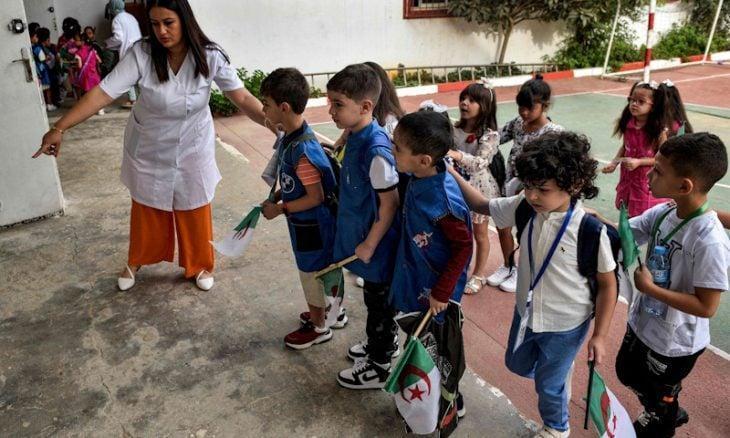
The most significant transformation began in 2023 when Algerian President Abdelmadjid Tebboune announced the introduction of English starting from the third year of primary education, alongside French. At that time, about 60,000 teachers were hired and trained within weeks, and the hours allocated for teaching both languages were shared.
The decision faced criticism from education unions and specialists who argued that such a large-scale reform cannot be implemented so quickly; however, it was welcomed by conservatives who view English as a step towards eliminating French, which some still describe as the “language of the colonizer.”
Marianne continued to clarify that the process of reducing French entered a new phase at the end of July when the Minister of National Education announced the removal of subjects classified as “non-essential” from the curricula of final-year classes. According to the report, French was among the most affected, as it is now only present in a limited number of scientific streams.
The magazine quoted researcher Abdelrazak Dourari criticizing the idea of linking English to scientific advancement, arguing that it is based on a “mythical vision of language education and knowledge acquisition,” as merely using English does not equate to producing scientific knowledge. It also quoted educator Ahmed Tissa, author of the book “Teaching French… The Impossible Eradication,” stating that replacing the French-speaking Algerian elite with an English-speaking elite would require “at least fifty years, if not more.”
Tissa emphasizes, according to the magazine, that a significant portion of Algeria’s national heritage is written in French, in addition to the millions of Algerians in French-speaking countries, making the exclusion of French an issue that transcends the school system. The magazine also quoted a researcher in the Amazigh language from Bejaia, stating that reducing French education targets not just the language but also “memory,” referring to Algerian literature written in French and the legacy of intellectuals and writers who used it to express their ideas and positions.
Marianne recalled the expression of the late Algerian novelist Kateb Yacine, who described French as a “war booty,” highlighting the paradox governing Algeria’s relationship with it: a language associated with colonialism that transformed after independence into a tool for creativity, thought, and scientific research.
The magazine noted that a group of Algerian intellectuals affirmed in an article published in the French newspaper Le Monde on August 12 that French has become part of Algeria’s intellectual, scientific, and cultural heritage, and that Algerians have reclaimed and used it as a means of creativity, liberation, and communication.
Marianne quoted former Algerian deputy Abdelwahab Yakoubi stating that French remains useful in many fields, including medicine, scientific research, higher education, industry, and the economy.
The magazine also referred to the position of writer Yasmina Khadra, who believes that French “carries part of the Algerian memory” and that erasing it would be illogical.
Marianne concluded that the Algerian debate over French has evolved from a mere disagreement about a foreign language into a discussion about identity, memory, heritage, and the future of education. While proponents of English see it as the language of the future and science, defenders of French fear that its exclusion could sever ties to a significant part of Algeria’s cultural and scientific history.