Sabrina Ailan
Africa-Press. Algeria is moving to expand its economic and energy partnership with Germany by presenting promising investment opportunities to several major German companies in the fields of oil, gas, petrochemicals, green hydrogen, and equipment manufacturing. This comes alongside its invitation to participate in the “Algeria Bid Round 2026” for the exploration and development of seven land blocks.
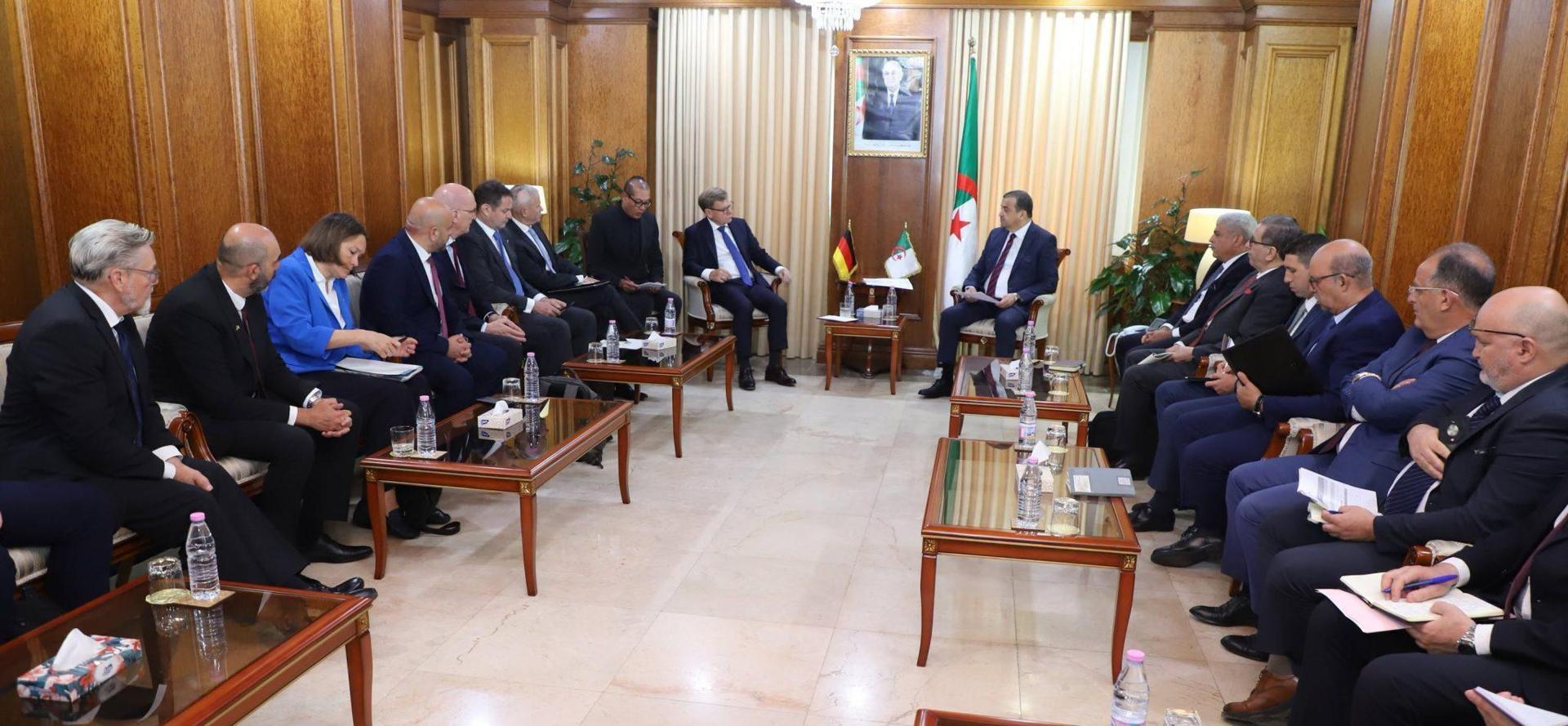
This was discussed during talks held by the Minister of State for Energy and Mines, Mohamed Arkab, with the German Foreign Minister, Johan Wadephol, and the accompanying economic delegation, as part of efforts to enhance bilateral cooperation and transform the political rapprochement between Algeria and Berlin into tangible investment, industrial, and energy projects.
The German delegation included representatives from several institutions active in energy, engineering, and industry, including Bosch Energy, Thyssenkrupp, VNG, and Siemens Energy, along with a representative from the German Automotive Industry Association (VDA), reflecting the broad range of topics on the table for the Algerian-German partnership.
The discussions addressed the potential for expanding cooperation in oil and gas production, engineering and infrastructure, equipment manufacturing, and the marketing of natural gas and liquefied natural gas, as well as integrating low-carbon technologies at various stages of the hydrocarbon chain.
Arkab emphasized the importance of developing petrochemical industries in Algeria and benefiting from German expertise and technology, confirming the readiness of the hydrocarbons sector to support foreign companies wishing to invest and provide suitable conditions for the implementation of their projects.
Petrochemicals hold particular significance for Algeria, given their ability to increase the added value of oil and gas resources by converting part of them into industrial materials and higher-value products, thereby reducing reliance on exporting raw materials and strengthening the national manufacturing base.
This sector also opens the door for the establishment of new industrial units and the development of a network of Algerian companies specialized in maintenance, engineering, services, and equipment, contributing to job creation and technology localization.
In this context, Dr. Baghdad Mendoush, an expert in oil and hydrocarbons, stated in a statement to a local source that Algeria has become an increasingly attractive destination for major global oil and gas companies in recent years, due to its geological qualifications, strategic location, developed infrastructure, and the legal framework provided by the 2019 Hydrocarbons Law.
Mendoush explained that the first strength that makes Algeria increasingly attractive to investors lies in its significant geological potential, noting that Algeria’s mining area is estimated at about 1.5 million square kilometers, which has not been fully explored, especially in the northern regions and offshore areas.
He added that this situation opens the door for new discoveries in oil and gas, whether related to conventional or unconventional hydrocarbons, which represents a key attraction factor for international companies seeking new areas for exploration and investment.
Algeria is becoming a strategic destination for major oil and gas companies.
In this regard, Mendoush highlighted that the legal framework for investment in the hydrocarbons sector is an additional factor enhancing Algeria’s attractiveness, especially after the issuance of the 2019 Hydrocarbons Law, which, according to him, introduced standards in line with internationally accepted norms.
He pointed out that the law includes a range of incentives, particularly in the tax aspect, and offers several contractual formats for investors, including Production Sharing Agreements, which are widely adopted in the global oil and gas industry.
Mendoush believes that providing this flexibility in contracts allows international companies to evaluate their projects according to different investment models and gives them a clearer framework for risk and return sharing, which is an important element when deciding to invest in exploration and production projects.
Among the factors that give Algeria an advantage in competing for oil and gas investments, the expert mentioned the size of its hydrocarbon reserves and its strategic geographical location.
He clarified that Algeria has significant proven reserves, estimated at about 4.5 trillion cubic meters of gas and around 12 billion barrels of oil, making it one of the countries with significant reserve bases in the region.
He confirmed that Algeria’s geographical location is also a strategic asset, given its proximity to European markets, which are among the largest energy-consuming markets, providing additional advantages for investments in gas and oil in Algeria regarding ease of access to markets.
A network of pipelines, ports, and facilities gives Algeria an advantage.
Mendoush did not stop at the geological and legal aspects but emphasized that Algeria’s extensive infrastructure in the hydrocarbons sector is a crucial factor in attracting foreign companies.
He explained that Algeria has oil and gas production centers and an important network of transport pipelines, including the Transmed pipeline connecting Algeria to Italy via Tunisia, in addition to the Medgaz underwater pipeline supplying Spain with Algerian gas, which gives the country considerable capabilities in transporting gas to European markets.
Regarding maritime transport, the expert noted that Sonatrach owns a fleet dedicated to transporting gas and oil, along with facilities for the production and liquefaction of natural gas, including the Skikda and Arzew complexes.
He also highlighted the importance of the oil refineries spread across various regions of the country, which cover a significant portion of national market needs and support the export capabilities of petroleum products.
In this context, he referred to future projects aimed at enhancing refining capacities, including a large-capacity refinery project in the Hassi Messaoud area.
Mendoush believes that these combined factors have reflected on Algeria’s attractiveness to major global oil companies, recalling the presence of prominent international companies in the Algerian market, such as the Italian group Eni, as well as Chinese companies like Sinopec and CNPC.
He added that the entry of global companies like Chevron and ExxonMobil into the Algerian market is an important indicator, given that these companies typically do not enter any market without a thorough study of the geological potential, investment environment, and political and geographical stability of the country in question.
According to the expert, the interest of these companies in Algeria reflects promising prospects for discovering new oil and gas resources, along with favorable investment and legal conditions and a geographical location that facilitates access to European markets.
Among the additional advantages for Algeria, according to Mendoush, is the presence of Sonatrach as a strong national partner with extensive experience in various stages of the hydrocarbons industry.
He clarified that Sonatrach is not just a national company in the energy sector but represents a reservoir of Algerian expertise and competencies in exploration, production, transportation, refining, and marketing, allowing foreign companies to rely on a local partner with knowledge of Algerian geology and various stages of the value chain in the hydrocarbons sector.
He emphasized that having this partner is crucial for foreign investors, as it reduces technical and investment risks and provides the necessary competencies and expertise to implement major projects.
Speaking about the evolution of investments, Mendoush noted that the new direction launched by Algeria through licensing rounds and investment in the hydrocarbons sector, especially after “Petroleum 2024,” has contributed to enhancing the attractiveness of the Algerian market.
He explained that 2025 witnessed the signing of several contracts in the exploration sector, with significant investments, reflecting, according to him, an increase in international companies’ interest in the available opportunities in Algeria.
He added that continuing this trend throughout 2026 would enhance exploration efforts and open the door for new discoveries, particularly in areas that have not yet been sufficiently explored for their geological potential.
The Hormuz crisis redraws the energy security map.
In a reading of recent geopolitical developments, Dr. Baghdad Mendoush believes that tensions in the Middle East and the risks associated with strategic maritime corridors, primarily the Hormuz Strait, are prompting global oil and gas companies to reconsider their investment maps.
He explained that energy crises and geopolitical disturbances are leading major companies to increasingly seek areas with higher levels of stability and political security, as well as infrastructure that allows for the transportation of hydrocarbons to global markets without excessive reliance on geopolitical choke points.
In this context, Mendoush considers that Algeria possesses a significant relative advantage, as it is located far from the main conflict zones in the Middle East, enjoys a location close to Europe, and has a network of pipelines, facilities, and ports that allow it to export oil and gas through multiple routes.
The oil and hydrocarbons expert added that the growing interest of major companies in Algeria is not linked to a single factor but is the result of a combination of geological, legal, economic, and geopolitical elements.
He confirmed that Algeria’s possession of a vast and not fully explored mining area, significant reserves of oil and gas, along with an incentivizing Hydrocarbons Law, a wide infrastructure network, a national partner like Sonatrach, and proximity to the European market, all make Algeria a candidate to enhance its position on the global energy investment map.
Mendoush believes that current geopolitical developments may provide Algeria with an additional opportunity to attract more investments, provided that it continues to improve the business climate, accelerate exploration efforts, develop infrastructure, and take advantage of the transformations occurring in the global energy market, allowing for the conversion of increasing international interest into actual investments, new discoveries, and additional revenues for the national economy.