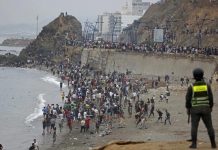

Africa-Press. Spain estimated that around 60,000 migrants crossed from Morocco to the city of Ceuta in the past 24 hours, marking one of the largest waves of mass crossings at the southern border of the European Union.
The Ministry of the Interior stated that the migrants arrived in the Spanish city by land and sea, as large numbers surged through the border area and the vicinity of the Moroccan city of Fnideq.
According to a local source, the announced figure is an initial official estimate that exceeds previous estimates reported by Spanish television, which mentioned between 2,000 and 3,000 crossings on Thursday. The Ministry of the Interior did not immediately clarify the methodology used to arrive at the estimate of 49,000.
The estimated number is more than half of Ceuta’s population, which is around 85,000, and it significantly surpasses the wave of crossings that occurred in 2021, when about 10,000 people entered during a diplomatic crisis between Madrid and Rabat. Ceuta, along with the city of Melilla, is located on the northern coast of Africa and represents the only land border of the European Union with the African continent.
Meanwhile, the Associated Press reported that at least 18 migrants died during attempts to reach Ceuta, some by drowning or during stampedes at the border area, while the streets and squares of the city were filled with arrivals who had no accommodation available in reception centers.
The Spanish government has sent reinforcements from the army, police, and civil guard to Ceuta to secure the border and assist local authorities in managing the large numbers of arrivals.
The Prime Minister of Spain and the Minister of the Interior are scheduled to visit the city to monitor developments and assess the situation at the Tarajal crossing.
The city of Fnideq and nearby areas experienced a turbulent night, with thousands still attempting to cross despite the presence of Moroccan security forces and the closure of most access roads to the crossing.
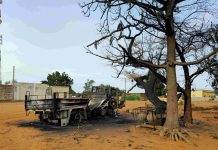
Moroccan authorities used water cannon trucks to prevent groups from approaching the border gates, while a bus and seven vehicles were burned during clashes that erupted when forces attempted to disperse the crowds.
In a related context, the opposition People’s Party accused the Sanchez government of being slow to protect the borders and called for the use of available resources to defend national security and the territorial integrity of Spain, while far-right parties described the wave of crossings as an “invasion.”
The crisis has extended to relations within the European Union, as the Italian government threatened to take measures related to the Schengen Area unless Spain regains control of its borders, while Madrid rejected the Italian statements, describing them as a political exploitation of the crisis.
Ceuta regularly experiences mass crossing attempts due to its geographical proximity to Moroccan territory and its status as a direct entry point to the European Union. Notable previous waves of crossings were recorded in May 2021, when around 10,000 people entered Ceuta amid a diplomatic dispute between Rabat and Madrid.
The current wave raises humanitarian, security, and legal challenges related to the reception of migrants, the processing of their requests, and the return of those unqualified for residency, in addition to its impact on Spanish-Moroccan relations and European migration policy.