
What You Need to Know
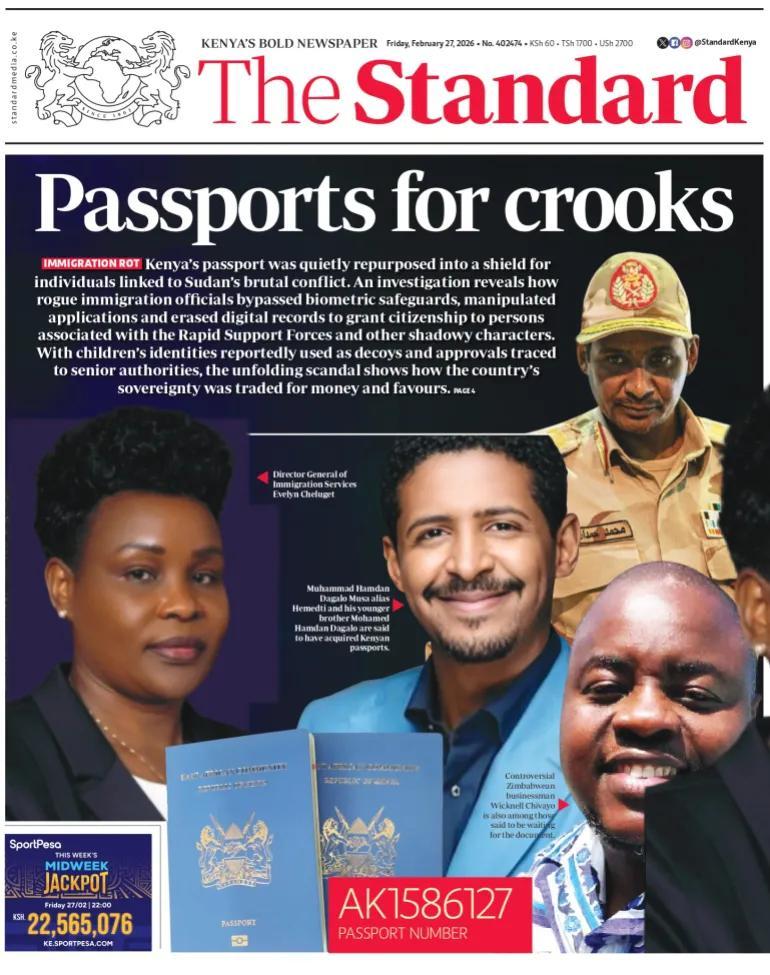
A political uproar has erupted in Kenya following revelations that Sudanese individuals linked to the Rapid Support Forces received Kenyan passports. Activists demand an urgent investigation into the matter, which raises questions about the integrity of Kenyan institutions responsible for passport issuance and the implications for Kenya’s international relations.
Africa-Press. A political uproar has erupted in Kenya following revelations that Sudanese individuals linked to the Rapid Support Forces received Kenyan passports. Activist Boniface Mwangi disclosed that these passports have sparked widespread political and legal controversy in Nairobi, with calls for an urgent investigation and demands for the cancellation of the documents.
The issue came to light after leaked documents indicated that Hamdan Dagalo, brother of Rapid Support Forces leader Mohamed Hamdan Dagalo (Hemedti), obtained an official Kenyan passport. Hamdan is described as a businessman residing in Dubai, but he is also one of the key logistical officials in the Rapid Support Forces and is subject to U.S. and European sanctions due to his role in the Sudanese conflict.
Possessing such a document allows him to move freely and bypass imposed restrictions, raising questions about the integrity of Kenyan institutions responsible for passport issuance.
Notable Names in the Documents
The scandal does not involve only Hamdan Dagalo; the leaked documents revealed other controversial names, including prominent politicians from the Front for Resilience, such as Sharif Mohamed Othman Sharif Suleiman and Taha Othman Ishaq Adam, among others.
The Front for Resilience is viewed as the political wing considered a civilian facade for the Rapid Support Forces, raising further concerns that Kenya may have issued passports to figures representing a political and military extension of this force, which is accused of widespread violations in Sudan. The presence of these names strengthens suspicions of a network of relationships that go beyond mere administrative error, raising questions about potential political or economic interests behind the issuance of these documents.
Political Outrage
Former Chief Justice and current presidential candidate David Maraga described the situation as a “deep constitutional crisis” and called for a transparent investigation by the Ethics and Anti-Corruption Commission and the Directorate of Criminal Investigations. He emphasized that granting a passport to an individual accused of war crimes undermines Kenya’s neutrality in the Sudanese conflict and erodes public trust in state institutions.
Meanwhile, the Kenyan opposition, led by Kalonzo Musyoka and Martha Karua, accused President William Ruto’s government of being involved in dubious relationships with Sudanese militia leaders. They warned that this move damages Kenya’s international image and exposes it to potential sanctions, noting that recent developments have negatively impacted economic interests, such as losing part of the Sudanese tea market.
Potential Diplomatic Fallout
Media reports have described the issue as a “major diplomatic scandal,” as possessing a passport by an individual listed on international sanctions opens the door to bypassing international restrictions.
Human rights organizations and Western governments have expressed concern over these developments, while Washington has threatened to impose additional sanctions on Kenyan officials if their involvement in facilitating the issuance of the document is confirmed. This stance reflects the seriousness of the issue for Nairobi’s foreign relations, particularly with its Western partners who are closely monitoring the course of the Sudanese conflict.
Kenya plays a pivotal role in regional mediation efforts through IGAD, yet this case raises questions about its neutrality and credibility. While it positions itself as a mediator in the Sudanese crisis, the leaked documents reveal the possibility of corruption networks within the immigration system being exploited to provide safe havens for individuals accused of serious violations, threatening to undermine Nairobi’s role as a neutral mediator and erode the trust of Sudanese parties and the international community in its efforts.
Is Kenya’s Neutrality at Stake?
The Kenyan government has not officially confirmed the authenticity of the documents, but the scale of public and political outrage, along with international pressure, suggests that official steps are likely to be taken in the coming days, whether through investigations or decisions to revoke the documents. This case remains a challenging test of Nairobi’s commitment to principles of transparency and the rule of law, as well as its ability to maintain its role as a neutral mediator in one of the region’s most complex crises.
Kenya has historically played a significant role in regional diplomacy, particularly in mediating conflicts in the Horn of Africa. However, its credibility has been challenged by allegations of corruption and political favoritism, especially in sensitive matters involving foreign entities. The recent passport scandal involving individuals linked to the Rapid Support Forces highlights ongoing concerns about governance and accountability within Kenyan institutions.