Africa-Press. Ghana aims to transform the increasing international support for slavery reparations into tangible actions. As a three-day summit concluded in the capital, Accra, African and Caribbean leaders are set to adopt a declaration outlining the next steps on this issue.
The summit follows a “non-binding” resolution adopted by the United Nations General Assembly last March, championed by Ghana’s President John Mahama, calling on countries involved in the slave trade to engage in redress efforts and provide reparations.
The historic UN resolution recognized the transatlantic slave trade as “the most heinous crime against humanity.”
The summit concluded with a ceremony held at the Osu Castle in Accra, a fortress built by the Danes and Norwegians in the 17th century, which was used to hold enslaved individuals.
It coincided with the commemoration of “Juneteenth,” the annual holiday in the United States marking the end of slavery, in the first celebration of its kind held outside American soil, according to organizers.
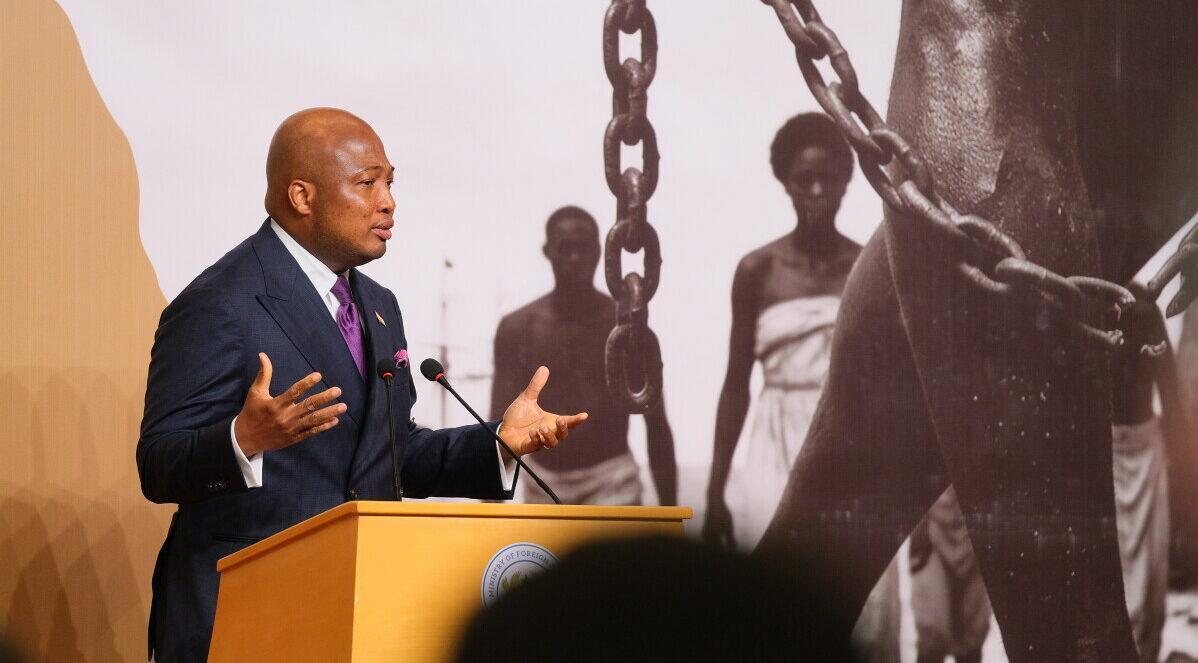
Ghana’s Foreign Minister, Samuel Ablakwa, told participants: “We have triumphed in the battle against slavery, we have triumphed in the battle against colonialism, we have triumphed in the battle against apartheid, and we are confident that we will triumph in the battle against injustice related to reparations.”
He added that the resolution, supported by 123 UN member states, has given the campaign “unprecedented momentum.”
President John Mahama announced the establishment of three working groups to explore practical ways forward, with the first group comprising heads of state, the second focusing on reparations and restitution, and the third addressing legal aspects related to reparations.
Mahama stated: “The question before us is not whether we can change history, that is impossible, but whether we have the courage to face it honestly and the will to turn acknowledgment into meaningful action.”
The Foreign Minister of the Republic of Congo, Constant Serge Bonda, stated in remarks to Radio France Internationale that the summit brings together not only African nations but also descendants of the enslaved in the Americas.
He said: “This issue does not concern Africa alone; it concerns Africa and the countries to which our brothers and sisters were forcibly taken centuries ago,” adding that education, historical research, and the restoration of sites linked to the slave trade will all be part of the reparations process.
He pointed to the Luango region on the Congolese coast, which witnessed the deportation of large numbers of Congolese during the slave trade era, saying: “Luango is one of the important sites that must be restored because it is part of our shared history.”
In a video message to the summit, French President Emmanuel Macron stated that reparations could take various forms, emphasizing that “history cannot be reduced to mere accounting.”
He added that the process should include confronting historical and scientific truths through education and research, alongside the return of artworks looted during the colonial era.
Macron stated: “Reparations cannot just be a check written to end the story.”
He also supported the symbolic abolition of royal decrees that governed the system of slavery in former French colonies, stressing the need to address the issue of reparations while warning against making “false promises.”
For his part, the Congolese Foreign Minister considered France’s efforts to return African artifacts a good start, adding: “It is important that we all work together; these reparations cannot be achieved without the contribution and mobilization of everyone.”
He affirmed that a strong declaration from the summit would be a significant achievement but noted that “the biggest challenges will be in its implementation.”
The Prime Minister of Barbados, Mia Mottley, stated that slavery robbed Africa of more than just labor power, adding: “What crossed the Atlantic was not just humans, but also ideas, humanity, arts, and culture.”
She added that these ideas are returning today in a different form, saying: “What is now a level of consciousness will shape the world in the 21st century.”
Conversely, other participants at the summit felt that mere acknowledgment of historical injustice is not enough.
Nigerian Nobel laureate Wole Soyinka stated that reparations “must go beyond symbolism.”
He added: “It is not just about apologies or financial compensation; it is about restoring the humanity of memory and reclaiming the values that centuries of dehumanization have distorted.