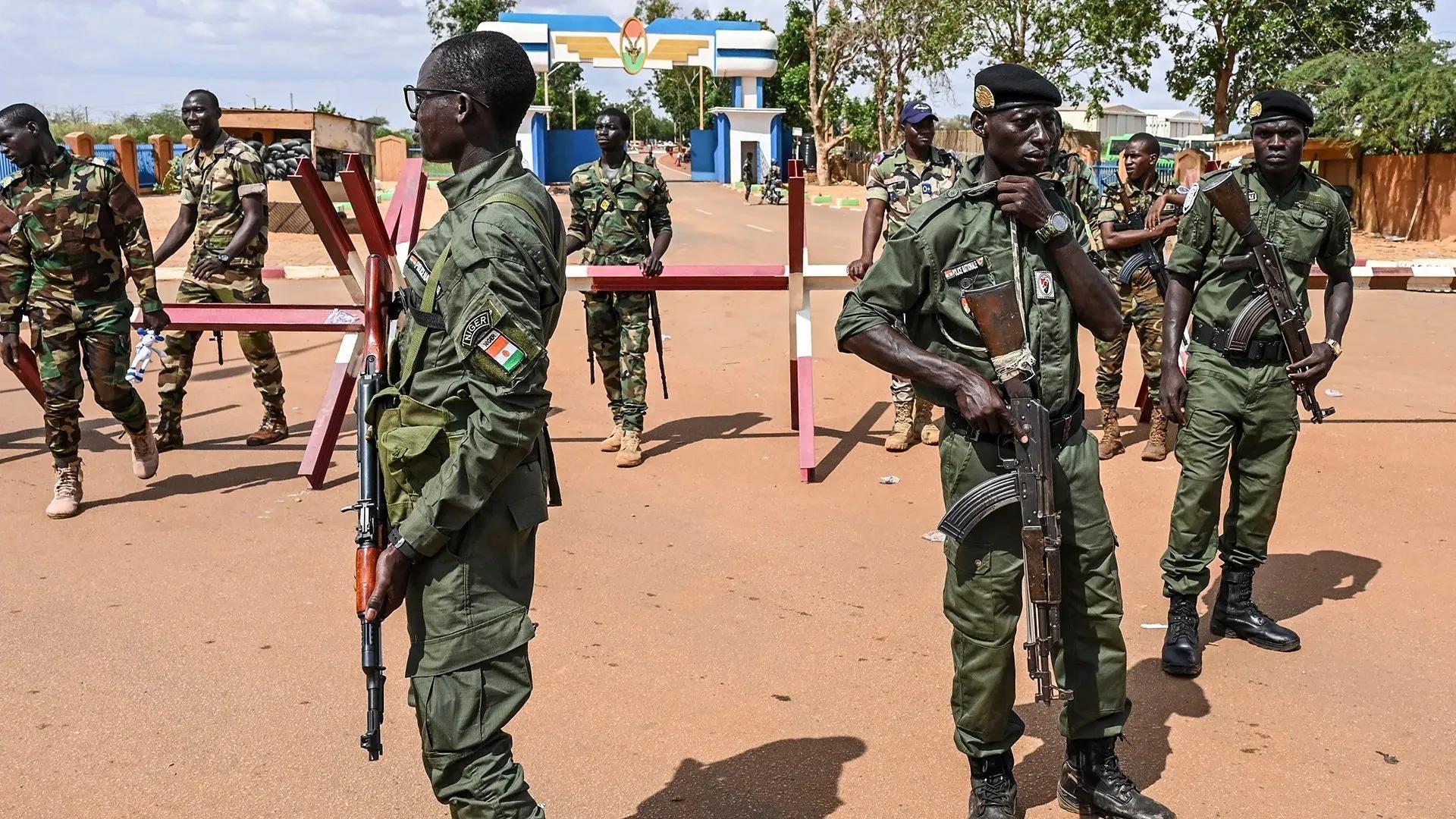
Africa-Press. The President of Niger, General Abdourahamane Tiani, has accused France of financing and training fighters from the group “Support for Islam and Muslims.” He stated that they carried out two attacks targeting the capital’s airport in Niamey this year, marking a new escalation in tensions between Nigerien authorities and Paris, which has been experiencing a continuous decline in influence in the Sahel region for years.
Tiani claimed that his country’s authorities possess “evidence” of France’s involvement in financing the attacks that targeted Hamani Diori Airport on the nights of January 28 and 29, and again on June 18, 2026. He accused Paris of mobilizing and training the attackers and issuing orders to completely burn the airport and shoot at travelers.
He added that the perpetrators of the latest attack were “mercenaries” belonging to the Support for Islam group, which is also active in Mali, asserting that the goal was to completely destroy the airport, directly accusing France of being involved in threatening Niger’s internal security.
Tiani’s statements come at a time when relations between Niamey and Paris have been increasingly strained since the military coup that ousted President Mohamed Bazoum in July 2023, followed by the termination of the French military presence in the country and a strengthening of ties with new international partners.
These remarks coincide with the third anniversary of the coup and may pave the way for further steps in the process of severing ties with Paris, similar to actions taken by Burkina Faso.
Previously, the Nigerien president made similar accusations against Benin, accusing it of hosting bases to train fighters who carry out attacks within Niger. These accusations were denied by Cotonou, which urged Tiani to visit the areas he mentioned to verify the accuracy of those claims. In recent months, Niger resumed communications with Benin following the election of Romuald Wadani, but Niamey has not yet reopened its borders with its neighbor.
The Tillabéri region in the west of the country is particularly vulnerable to armed groups. Since the beginning of the year, the area surrounding Niamey Airport has been targeted by two attacks claimed by the Support for Islam and Muslims group, linked to al-Qaeda, while the other was carried out by the Islamic State in the Sahel.
In response to the accusations, African affairs expert Ahmed Mohamed Mustafa stated that the conflict between France and military regimes in the Sahel goes beyond these accusations, as these governments seek to end French influence that has persisted for decades in its former colonies, against French attempts to maintain its presence in the region.
He noted that Mali, Burkina Faso, and Niger, which form what is known as the “Sahel States Alliance,” consider the alliance a substitute for the previous security arrangements in which France was a key partner. The leaders of these countries believe that Paris supports regional parties to undermine the stability of their regimes.
In response to a question regarding the reality of French intervention in West Africa, Ahmed Mohamed Mustafa stated that Paris’s influence in its former colonies “does not need proof,” describing the region as having traditionally represented a sphere of French influence for decades, considering that the recent military coups have posed the first real challenge to this presence.
He added that France would not easily relinquish its influence in the region, pointing to recurring indicators and accusations linking it to attempts to influence the course of political and security developments in several Sahel countries.
Regarding the armed groups active in the region, Mustafa observed that focusing solely on the Support for Islam and Muslims group does not reflect the ground reality, explaining that many armed organizations are fundamentally based on tribal and local extensions, even if they adopt names associated with jihadist organizations.
He pointed to the existence of other groups, such as the “Azawad Liberation Front” and the “Tebu Front,” which he said have recently issued direct threats against Tiani’s regime, considering that these movements may represent increasing security challenges for the authorities in Niger. He added that some regimes in the region accuse external powers, including France and Ukraine, of providing support to some of these groups.