What You Need to Know
Leaders of the Sahel Alliance, comprising Mali, Niger, and Burkina Faso, concluded a summit in Bamako, expressing their determination to eradicate terrorism in all its forms. They condemned foreign-backed attempts to destabilize the region and emphasized the need for regional cooperation to address security challenges posed by armed groups linked to Al-Qaeda and ISIS.
Africa. Leaders of the Sahel Alliance reaffirmed their commitment to combat terrorism in all its forms during a summit held in Bamako, Mali.
In the closing statement of the summit, the Sahel countries condemned what they termed as futile attempts to destabilize the region by “terrorists supported by foreign nations, including some in the area.”
The final communiqué emphasized the determination of Mali, Niger, and Burkina Faso to eradicate what they referred to as terrorism in all its forms, denouncing economic and media terrorism, disinformation campaigns, and the exploitation of international justice aimed at seizing the resources of these countries.
Bamako hosted the second summit of the Sahel Alliance, which discussed the security challenges these countries face due to the increasing activities of armed groups linked to Al-Qaeda and ISIS.
Malian President and transitional leader General Assimi Goita stated at the summit’s opening that cooperation among Mali, Niger, and Burkina Faso has enabled the elimination of many members of terrorist groups.
Burkina Faso’s President Ibrahim Traore affirmed the alliance’s resolve to counter what he described as attempts by imperialist forces to subjugate Africans. Meanwhile, Niger’s President General Abdrahmane Tiani stated that the Sahel Alliance would ensure its own security without the presence of foreign troops on its territory.
The Sahel Alliance was formed amid rising security crises and regional and Western pressures following a series of military coups in these countries, the latest being in Niger in mid-2023. After ECOWAS threatened military intervention to address this recent coup, the alliance began to take shape as these nations sought to enhance their cooperation and subsequently withdrew from the organization.
The Sahel countries have aimed to sever military ties with France and strengthen their alliances with other partners such as Russia, Turkey, and China, claiming these partnerships provide the necessary equipment and military training.
Existential Challenges
According to political analyst Bandiyogo Dante, the Sahel countries face existential challenges, with ongoing wars, killings, and economic issues. He noted that “failure is not an option; these nations must either succeed or disappear”.
Reports indicate that armed groups, including those linked to Al-Qaeda and ISIS, have launched attacks that have pushed vast areas beyond state control, particularly in the Liptako-Gourma region at the border triangle between Mali, Niger, and Burkina Faso.
The security disturbances in northern and central Mali have had significant repercussions on the capital Bamako and the normal flow of life there. Approximately three months ago, attacks by armed groups linked to Al-Qaeda disrupted supply flows to this landlocked country from the ports of Dakar and Abidjan in Senegal and Ivory Coast.
Sahel Alliance TV Channel Launch
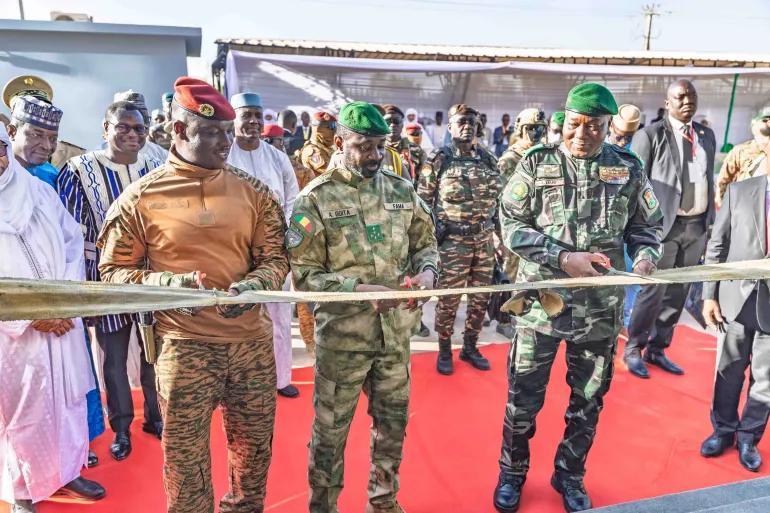
The summit witnessed the inauguration of the official TV channel of the alliance, which will soon begin broadcasting under the name “AES TV.” This initiative aims to serve as a unified media platform that conveys the official discourse of the alliance and keeps pace with regional and international developments.
Malian President Assimi Goïta emphasized that this channel will contribute to coordinating common positions and views, including voting within regional and international bodies. He stressed that any support for other countries will occur within the framework of the alliance and based on collective consultation.
The launch of the channel comes as part of what authorities describe as the “information battle,” complementing the media system that also includes the “Dandy Liptako” radio station in Ouagadougou. This underscores the alliance’s desire to establish independence in its media decision-making.
Investment and Development Bank of the Alliance
In addition to the media initiative, leaders announced the establishment of the Investment and Development Bank of the alliance with an initial capital of 500 billion CFA francs (approximately 900 million dollars).
The bank is set to officially commence operations next year, focusing on financing infrastructure projects and strategic initiatives in the three countries. This financial institution is seen as a crucial step towards enhancing economic sovereignty and reducing reliance on external funding, as the alliance countries aim to build shared financial tools that serve their interests and support their independence in the face of international pressures.
Meeting with National Cadres
At the conclusion of the summit, leaders held a meeting with cadres from the three countries, acknowledging that “not everything is perfect, and progress cannot be made at the desired pace,” but they stressed that the alliance “will evolve.”
The President of Burkina Faso affirmed that the alliance will continue its path toward defeating terrorism, achieving development, and asserting its identity, stating, “We will defeat terrorism, we will evolve, and we will prove ourselves. Homeland or death, we will prevail!”
Strategic Implications
These initiatives confirm the determination of the alliance countries to build joint institutions that serve their interests and support their media, economic, and political independence. They also represent part of a reconfiguration of power dynamics in the Sahel region amid regional and international challenges.
Through these steps, the alliance seeks to solidify its sovereignty and enhance its presence as an independent regional actor capable of facing external pressures and developing its media and financial tools to serve its strategic interests.
The Sahel region has faced escalating security challenges, particularly from armed groups affiliated with Al-Qaeda and ISIS. The recent military coups in the region, including Niger in mid-2023, have prompted countries to seek greater autonomy from foreign military presence, notably from France, and to strengthen ties with other partners like Russia and Turkey. This shift aims to enhance military capabilities and address the growing threats to stability in the region.