What You Need to Know
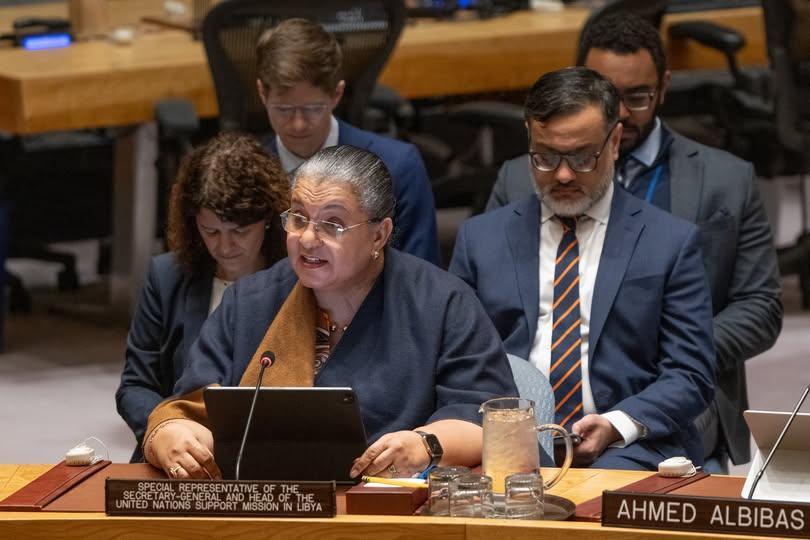
Hana Titi, the UN envoy to Libya, cautioned that increasing divisions within the judiciary and worsening economic conditions pose a significant threat to national unity. During a briefing to the Security Council, she emphasized the need for a coordinated judicial system and urged Libyan leaders to avoid escalatory actions.
Africa-Press. Hana Titi, the UN Special Representative and Head of the Support Mission in Libya, warned that increasing divisions within the judiciary, alongside deteriorating economic conditions, threaten Libyan national unity and could extend their repercussions to regional stability.
In a regular briefing to the Security Council, Titi stated that the Libyan judiciary is experiencing escalating divisions following the establishment of a constitutional court in Benghazi that operates parallel to the constitutional chamber of the Supreme Court in Tripoli, resulting in “conflicting rulings” that threaten the unity of the legal system. She emphasized that judicial unity is a “red line” because any collapse in this area will impact the economy, elections, governance, security, and human rights.
Titi urged Libyan leaders to avoid escalatory steps and cooperate with an independent judicial mediation committee to maintain a unified judiciary, calling on the Security Council to hold accountable those who take actions that deepen institutional divisions.
On the economic front, she described the trajectory as “heading towards the worst,” pointing to the depreciation of the dinar, rising prices, fuel shortages, and increasing public frustration. She noted that the absence of a unified national budget, uncoordinated spending from parallel institutions, and declining oil revenues exacerbate foreign currency imbalances and pressure reserves.
She also highlighted that the lack of a unified national budget and continued uncoordinated spending, along with declining oil revenues, have contributed to financial imbalances and pressures on foreign reserves. She explained that about 80% of public spending goes to salaries and subsidies, limiting investment opportunities in development.
According to official statements, 30% of Libyans live below the poverty line, with expectations of rising rates amid ongoing political instability, especially in marginalized areas like the south.
The UN envoy affirmed that a sustainable solution requires a political settlement, a unified government, and coordinated reforms, stressing the importance of international coordination and the Security Council’s support for UN efforts to establish a roadmap that ends divisions and paves the way for long-awaited national elections.
Titi congratulated Muslims on the arrival of Ramadan, confirming that the consultations launched by the UN mission as part of the roadmap have seen two rounds of structured dialogue in Tripoli focusing on economic, governance, security, national reconciliation, and human rights.
She noted that participants expressed an urgent need to break the political deadlock and implement structural reforms in governance and the economy, indicating that the governance and security tracks focused on preparing the conditions for national elections, while the economic track emphasized the need to control public spending, diversify income sources, and enhance public financial management.
However, she expressed regret over the lack of real progress between the House of Representatives and the High Council of State regarding the implementation of the initial steps of the roadmap, particularly concerning the mechanism for selecting the board of the National High Electoral Commission, stressing that unilateral actions from both sides have complicated the situation and threatened the unity of the commission.
She stated, “We cannot wait indefinitely. The facts speak for themselves, and in the absence of political will, trust in the ability of the institutions to fulfill the required obligations dissipates.”
She mentioned that she proposed an alternative approach based on forming a small group to accomplish the two essential tasks in preparation for the elections, with the possibility of expanding consultations if consensus falters, urging the Security Council to support these efforts.
On the security front, Titi stated that transnational criminal networks have benefited from the fragmentation of security institutions and weak oversight, warning that Libya could become a major transit hub for drug trafficking and human trafficking.
She referred to recent UN reports revealing the discovery of a mass grave containing 21 migrants in Ajdabiya, in addition to the liberation of hundreds of migrants from illegal detention sites, calling on Libyan authorities to dismantle trafficking networks and hold those responsible accountable.
She also noted the continued targeted assassinations, calling for transparent investigations to ensure accountability.
In conclusion, the UN envoy emphasized that the deterioration of economic conditions and rising poverty, along with the fragility of the security situation and governmental division, creates a concerning environment that could lead to unforeseen political and security challenges.
She stated, “The only way forward is to reach a political solution that unites Libyans. The support of the Security Council remains a prerequisite for the success of the roadmap and achieving the desired stability.”
She confirmed that the UN mission continues to restructure its efforts and enhance its presence in various Libyan regions, expressing hope for the integration of international efforts to support a comprehensive political path that preserves Libya’s unity and fulfills its people’s aspirations.
Libya has faced ongoing political instability since the fall of Muammar Gaddafi in 2011, leading to a fragmented governance structure and competing authorities. The country has struggled with economic challenges, including fluctuating oil revenues and a lack of unified financial management, which have exacerbated social tensions and hindered development efforts. The UN has been actively involved in mediating peace efforts and promoting a political solution to restore stability and unity in Libya.