Africa-Press. The World Health Organization announced that the world is “making progress” in controlling the Ebola outbreak in the Democratic Republic of the Congo, where 344 confirmed cases of the disease and 60 confirmed deaths have been recorded, despite ongoing challenges.
The Director-General of the World Health Organization, Tedros Adhanom Ghebreyesus, stated during a press conference: “The outbreak began early, and we are still behind, but with the leadership of the government of the Democratic Republic of the Congo, we are making progress.”
The organization added that the outbreak, linked to the Bundibugyo strain of the virus, has spread to neighboring Uganda, where 15 cases have been confirmed, including one death.
The World Health Organization announced that access to testing has improved, which is why hundreds of cases that were initially suspected to be Ebola have been ruled out. The most common tests used to detect Ebola do not identify the Bundibugyo strain responsible for this outbreak, leading to a backlog of tests.
Abdul Rahman Mahmoud, Director of Emergency Preparedness and Response at the World Health Organization, said: “The field team is working to address the backlog of tests. The laboratory has conducted 1,445 tests so far, helping to clear most of the backlog, and as the surveillance system improves daily, new suspected cases are emerging.”
He added that there are 116 suspected cases awaiting testing. He also noted that a team is studying 220 suspected deaths to determine the likelihood that they were caused by Ebola.
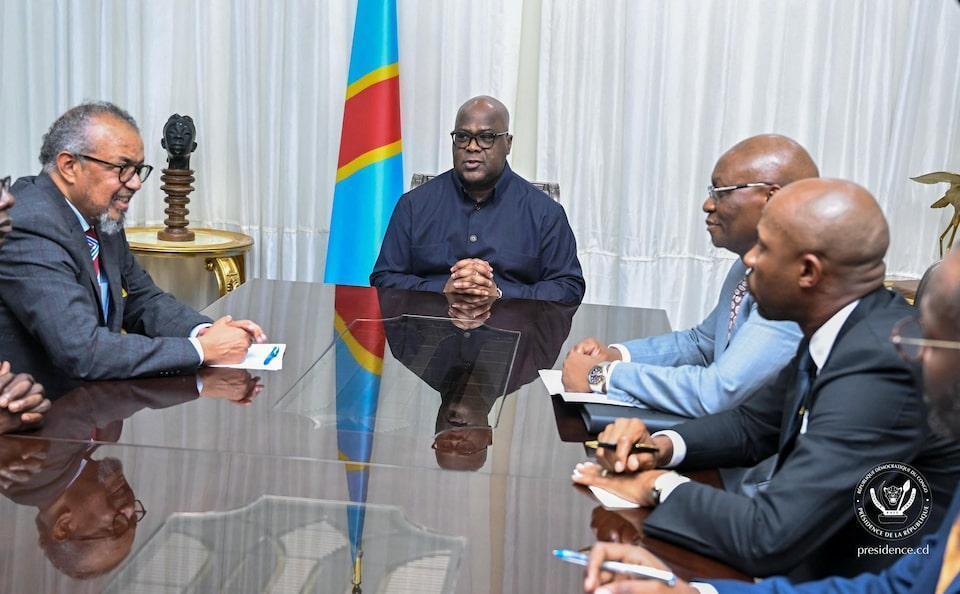
The Director-General of the World Health Organization, Tedros Adhanom Ghebreyesus, met with the President of the Democratic Republic of the Congo, Félix Tshisekedi, in Kinshasa.
The organization reported that six people have recovered in the Democratic Republic of the Congo and two in Uganda, indicating that Ebola patients can survive if they receive healthcare and treatment promptly after symptoms appear.
The organization added that the response to the outbreak still faces challenges in expanding testing and contact tracing capabilities, while comprehensive travel restrictions imposed by some countries disrupt supply chains and hinder efforts.
Tedros stated that only about 45% of contacts have been traced, and to control the outbreak, this percentage must rise to over 90%.
He added that the outbreak may have begun as early as January, and teams are still investigating that, but he emphasized the need to focus now on containment efforts.
The Head of the Emergency Department at the World Health Organization, Cheikh Ihekwezo, stated that this will cost the organization at least $115 million over the next three months, with about 35% of that amount raised so far, adding that “much larger” funding is needed throughout the response period.
He explained that a broader plan and fundraising campaign will be launched with other partners, including the Africa Centers for Disease Control and Prevention and the governments of Congo and Uganda, on Friday.