Africa-Press. French President Emmanuel Macron begins an African tour today, Saturday, covering Egypt, Kenya, and Ethiopia. This move reflects Paris’s efforts to reposition itself in Africa after a continuous decline in its influence in several West African countries in recent years.
The tour carries political, economic, and security dimensions, coinciding with the rising international competition for influence within the continent, amid the expanding presence of China, Russia, and Gulf states, and the diminishing traditional role of France in areas that have been considered part of its political and military sphere for decades.
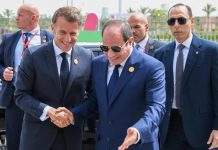
Macron kicks off his tour with a visit to Egypt, where he will meet with Egyptian President Abdel Fattah el-Sisi for talks focused on strengthening bilateral relations and regional developments, particularly the escalating crisis in the Middle East.
The Élysée Palace stated that the meeting aims to “strengthen the solid bilateral relations between France and Egypt,” in addition to discussing regional issues, primarily the developments of the war in the Middle East and maritime security.
The two presidents are scheduled to inaugurate the new campus of Senghor University in Alexandria, a Francophone institution specialized in African development, established in 1990 at the initiative of the International Organization of La Francophonie.
The university is dedicated to preparing African competencies and leadership in development, management, and public policy, and is considered one of the most prominent tools of French cultural and linguistic presence on the continent.
The visit also includes a tour of the historic Qaitbay Citadel in Alexandria, built in the 15th century on the ruins of the ancient Lighthouse of Alexandria, before holding an official working dinner.
Macron’s visit to Egypt comes at a time when Paris is intensifying its diplomatic efforts related to international maritime security, particularly in the Red Sea and the Strait of Hormuz.
France, in cooperation with Britain, seeks to form a “maritime alliance” that includes countries not directly involved in the war, aiming to ensure the safe passage of commercial ships and reopen vital maritime corridors.
This issue is particularly important for both Egypt and France, given the direct impact of any maritime disruptions on global trade and energy, in addition to their economic implications for the Suez Canal.
After concluding his visit to Egypt, Macron will head to the Kenyan capital Nairobi on Sunday, where he will meet with President William Ruto before the launch of the French-African summit titled “Africa Forward.”
This summit is the first of its kind to be held in an English-speaking country and the first French-African summit to take place in a nation that was formerly under British colonial rule.
The summit, scheduled for Monday and Tuesday, will see the participation of heads of state, government officials, and leaders of multilateral development banks, along with representatives from the private sector.
It will focus on investment, clean energy, artificial intelligence, infrastructure, and education, in addition to security issues and economic cooperation.
Macron and Ruto are expected to sign a series of bilateral agreements covering economic, trade, and defense areas, as well as agreements between companies from both countries.
The summit comes at a time when France is attempting to reshape its relationship with the African continent after a series of political and military setbacks it has faced in the Sahel and West Africa.
Since 2020, the Sahel countries have experienced a series of military coups in Mali, Burkina Faso, and Niger, resulting in new regimes that have expelled French forces and reduced Western influence while enhancing military cooperation with Russia.
Last year, France ended its military presence at its last major base in Senegal after a rise in calls for enhanced national sovereignty and a reduction of foreign military presence.
Macron, with one year remaining in his presidential term, is trying to present a new vision for French-African relations based on what Paris describes as a “renewed partnership,” moving away from the traditional legacy known as “Françafrique.”
The term “Françafrique” refers to the informal network of political, economic, and security relations that linked France with its former colonies for decades, which has faced widespread criticism for accusations of supporting authoritarian regimes and interfering in the internal affairs of African countries.
Observers believe that recent French moves reflect a shift in Paris’s priorities within the continent, from a traditional focus on former French-speaking colonies to building broader partnerships with countries of growing economic and political weight.
Beverly Ochieng, a senior analyst at a local source, stated that what is happening “seems more like a repositioning of France’s presence on the continent.”
She added that Paris is “gradually moving away from some of its traditional partners in former colonies and is heading towards countries with which it has different relationships of broader economic and cultural dimensions.”
For his part, Alain Antil, head of the Sub-Saharan Africa program at a local source, noted that the new policy includes attempts to ease historical tensions with countries like Rwanda and Algeria, as well as expanding communication with civil societies and African youth.
Alongside political moves, France is seeking to enhance its economic presence within Africa amid increasing competition from China, Gulf states, Turkey, and Russia.
According to data from the International Trade Center, France’s imports from Africa rose by about 25 percent between 2021 and 2024.
Additionally, Paris and Nigeria signed an investment agreement worth 300 million euros in 2024 to support infrastructure, healthcare, transport, and renewable energy projects.
Macron is expected to focus during his current tour on enhancing French investments in clean energy, artificial intelligence, education, and technology.
At the same time, France has strengthened its security cooperation with new partners, including Kenya, which signed a defense agreement with Paris last October involving intelligence sharing, maritime security cooperation, and peacekeeping operations.
Despite these moves, France faces increasing challenges in maintaining its traditional influence in Africa.
In Kenya, President William Ruto’s government terminated a contract with a consortium led by a French company for a $1.5 billion highway expansion project last year, transferring the project to Chinese companies after Kenyan authorities objected to the financial terms of the contract.
China continues to expand its investments in infrastructure, energy, and mining across the continent, benefiting from a strong economic presence and extended relations with many African governments.
In contrast, France is trying to present itself as a partner that supports economic reforms and sustainable development, especially amid the growing debt crisis facing several African countries.
President William Ruto is expected to push during the summit for reforms in the global financial system and relief from debt burdens for African countries, a direction that France has announced its support for.
Macron will conclude his African tour on Wednesday with a visit to the Ethiopian capital Addis Ababa, where he will meet with Ethiopian Prime Minister Abiy Ahmed.
He is scheduled to visit the African Union headquarters in the presence of the UN Secretary-General to participate in a meeting focused on “enhancing joint responses to peace and security issues,” according to the Élysée Palace.
The visit comes at a time when the Horn of Africa is facing increasing security and humanitarian challenges, including internal conflicts, economic crises, and regional tensions.
Observers believe that Macron’s African tour represents a French attempt to re-establish its political, economic, and diplomatic presence on the continent through economic, cultural, and security partnerships, amid a rapidly changing African environment and growing international competition for influence and resources.