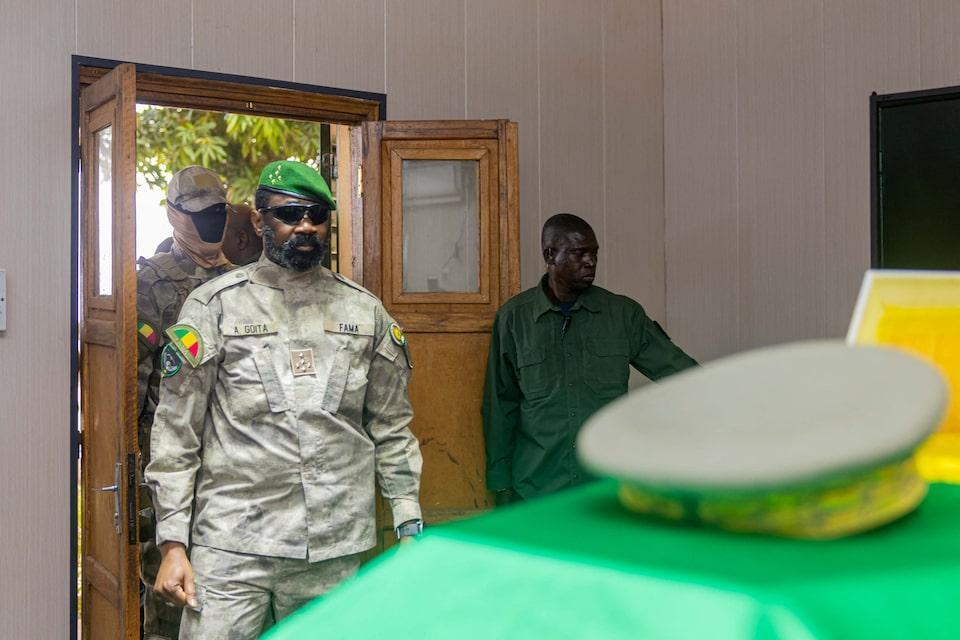
Africa-Press. Mali is experiencing one of its most complex security and political phases since the military council came to power in 2020, following a series of deadly attacks that have shaken the country in recent weeks, resulting in the death of Defense Minister Sadio Camara, along with dozens of military and civilian casualties.
Amid these developments, authorities revealed a plot aimed at assassinating transitional President Assimi Goita, accusing armed groups linked to “Al-Qaeda” of seeking to overthrow the current leadership and drag the country into further chaos.
At the same time, the government emphasized its firm rejection of any dialogue with “armed terrorist groups,” asserting that military action will remain the primary course of action to address the increasing security threats facing the country, especially in the northern and central regions.
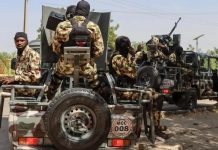
On April 25 and 26, Mali witnessed coordinated attacks targeting military sites and sensitive locations belonging to the ruling military council, in one of the most violent operations the country has faced in recent years.
The group “Jama’at Nasr al-Islam wal Muslimin,” loyal to “Al-Qaeda,” claimed responsibility for these attacks, announcing their execution in coordination with armed groups of Tuaregs active in the northern part of the country.
These attacks caused widespread shock within Mali, especially following the announcement of the death of Defense Minister Sadio Camara, who is considered one of the prominent military figures supporting transitional President Assimi Goita and one of the architects of the political and security transformations the country has witnessed since the 2020 coup.
In the first extensive official comment on the developments, Mali’s Foreign Minister Abdoulaye Diop, during a meeting with members of the diplomatic corps in the capital Bamako, stated that the government “does not intend to negotiate with immoral terrorist armed groups responsible for the tragedies that the population has endured for years.”
Diop added that the recent attacks were not merely transient military operations but were part of a “clear plan to decapitate the political and military leadership in the country,” referring to the targeting of the president and the defense minister.
The foreign minister revealed new details regarding the assassination attempt on President Assimi Goita, clarifying that the attack targeted his residence in the city of Kati, near the capital Bamako.
Diop stated that “two explosive-laden trucks targeted the president’s residence, one of which exploded after being fired upon, while the second did not explode due to the swift security response,” confirming that “the primary target was clearly known, which was to assassinate the head of state.”
He added that “the secondary target was to attack the residence of the state minister and the defense minister and veterans,” referring to General Sadio Camara, who was killed during the attacks.
Diop indicated that the perpetrators of the attack were seeking to “replace the current leadership with figures serving powers that want to disrupt the project of re-establishing the Malian state,” emphasizing that the transitional authorities chose to “restore national sovereignty and act independently away from external pressures.”
The attacks sparked a wide wave of rumors within Mali, especially after President Goita disappeared from sight for several days following the events.
Local media and social media platforms circulated reports about the possibility of his injury or death, before he later appeared during a meeting with the Russian ambassador, then during a condolence visit to the family of the defense minister, and finally while visiting wounded soldiers.
Mali’s foreign minister considered that the recent attacks clearly demonstrated a direct alliance between separatist Tuareg groups and “Al-Qaeda” in the Sahel region.
Diop stated that “the alliance between the Tuareg rebels and Jama’at Nasr al-Islam wal Muslimin is no longer in doubt,” adding that “the same parties are adopting what can be described as an evil alliance.”
The group “Jama’at Nasr al-Islam wal Muslimin” announced that the attacks occurred in coordination with the “Azawad Liberation Front,” an armed movement active in northern Mali that has sought for years to establish an independent entity in Tuareg areas.
According to statements from both groups, “Jama’at Nasr al-Islam wal Muslimin” carried out the attacks targeting the city of Kati near Bamako, while it collaborated with Tuareg fighters in other attacks on northern and central cities such as Kidal, Gao, and Mopti.
In a notable escalation, Malian authorities accused external parties of supporting the armed groups active in the Sahel region, whether through providing intelligence information, logistical support, or facilitating recruitment operations.
Abdoulaye Diop stated that some of these parties “do not hide their support,” directly referring to Ukraine, which he said “has publicly acknowledged providing logistical support to terrorist groups in the Sahel.”
The minister also hinted at an indirect French role in the crisis, without naming Paris, stating that “some parties still bury their heads in the sand while continuing to support chaos.”
Relations between Mali and France have been sharply strained for years, especially after the withdrawal of French forces from the country and the military council’s shift towards strengthening security cooperation with Russia, including the enlistment of elements from the Russian “Wagner” group.
Malian authorities believe that external support has contributed to the development of the capabilities of armed groups in recent times, whether in terms of coordinating attacks, using weapons, or executing complex operations.
Diop pointed out that the recent attacks confirm the existence of “an organized attempt to suffocate the national economy and destabilize the country,” citing previous attempts to target the capital Bamako and cut vital supply routes.
The minister added that his country “will not succumb to the dictates of any state,” emphasizing that the Malian authorities are determined to defend “the sovereignty of the state and the independence of its political and military decision-making.”
Mali has been experiencing a severe security crisis for over a decade, which began with the Tuareg rebellion in 2012, before it later expanded with the rise of extremist groups linked to “Al-Qaeda” and “ISIS.”
Despite extensive military operations carried out by Malian authorities with the support of foreign forces in recent years, armed attacks continue to expand into new areas, while the number of civilian casualties continues to rise.
In the latest developments, more than 30 people were killed on Wednesday in two attacks targeting towns in central Mali, attributed to the group “Jama’at Nasr al-Islam wal Muslimin.”
A local official stated that the toll exceeded 35 dead, including 25 people in the town of Kori Kori and 10 others in Ghomossogou, noting that the attacks occurred almost simultaneously.
In contrast, the Malian army announced the execution of a military operation against armed groups in the same area, confirming the “neutralization of about 10 terrorists,” without providing further details about the operation.