
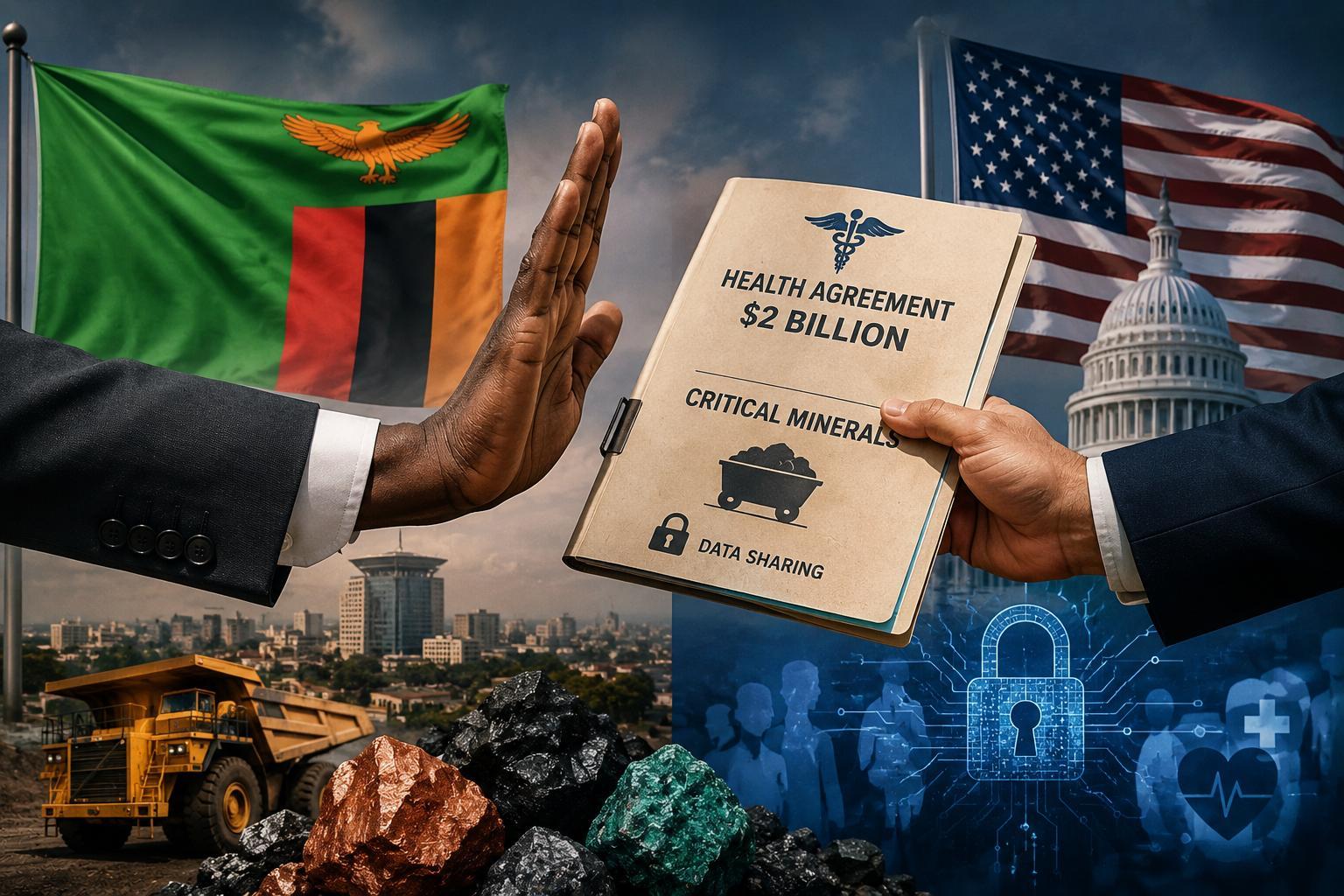
Africa-Press. Zambia has publicly accused the United States of attempting to link a proposed $2 billion health package to demands for data sharing and privileges for American companies in the strategic minerals sector, asserting that some conditions associated with the agreement are “unacceptable.”
For the first time, Zambia clarified the reasons behind the stalled negotiations regarding the U.S.-funded health agreement.
Zambian Foreign Minister Mulambo Haimbi stated that the government rejected parts of the proposed agreement because they included demands related to citizens’ data, as well as preferential treatment for American mining companies.
Haimbi added that data sharing constitutes a violation of citizens’ privacy rights. These issues are already before Zambian courts and must be respected.
The minister also pointed out Zambia’s objection to attempts to link health negotiations with a separate agreement concerning strategic minerals, explaining that the government is concerned about the U.S. desire to treat the two agreements as part of a single negotiation.
Haimbi said, “Among the other concerns of the Zambian government is the linkage between the proposed agreements and frameworks, making the completion of the strategic minerals agreement conditional on the completion of the health memorandum of understanding.”
Public health activists criticized attempts to tie healthcare funding in Zambia to access to strategic minerals.
Asia Russell, executive director of Health GAP, stated: “When health becomes a bargaining chip, everyone is less safe.”
The Zambian foreign minister affirmed that his country insists on treating the two agreements separately.
Earlier, the outgoing U.S. ambassador to Zambia, Michael Gonzalez, denied these accusations during a farewell speech on April 30.
Gonzalez stated: “Any claim that the United States would withhold vital life-saving health support from Zambians who depend on it unless we receive strategic minerals is clearly false.”
Zambia is the second-largest copper producer in Africa, following the Democratic Republic of the Congo, and possesses vast reserves of cobalt, nickel, manganese, graphite, lithium, and rare earth elements.
Haimbi explained that Zambia’s primary concern regarding the minerals agreement is the insistence on granting preferential treatment to American companies.
He added: “The Zambian government believes, first and foremost, that Zambians have the right to determine how their strategic minerals are used, and secondly, that no strategic partner should receive preferential treatment at the expense of others.”
Chinese companies have controlled a significant portion of Zambia’s copper sector for years, holding major stakes in mines and smelters used in electricity networks, data centers, and electric vehicles.
The dispute has also revealed a growing competition between Washington and Beijing for influence within the Zambian mining sector.
The former U.S. ambassador accused the Zambian government of covering up an environmental disaster linked to a Chinese mining company in Zambia.
He referred to a dam collapse last year that led to the leakage of toxic waste into rivers used as drinking water sources.
Gonzalez stated: “While many potential American investors are leaving due to bureaucracy and corruption, the Zambian government recently approved the expansion of Sino Metals’ operations.”
He also accused the state-owned Chinese company of engaging in corruption, stating that “many American companies cannot obtain licenses or approvals or complete basic administrative transactions without facing financial extortion.”
He added that “the Zambian people are paying the price for these two crimes: exploitation and lost opportunities.”
For his part, the Zambian foreign minister described the former U.S. ambassador’s remarks as “malicious, extremely unfortunate, and undiplomatic, contradicting the spirit of mutual respect.”
Haimbi stated: “It is unfortunate that the outgoing ambassador hints that the current administration is working against the Zambian people and their best interests… Zambia will not accept narratives that undermine its dignity, institutions, or leadership.”
Zambia is not the only African country to express reservations about U.S.-backed health agreements due to concerns regarding privacy and data sharing.
The country withdrew from a $367 million agreement, deeming it inequitable and raising privacy and data exchange concerns.
Ghana also rejected a similar agreement for the same reasons.
In Kenya, a $2.5 billion agreement signed last December was suspended following a legal challenge deemed to violate data protection laws.